

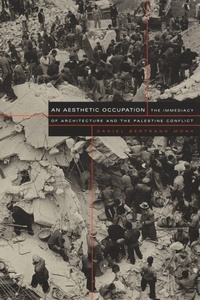
An Aesthetic Occupation
The Immediacy of Architecture and the Palestine Conflict
Will be published approx. on 18. March 2002
Book
Hardback
272 pages
978-0-8223-2803-2 (ISBN)
Description
In An Aesthetic Occupation Daniel Bertrand Monk unearths the history of the unquestioned political immediacy of "sacred" architecture in the conflict between Palestinians and Israelis. Monk combines groundbreaking archival research with theoretical insights to examine in particular the Mandate era-the period in the first half of the twentieth century when Britain held sovereignty over Palestine. While examining the relation between monuments and mass violence in this context, he documents Palestinian, Zionist, and British attempts to advance competing arguments concerning architecture's utility to politics.
Succumbing neither to the view that monuments are autonomous figures onto which political meaning has been projected, nor to the obverse claim that in Jerusalem shrines are immediate manifestations of the political, Monk traces the reciprocal history of both these positions as well as describes how opponents in the conflict debated and theorized their own participation in its self-representation. Analyzing controversies over the authenticity of holy sites, the restorations of the Dome of the Rock, and the discourse of accusation following the Buraq, or Wailing Wall, riots of 1929, Monk discloses for the first time that, as combatants looked to architecture and invoked the transparency of their own historical situation, they simultaneously advanced-and normalized-the conflict's inability to account for itself.
This balanced and unique study will appeal to anyone interested in Israel or Zionism, the Palestinians, the Middle East conflict, Jerusalem, or its monuments. Scholars of architecture, political theory, and religion, as well as cultural and critical studies will also be informed by its arguments.
Succumbing neither to the view that monuments are autonomous figures onto which political meaning has been projected, nor to the obverse claim that in Jerusalem shrines are immediate manifestations of the political, Monk traces the reciprocal history of both these positions as well as describes how opponents in the conflict debated and theorized their own participation in its self-representation. Analyzing controversies over the authenticity of holy sites, the restorations of the Dome of the Rock, and the discourse of accusation following the Buraq, or Wailing Wall, riots of 1929, Monk discloses for the first time that, as combatants looked to architecture and invoked the transparency of their own historical situation, they simultaneously advanced-and normalized-the conflict's inability to account for itself.
This balanced and unique study will appeal to anyone interested in Israel or Zionism, the Palestinians, the Middle East conflict, Jerusalem, or its monuments. Scholars of architecture, political theory, and religion, as well as cultural and critical studies will also be informed by its arguments.
Reviews / Votes
"A revelatory history of the architectural construction of the Israel/Palestine conflict that is also a stunningly original contribution to critical theory in the tradition of Adorno and Benjamin. Monk shows how both sides-thanks in part to the British-became trapped in a deadly quicksand of sacralized geographies and imagined histories."-Mike Davis, author of City of Quartz "Why is the question of Israel/Palestine so intractable? Why, in this supposedly enlightened, secular age, does there seem to be no exit from a conflict that has focussed obsessively on the material features of this tiny country for millennia? How is it that the very stones, monuments, and landscape have become so invested with conflicting values that they seem to have 'lives of their own' that are not simply shaped by historical events, but themselves play the role of causal agents in those events? Daniel Monk's brilliant and profound meditation on these questions eschews all the easy alternatives: it avoids the temptation both of one-sided polemics (on the one hand) and Olympian neutrality (on the other); it refuses to pass over the fetishizing of monuments and places as a mere symptom that could be dispelled by critique; above all, it insists on looking steadily at the objects themselves in all their paradoxical, conflicted formulations, their positioning in events, memories of events, and fantasies of a final event to come. This is an essential book for anyone who wants to think about the Holy Land, or about the way objects make and are made by history."-W. J. T. Mitchell, University of Chicago, Editor, Critical InquiryMore details
Language
English
Place of publication
North Carolina
United States
Target group
Professional and scholarly
Product notice
Cloth over boards
Illustrations
9 b&w photos
Dimensions
Height: 244 mm
Width: 158 mm
Thickness: 26 mm
Weight
626 gr
ISBN-13
978-0-8223-2803-2 (9780822328032)
Copyright in bibliographic data and cover images is held by Nielsen Book Services Limited or by the publishers or by their respective licensors: all rights reserved.
Schweitzer Classification
Other editions
Additional editions
Daniel Bertrand Monk
An Aesthetic Occupation
The Immediacy of Architecture and the Palestine Conflict
E-Book
03/2002
1st Edition
De Gruyter
€198.99
Available for download
Person
Daniel Bertrand Monk is George T. and Myra W. Cooley Chair of Peace and Conflict Studies and Director, Peace and Conflict Studies Program [P-CON] at Colgate University.
Content
Abbreviations
Glossary
Note on Transliteration
Preface
Introduction: The Foundation Stone of Our National Existence, without Exaggeration
Part I. Stone
1. A Hieroglyph Designed by God
Part II. Tile
2. An Unmistakable Sign
3. You are Blind to the Meaning of the Dome of the Rock
4. Cataclysm and Pogrom: An Exergue on the Naming of Violence
Part III. Paper
5. Sir Alfred Mond's After-Dinner Eloquence
6. Designs on Our Holy Places
Part IV. Celluloid
Conclusion: A Terrible Caricature
Notes
Bibliography
Index
Glossary
Note on Transliteration
Preface
Introduction: The Foundation Stone of Our National Existence, without Exaggeration
Part I. Stone
1. A Hieroglyph Designed by God
Part II. Tile
2. An Unmistakable Sign
3. You are Blind to the Meaning of the Dome of the Rock
4. Cataclysm and Pogrom: An Exergue on the Naming of Violence
Part III. Paper
5. Sir Alfred Mond's After-Dinner Eloquence
6. Designs on Our Holy Places
Part IV. Celluloid
Conclusion: A Terrible Caricature
Notes
Bibliography
Index