

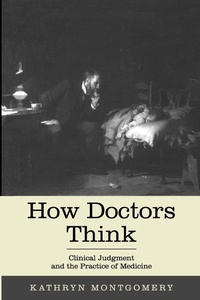
How Doctors Think
Clinical Judgment and the Practice of Medicine
Published on 22. November 2012
Book
Paperback/Softback
256 pages
978-0-19-994205-3 (ISBN)
Description
How Doctors Think defines the nature and importance of clinical judgment. Although physicians make use of science, this book argues that medicine is not itself a science but rather an interpretive practice that relies on clinical reasoning. A physician looks at the patient's history along with the presenting physical signs and symptoms and juxtaposes these with clinical experience and empirical studies to construct a tentative account of the illness.
How Doctors Think is divided into four parts. Part one introduces the concept of medicine as a practice rather than a science; part two discusses the idea of causation; part three delves into the process of forming clinical judgment; and part four considers clinical judgment within the uncertain nature of medicine itself. In How Doctors Think, Montgomery contends that assuming medicine is strictly a science can have adverse side effects, and suggests reducing these by recognizing the vital role of clinical judgment.
"This is a book that will be read with pleasure by anyone interested in how medicine is done and it is a book that should be required reading for all students starting their clinical training."--Journal of the Royal Society of Medicine
"Montgomery has certainly written a piece that will stimulate people to think more deeply about medical and wider health professional practice. It is a text I will recommend to students and colleagues."--PsycCRITIQUES
How Doctors Think is divided into four parts. Part one introduces the concept of medicine as a practice rather than a science; part two discusses the idea of causation; part three delves into the process of forming clinical judgment; and part four considers clinical judgment within the uncertain nature of medicine itself. In How Doctors Think, Montgomery contends that assuming medicine is strictly a science can have adverse side effects, and suggests reducing these by recognizing the vital role of clinical judgment.
"This is a book that will be read with pleasure by anyone interested in how medicine is done and it is a book that should be required reading for all students starting their clinical training."--Journal of the Royal Society of Medicine
"Montgomery has certainly written a piece that will stimulate people to think more deeply about medical and wider health professional practice. It is a text I will recommend to students and colleagues."--PsycCRITIQUES
More details
Language
English
Place of publication
New York
United States
Target group
College/higher education
Dimensions
Height: 234 mm
Width: 156 mm
Thickness: 15 mm
Weight
401 gr
ISBN-13
978-0-19-994205-3 (9780199942053)
Copyright in bibliographic data and cover images is held by Nielsen Book Services Limited or by the publishers or by their respective licensors: all rights reserved.
Schweitzer Classification
Other editions
Additional editions
Book
12/2005
Oxford University Press Inc
€92.40
Shipment within 15-20 days
E-Book
11/2005
OUP eBook
€27.49
Available for download
E-Book
11/2005
1st Edition
OUP eBook
€27.49
Available for download
Person
Professor of Medical Humanities and Bioethics, Northwestern University
Content
PART I. MEDICINE AS A PRACTICE ; 1. Medicine and the Limits of Knowledge ; 2. The Misdescription of Medicine ; PART II. CLINICAL JUDGMENT AND THE IDEA OF CAUSE ; 3. Clinical Judgment and the Interpretation of the Case ; 4. "What Brings You Here Today?": The Idea of Cause in Medical Practice ; 5. The Simplification of Clinical Cause ; 6. Clinical Judgment and the Problem of Particularizing ; PART III. THE FORMATION OF CLINICAL JUDGMENT ; 7. Aphorisms, Maxims, and Old Saws: Some Rules of Clinical Reasoning ; 8. "Don't Think Zebras": A Theory of Clinical Knowing ; 9. Knowing One's Place: The Evaluation of Clinical Judgment ; PART IV. CLINICAL JUDGMENT AND THE NATURE OF MEDICINE ; 10. The Self in Medicine: The Use and Misuse of the Science Claim ; 11. A Medicine of Neighbors ; 12. Uncertainty and the Ethics of Practice