

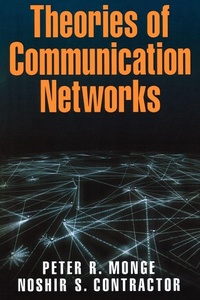
Theories of Communication Networks
Published on 15. May 2003
Book
Paperback/Softback
432 pages
978-0-19-516037-6 (ISBN)
Description
To date, most network research contains one or more of five major problems. First, it tends to be atheoretical, ignoring the various social theories that contain network implications. Second, it explores single levels of analysis rather than the multiple levels out of which most networks are comprised. Third, network analysis has employed very little the insights from contemporary complex systems analysis and computer simulations. Foruth, it typically uses descriptive rather than inferential statistics, thus robbing it of the ability to make claims about the larger universe of networks. Finally, almost all the research is static and cross-sectional rather than dynamic.
Theories of Communication Networks presents solutions to all five problems. The authors develop a multitheoretical model that relates different social science theories with different network properties. This model is multilevel, providing a network decomposition that applies the various social theories to all network levels: individuals, dyads, triples, groups, and the entire network. The book then establishes a model from the perspective of complex adaptive systems and demonstrates how to use Blanche, an agent-based network computer simulation environment, to generate and test network theories and hypotheses. It presents recent developments in network statistical anlysis, the p* family, which provides a basis for valid multilevel statistical inferences regarding networks. Finally, it shows how to relate communication networks to other networks, thus providing the basis in conjunction with computer simulations to study the emergence of dynamic organizational networks.
Theories of Communication Networks presents solutions to all five problems. The authors develop a multitheoretical model that relates different social science theories with different network properties. This model is multilevel, providing a network decomposition that applies the various social theories to all network levels: individuals, dyads, triples, groups, and the entire network. The book then establishes a model from the perspective of complex adaptive systems and demonstrates how to use Blanche, an agent-based network computer simulation environment, to generate and test network theories and hypotheses. It presents recent developments in network statistical anlysis, the p* family, which provides a basis for valid multilevel statistical inferences regarding networks. Finally, it shows how to relate communication networks to other networks, thus providing the basis in conjunction with computer simulations to study the emergence of dynamic organizational networks.
More details
Language
English
Place of publication
New York
United States
Target group
Professional and scholarly
Illustrations
numerous tables and figures
Dimensions
Height: 229 mm
Width: 152 mm
Thickness: 23 mm
Weight
622 gr
ISBN-13
978-0-19-516037-6 (9780195160376)
Copyright in bibliographic data and cover images is held by Nielsen Book Services Limited or by the publishers or by their respective licensors: all rights reserved.
Schweitzer Classification
Other editions
Additional editions
Peter R. Monge | Noshir Contractor
Theories of Communication Networks
E-Book
03/2003
1st Edition
OUP eBook
€44.99
Available for download
Peter R. Monge | Noshir Contractor
Theories of Communication Networks
E-Book
03/2003
1st Edition
OUP USA
€44.99
Available for download
Persons
Author
Professor, Annenberg School for Communication and the Marshall School of BusinessProfessor, Annenberg School for Communication and the Marshall School of Business, University of Southern California
Professor in the Departments of Speech Communications and Psychology and Research Affiliate at the Beckman Institute for Advanced Science and TechnologyProfessor in the Departments of Speech Communications and Psychology and Research Affiliate at the Beckman Institute for Advanced Science and Technology, University of Illinois at Urbana-Champaign
Content
PART I: THE MULTITHEORETICAL, MULTILEVEL FRAMEWORK; PART II: SOCIAL THEORIES FOR STUDYING COMMUNICATION NETWORKS; PART III: INTEGRATION