

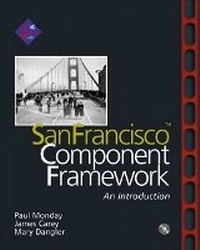
SanFrancisco (TM) Component Framework
An Introduction
Published on 10. December 1999
Book
Mixed media product
368 pages
978-0-201-61587-6 (ISBN)
Description
The SanFrancisco Component Framework product from IBM fills a long-standing need in the business applications development industry. One of the most ambitious projects ever based on object-oriented design patterns and Java technology, SanFrancisco is a set of frameworks that provide a platform-independent infrastructure and ready-built components for constructing business applications. SanFrancisco enables solution developers to spend less time reinventing functions common to most business applications and more time customizing applications to better serve their end-customersi specific needs. Written by key members of the SanFrancisco team at IBM, this authoritative book introduces the SanFrancisco product, describes its major components, and shows how to use it to create business applications. SanFrancisco Component Framework provides an overview of SanFranciscois architecture and comprehensive coverage of its three layers: The Foundation, Common Business Objects, and Core Business Processes.Specific topics include: An overview of SanFrancisco Developing an application The driving principles and architecture The Foundation Application server support overview Application programming model The Common Business Objects General Business Objects, such as Business Partner, Credit Checking, and Currency Financial Business Objects, including the interface, the general ledger, and Accounts Receivable/Accounts Payable Generalized Mechanisms, including Cached Balances The Core Business Processes General Ledger Core Business Process Accounts Receivable/Accounts Payable Core Business Process Warehouse Management Core Business Process Order Management Core Business Process The book also presents application examples and case studies, and a step-by-step guide to building client applications that addresses such vital topics as multithreaded programs and the SanFrancisco JavaBeans tool.
0201615878B04062001
0201615878B04062001
More details
Language
English
Place of publication
Boston
United States
Publishing group
Pearson Education (US)
Target group
College/higher education
Dimensions
Height: 234 mm
Width: 187 mm
Thickness: 18 mm
Weight
570 gr
ISBN-13
978-0-201-61587-6 (9780201615876)
Copyright in bibliographic data and cover images is held by Nielsen Book Services Limited or by the publishers or by their respective licensors: all rights reserved.
Schweitzer Classification
Persons
Paul Monday is an Advisory Software Engineer at IBM, where he is currently working on the migration of SanFrancisco into Enterprise JavaBeans. Previously Paul was instrumental in defining and refining the SanFrancisco client model, including the SanFrancisco Bean model and client infrastructure.
James Carey is the Base Component (fine-grained component) architect for IBM's WebSphere Business Components. He previously served as a lead designer for the Common Business Objects and General Ledger Core Business Processes part of the IBM SanFrancisco frameworks.
Mary Dangler is an Advisory Software Engineer at IBM, where she creates educational materials and sample applications that are used in the SanFrancisco curriculum. She also works with solution developers who are developing applications using SanFrancisco, and with IBM SanFrancisco technical consultants around the world.
0201615878AB04172002
James Carey is the Base Component (fine-grained component) architect for IBM's WebSphere Business Components. He previously served as a lead designer for the Common Business Objects and General Ledger Core Business Processes part of the IBM SanFrancisco frameworks.
Mary Dangler is an Advisory Software Engineer at IBM, where she creates educational materials and sample applications that are used in the SanFrancisco curriculum. She also works with solution developers who are developing applications using SanFrancisco, and with IBM SanFrancisco technical consultants around the world.
0201615878AB04172002
Content
(Each chapter concludes with a Summary.) List of Figures. Preface. I. INTRODUCTION. 1. An Overview of SanFrancisco Development. The Object-oriented Development Process. Requirements Gathering. Scenario Creation. Object-oriented Analysis. Object-oriented Design. Code. Test. A Framework-Enhanced Development Process. Requirements Mapping. Scenario Mapping. Object-oriented Analysis Mapping. Object-oriented Design Mapping. Implementation Mapping. Documentation. An Example. 2. Architecture Overview. SanFrancisco Architectural Vision. Maximizing Reuse. Isolation from Underlying Technology. Focus on the Core. Integration with Existing Systems. SanFrancisco Architecture. The Core Business Processes. The Common Business Objects. The Foundation. Patterns. Client Programming. II. THE FOUNDATION. 3. An Introduction to the Foundation. Foundation Services. Foundation Object Model. SanFrancisco Programming Model. Foundation Utilities. 4. The Foundation Object Model. The Big Three. Entity. Dependent. Command. Localization. Collections. 5. Using the Foundation. Application Case Study. Mapping Business Objects to SanFrancisco. Implementing SanFrancisco Business Objects. Interfaces and Classes. Creating an Entity Subclass. Creating a Dependent Subclass. Creating a Command Subclass. Code Generation of SanFrancisco Business Objects. Using SanFrancisco Business Objects. The Transaction Model. The AccessMode Class. Creating Business Object Instances. Accessing Existing Business Object Instances. Accessing and Querying Collections. Destroying Business Object Instances. Administering and Configuring a SanFrancisco Application. Class and Container Configuration. The Logical SanFrancisco Network. Schema Mapping. Security Administration. III. THE COMMON BUSINESS OBJECTS. 6. An Introduction to the Common Business Objects. Contents of the Common Business Objects Layer. Using the Contents of the Common Business Objects Layer. Common Business Object Categories. The Company Category. Representing Your Company Organization and Structure. Using the Company as the Context for Your Application. The Active Company. Patterns. The Controller Pattern. The Policy Pattern. Remaining Patterns. 7. Common Business Object Categories. General Business Objects. Address. Business Partner. Company. Credit Checking. Currency. Document Location. Fiscal Calendar. Initials. Natural Calendar. Number Series. Payment Method. Payment Terms. Periodized Calendar. Process Token. Project. Supplementary Charges. Unit of Measure. Financial Business Objects. Bank Accounts. Currency Gain/Loss Accounts. Financial Batches. Financial Calendar. Financial Integration. Interface to Banks. Interface to General Ledger. Interface to Accounts Receivable/Accounts Payable. Invoicing. Generalized Mechanisms. Cached Balances. Classification. Keys and Keyables. LifeCycle. Patterns. Controllers. Generic Interface. Token Driven Policy. Chain of Responsibility Driven Policy. 8. Using the Common Business Objects The GPSE Customer Classes. Using the BusinessPartner Common Business Object and the Controller Pattern. The GPSE Product Classes. Using the Policy Pattern. IV. THE CORE BUSINESS PROCESSES. 9. An Introduction to the Core Business Processes. Contents of the Core Business Processes. Using the Core Business Processes. Core Business Process Domains. Patterns. Keyed Attribute Retrieval. List Generation. 10. Core Business Process Domains. The General Ledger Core Business Process. The Domain. The Core Business Process. GL Business Processes. The Accounts Receivable/Accounts Payable Core Business Process. The Domain: Accounts Receivable. The Domain: Accounts Payable. The Core Business Process. AR/AP Processes. The Warehouse Management Core Business Process. The Domain. The Core Business Process. WM Business Processes. The Order Management Core Business Process. The Domain. The Core Business Process. OM Business Processes. -Able/-Ing Processes. OM Order Types. 11. Using the Core Business Processes. Application Case Study. Beta Customer 1: Home Entertainment Store. Beta Customer 2: Big Electronics Superstore. Application Requirements. Mapping to the SanFrancisco. Core Business Processes. Application Use Case. Stock Take Structure. Stock Take Generation Extension. Variances and Recounts Extension. Stock Take List Generation Extension. Reuse of the Core Business Process. Use of the Common Business Objects. Company. Initials. Policies. Controllers. Properties. Use of Security. V. THE CLIENT. 12. Preparing to Build a Client Application. An Overview of Multithreaded Applications. A Multithreaded Application without SanFrancisco Interaction. Adding SanFrancisco Interaction to the Multithreaded Program - ? - Almost. Handling the SanFrancisco Work Area and Finishing the Multithreaded Program. A Simplified Mechanism for Handling the Work Area. Transaction Scope. Locking Strategies. 13. Using Commands in an Application. Performance Characteristics of Commands. Setup and Initialization of an Application Using Commands. Creating a Setup Command. Creating an Initialization Command. Running the Setup and Initialization Commands from an Application. 14. The Presentation Layer. The SanFrancisco User Interface Framework. The Design. Constructing a Client. The Maintainer. Using Java Foundation Classes in a SanFrancisco Application. Building the View. Building the Model. Model, View, Controller. Thin Client Construction. 15. SanFrancisco JavaBeans. How SanFrancisco JavaBeans Work. SanFrancisco JavaBean Tools. Using the SanFrancisco JavaBeans with the Sample Application. Building a New SanFrancisco JavaBean for Product. Building an Application. Appendix A: Tools. Development Tools. Modeling Tools. The SanFrancisco Code Generator. Rational Rose Directive Assistant. Integrated Development Environments. Java Development Kit (JDK). Server Management. Problem Manager. HTML Documentation Print Tool. Appendix B: The CD-ROM. Index.