

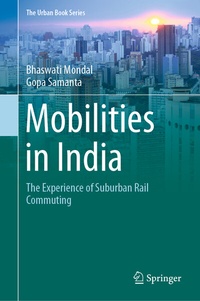
Mobilities in India
Description
This book presents commuting as a new paradigm in mobility studies in the context of global south. It delves into suburban train commuting in Eastern India. The book interprets commuting not only as a means to attend work but also as a process producing kinetic event-space infused with different mobile practices, which is not determined by their locational fixity, rather can be cognized. It analyses the role of suburban train commuting in the metropolitan expansion of Kolkata, and the transformation of rural space into urban. The significant contribution of the book lies in explaining commuters' experiencescape and the production of spatial fluidity in time capsule through commuting. It also explores the subjective reality of gendered commuting.
The book uses a trans-disciplinary research design, blending quantitative and ethnographic research methods. The area selected for the empirical research is the Howrah-Bardhaman Main Railway Line (108 km), the first suburban railwayline in Eastern India. Commuters originating from three adjacent districts of Purba Bardhaman, Hooghly and Howrah took part in this research. Besides the commuters, non-commuting passengers and hawkers in the train were also interviewed to understand the diverse perceptions of the process of commuting. This book may be considered as a reference book for mobility studies, transport studies, urban geography and regional planning.
More details
Other editions
Additional editions
Persons
Gopa Samanta is a Professor in the Department in Geography, The University of Budwan. Her core areas of research and teaching interest are Urban, Gender and Mobility studies. With grants from different national and international institutions such as the UGC, ICSSR, Ford Foundation, Australia India Institute and INR-France, IRD-France, she has completed a number of research projects with interdisciplinary methodologies and collaborative research teams. As a geographer, she has a passion for undertaking in-depth and field-based empirical research. She is the joint author of two books: 1. Dancing with the River: People and Life on the Chars of South Asia , published from Yale University Press; 2. Negotiating Terrain in Local Governance: Freedom, Functioning and Barriers of Women Councillors in India, published from Springer. She acts as peer reviewer of academically acclaimed journals such as Community Development Journal, Development in Practice, ACME: An International E-Journal for Critical Geographies, Local Environment, Economic and Political Weekly, etc. She was on the editorial board of the Journal of Mobility Studies called Transfers . She has acted as Visiting Fellow of Australian National University and Paris Diderot University, and as Gender Chair of Paris Sorbonne University.
Content
Preface.- Acknowledgement.- Chapter 1. Commuting in Geography of Mobilities.- Chapter 2. Suburban Railways, Commuting and Metropolitan Expansion.- Chapter 3. Commute Experiencescapes.- Chapter 4. The Perceived Space.- Chapter 5. Commuting and Gender.- Chapter 6. Conclusion.- Appendices.- References.