

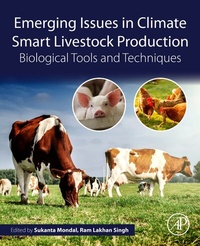
Emerging Issues in Climate Smart Livestock Production
Biological Tools and Techniques
Published on 6. December 2021
Book
Paperback/Softback
528 pages
978-0-12-822265-2 (ISBN)
Description
Emerging Issues in Climate Smart Livestock Production: Biological Tools and Techniques furnishes a detailed reference on livestock sustainability and the role of biotechnology for creating more sustainable livestock production systems. The book is a collection of scientific techniques, including genetic engineering used to modify and improve animals, fishes, and microorganisms for human benefit. The book is particularly attractive for scientists, researchers, students, educators, and professionals in agriculture, veterinary, and biotechnology science. This book promotes several biotechnological approaches that can easily be evaluated in the field for quality assurance programs beneficial to producing livestock products and overall public health.
Biotechnology has the potential to improve the productivity of animals via increased growth, carcass quality and reproduction, improved nutrition and feed utilization, improved food quality and safety, improved animal health and welfare, and reduced waste through more efficient utilization of resources.
Biotechnology has the potential to improve the productivity of animals via increased growth, carcass quality and reproduction, improved nutrition and feed utilization, improved food quality and safety, improved animal health and welfare, and reduced waste through more efficient utilization of resources.
More details
Language
English
Place of publication
San Diego
United States
Publishing group
Elsevier Science Publishing Co Inc
Target group
Professional and scholarly
Illustrations
Approx. 100 illustrations; Illustrations
Dimensions
Height: 235 mm
Width: 191 mm
Weight
1060 gr
ISBN-13
978-0-12-822265-2 (9780128222652)
Copyright in bibliographic data and cover images is held by Nielsen Book Services Limited or by the publishers or by their respective licensors: all rights reserved.
Schweitzer Classification
Other editions
Additional editions
Sukanta Mondal | Ram Lakhan Singh
Emerging Issues in Climate Smart Livestock Production
Biological Tools and Techniques
E-Book
12/2021
Academic Press
€219.00
Available for download
Persons
Sukanta Mondal is currently working as Principal Scientist, Physiology Division, ICAR-National Institute of Animal Nutrition and Physiology. His major research interests involve CRISPR/Cas 9 guided targeted genome editing, gene silencing, molecular cloning, characterization and expression of genes regulating early embryonic loss, molecular characterization and expression of hormone receptors, regulation of prostaglandin production, and impact of stress on maternal recognition of pregnancy. Dr. Mondal has published more than 130 research publications in various journals and presented more than 30 papers at various national and international conferences.
Professor Ram Lakhan Singh is Vice-Chancellor of Nilamber-Pitamber University, Medininagar, India. He held position of Professor and Chair of Biochemistry at Dr. Rammanohar Lohia Avadh University, Ayodhya, India prior to joining this assignment. He has 31 years of experience as teacher and 39 years as researcher in the area of Environmental and Nutraceutical Biochemistry. Professor Singh published more than 87 research papers, written 17 book chapters and edited 6 books published by Springer, CRC and Elsevier. He guided 25 PhD students and has been invited as editorial board member of International journals. He has been awarded IUTOX Senior Fellowship in 2007 and admitted to the Fellowships of the Society of Toxicology in 2011 and Academy of Environmental Biology in 2015.
Professor Ram Lakhan Singh is Vice-Chancellor of Nilamber-Pitamber University, Medininagar, India. He held position of Professor and Chair of Biochemistry at Dr. Rammanohar Lohia Avadh University, Ayodhya, India prior to joining this assignment. He has 31 years of experience as teacher and 39 years as researcher in the area of Environmental and Nutraceutical Biochemistry. Professor Singh published more than 87 research papers, written 17 book chapters and edited 6 books published by Springer, CRC and Elsevier. He guided 25 PhD students and has been invited as editorial board member of International journals. He has been awarded IUTOX Senior Fellowship in 2007 and admitted to the Fellowships of the Society of Toxicology in 2011 and Academy of Environmental Biology in 2015.
Content
1. Introduction (scope and applications of biotechnology for sustainable animal agriculture)
2. Biotechnological tools to enhance sustainable livestock production
3. Livestock production systems
4. Sustainable livestock production and food security
5. Livestock biodiversity and sustainability
6. Climate change and livestock
7. Climate change impacts fisheries and aquaculture
8. Nanotechnology in animal production
9. Transgenic Animals
10. Rumen metagenomics
12. Biotechnology in animal breeding, genetics and conservation of genetic resources
13. Biotechnology in animal nutrition and feed utilization
14. Biotechnology in livestock reproduction
15. Targeted genome editing by CRISPR/Cas9 for livestock improvement
16. Way forward for sustainable livestock sector
2. Biotechnological tools to enhance sustainable livestock production
3. Livestock production systems
4. Sustainable livestock production and food security
5. Livestock biodiversity and sustainability
6. Climate change and livestock
7. Climate change impacts fisheries and aquaculture
8. Nanotechnology in animal production
9. Transgenic Animals
10. Rumen metagenomics
12. Biotechnology in animal breeding, genetics and conservation of genetic resources
13. Biotechnology in animal nutrition and feed utilization
14. Biotechnology in livestock reproduction
15. Targeted genome editing by CRISPR/Cas9 for livestock improvement
16. Way forward for sustainable livestock sector