

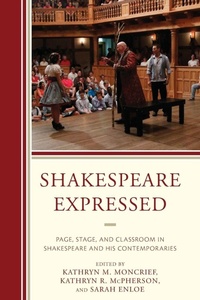
Shakespeare Expressed
Page, Stage, and Classroom in Shakespeare and His Contemporaries
Published on 2. May 2017
Book
Paperback/Softback
314 pages
978-1-68393-071-6 (ISBN)
Description
A collection of essays originally presented on the Blackfriars stage at the American Shakesepeare Center, Shakespeare Expressed brings together scholars and practitioners, often promoting ideas that can be translated into classroom experiences. Drawing on essays presented at the Sixth Blackfriars Conference, held in October 2011, the essays focus on Shakespeare in performance by including work from scholars, theatrical practitioners (actors, directors, dramaturgs, designers), and teachers in a format that facilitates conversations at the intersection of textual scholarship, theatrical performance, and pedagogy. The volume's thematic sections briefly represent some of the major issues occupying scholars and practitioners: how to handle staging choices, how modern actors embody early modern characters, how the physical and technical aspects of early modern theaters previously impacted and how they currently affect performance, and how the play texts can continue to enlighten theatrical and scholarly endeavors. A special essay on pedagogy that features specific classroom exercises also anchors each section in the collection. The result is an eclectic, stimulating, and forward-thinking look at the most current trends in early modern theater studies.
Reviews / Votes
This book would be most helpful for pedagogical and performative purposes; both for educators seeking to incorporate practical staging issues into their classrooms and for performance practitioners. It fosters an important conversation on the role of the practical by examining factors sometimes overlooked as tangential. * Parergon * Shakespeare Expressed: Page, Stage, and Classroom in Shakespeareand His Contemporaries succeeds in capturing the spirit of the 2011 Blackfriars Conference. . . .The essays in this collection are filled with insight and provocative questions and are linked to engaging classroom activities that will invite teachers to incorporate them into their lesson planning, making the challenge of acquiring those skills more achievable. * Shakespeare Quarterly * The volume is tightly focused and distinctive for the way it brings together teachers and theater practitioners to think about language and performance. It's one of those rare volumes that will be of interest to actors and directors as well as academics. * SEL: Studies in English Literature 1500-1900 *More details
Series
Language
English
Place of publication
Cranbury
United States
Publishing group
Associated University Presses
Target group
Professional and scholarly
Illustrations
19 BW Illustrations
Dimensions
Height: 229 mm
Width: 152 mm
Thickness: 17 mm
Weight
460 gr
ISBN-13
978-1-68393-071-6 (9781683930716)
Copyright in bibliographic data and cover images is held by Nielsen Book Services Limited or by the publishers or by their respective licensors: all rights reserved.
Schweitzer Classification
Other editions
Additional editions
Kathryn M. Moncrief | Kathryn R. McPherson | Sarah Enloe
Shakespeare Expressed
Page, Stage, and Classroom in Shakespeare and His Contemporaries
E-Book
08/2013
1st Edition
Fairleigh Dickinson University Press,U.S.
€55.99
Available for download
Persons
Kathyrn M. Moncrief is professor and chair of English at Washington College.
Kathryn R. McPherson is professor of English at Utah Valley University.
Sarah Enloe is the Director of Education at the American Shakespeare Center.
Kathryn R. McPherson is professor of English at Utah Valley University.
Sarah Enloe is the Director of Education at the American Shakespeare Center.
Content
Foreword: Lightning in a Bottle
Ralph Alan Cohen
Chapter 1: Introduction: Shakespeare Embodied, Expressed, and Enacted
Kathryn Moncrief and Kathryn McPherson:
I. The Body of the Actor
Chapter 2: Speaking in the Silence: Deaf Performance at the Oregon Shakespeare Festival
Lezlie Cross
Chapter 3: "I Have Given Suck:" The Maternal Body in Sarah Siddons' Lady Macbeth
Chelsea Phillips
Chapter 4: Competing Heights
Jemma Alix Levy
Chapter 5: The Mirror and the Monarchs: Suggestive Presences and Shakespeare's Cast-Size
Brett Gamboa
Chapter 6: Embodying Shakespeare: In the Classroom
Miriam Gilbert
II. Playing the Text
Chapter 7: Remember the Porter: Knock-Knock Jokes, Tragedy, and Other Unfunny Things
Chris Barrett
Chapter 8: Ghost in the Machine: Shakespeare, Stanislavski and Original Practices
Peter Kanelos
Chapter 9: "Speake[ing] the speech[es]:" Reassessing the Playability of the Earliest Printings of Hamlet
Matthew Vadnais
Chapter 10: A "Ha" in Shakespeare: The Soliloquy as Excuse and Challenge to the Audience
Bill Gelber
Chapter 11: A Knave to Know a Knock: Exploring Character Function in Scenic Structure
Symmonie Preston
III. Staging Choices
Chapter 12: Behind Closed Doors: Perspective and Painterly Technique on the Early Modern English Stage
Jennifer Low
Chapter 13: Shticky Shakespeare: Exploring Action as Eloquence
Sid Ray
Chapter 14: Seeing Ghosts: Hamlet and Modern Original Practices
Fiona Harris-Ramsby & Kathryn McPherson
Chapter 15: Remembrances of yours': Properties, Performance, and Memory in Shakespeare's Hamlet 3.1
Kathryn Moncrief
Chapter 16: The Mirror of All Christian Kings: Choral Medievalism in the Henry V Folio
Christina Gutierrez
Chapter 17: Playing with Character-Audience Members in Early Modern Playhouses
Sarah Enloe
IV. Playhouse and Playing Conditions
Chapter 18: Blackfriars Stage-Sitters and the Staging of The Tempest, The Maid's Tragedy and The Two Noble Kinsmen
Leslie Thomson
Chapter 19: "The Concourse of People on the Stage": An Alternative Proposal for Onstage Seating at the Second Blackfriars
Nova Myhill
Chapter 20: The Two Blackfriars Theatres: Discontinuity or Contiguity?
Jeanne McCarthy
Chapter 21: "Here sit we down...": The Location of Andrea and Revenge in The Spanish Tragedy
Annalisa Castaldo
Chapter 22: Thomas Middleton's Use of the Gallery Space
Christine Parker
Chapter 23: Performing Space: Playing the Architecture
Doreen Bechtol
V. Technical and Material Matters
Chapter 24: Light and Heat in the Playhouses
Ann Jennalie Cook
Chapter 25: Lighting Effects in the Early Modern Private Playhouses
Lauren Shell
Chapter 26: Sound Trumpets
Alisha Huber
Chapter 27: Play it again, Hal: The 1605 Revival of Henry V
Melissa Aaron
Chapter 28: Playing with Early Modern Special Effects
Cass Morris
Ralph Alan Cohen
Chapter 1: Introduction: Shakespeare Embodied, Expressed, and Enacted
Kathryn Moncrief and Kathryn McPherson:
I. The Body of the Actor
Chapter 2: Speaking in the Silence: Deaf Performance at the Oregon Shakespeare Festival
Lezlie Cross
Chapter 3: "I Have Given Suck:" The Maternal Body in Sarah Siddons' Lady Macbeth
Chelsea Phillips
Chapter 4: Competing Heights
Jemma Alix Levy
Chapter 5: The Mirror and the Monarchs: Suggestive Presences and Shakespeare's Cast-Size
Brett Gamboa
Chapter 6: Embodying Shakespeare: In the Classroom
Miriam Gilbert
II. Playing the Text
Chapter 7: Remember the Porter: Knock-Knock Jokes, Tragedy, and Other Unfunny Things
Chris Barrett
Chapter 8: Ghost in the Machine: Shakespeare, Stanislavski and Original Practices
Peter Kanelos
Chapter 9: "Speake[ing] the speech[es]:" Reassessing the Playability of the Earliest Printings of Hamlet
Matthew Vadnais
Chapter 10: A "Ha" in Shakespeare: The Soliloquy as Excuse and Challenge to the Audience
Bill Gelber
Chapter 11: A Knave to Know a Knock: Exploring Character Function in Scenic Structure
Symmonie Preston
III. Staging Choices
Chapter 12: Behind Closed Doors: Perspective and Painterly Technique on the Early Modern English Stage
Jennifer Low
Chapter 13: Shticky Shakespeare: Exploring Action as Eloquence
Sid Ray
Chapter 14: Seeing Ghosts: Hamlet and Modern Original Practices
Fiona Harris-Ramsby & Kathryn McPherson
Chapter 15: Remembrances of yours': Properties, Performance, and Memory in Shakespeare's Hamlet 3.1
Kathryn Moncrief
Chapter 16: The Mirror of All Christian Kings: Choral Medievalism in the Henry V Folio
Christina Gutierrez
Chapter 17: Playing with Character-Audience Members in Early Modern Playhouses
Sarah Enloe
IV. Playhouse and Playing Conditions
Chapter 18: Blackfriars Stage-Sitters and the Staging of The Tempest, The Maid's Tragedy and The Two Noble Kinsmen
Leslie Thomson
Chapter 19: "The Concourse of People on the Stage": An Alternative Proposal for Onstage Seating at the Second Blackfriars
Nova Myhill
Chapter 20: The Two Blackfriars Theatres: Discontinuity or Contiguity?
Jeanne McCarthy
Chapter 21: "Here sit we down...": The Location of Andrea and Revenge in The Spanish Tragedy
Annalisa Castaldo
Chapter 22: Thomas Middleton's Use of the Gallery Space
Christine Parker
Chapter 23: Performing Space: Playing the Architecture
Doreen Bechtol
V. Technical and Material Matters
Chapter 24: Light and Heat in the Playhouses
Ann Jennalie Cook
Chapter 25: Lighting Effects in the Early Modern Private Playhouses
Lauren Shell
Chapter 26: Sound Trumpets
Alisha Huber
Chapter 27: Play it again, Hal: The 1605 Revival of Henry V
Melissa Aaron
Chapter 28: Playing with Early Modern Special Effects
Cass Morris