

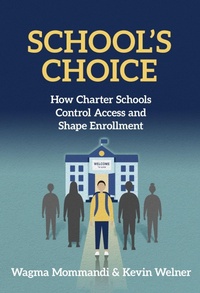
School's Choice
How Charter Schools Control Access and Shape Enrollment
Will be published approx. on 10. September 2021
Book
Hardback
232 pages
978-0-8077-6582-1 (ISBN)
Description
Access issues are pivotal to almost all charter school tensions and debates. How well are these schools performing? Are they segregating and stratifying? Are they public and democratic? Are they fairly funded? Can apparent successes be scaled up? Answers to all these core questions hinge on how access to charter schools is shaped. This book describes the incentives and pressures on charter schools to restrict access and examines how charters navigate those pressures, explaining access-restricting practices in relation to the ecosystem within which charter schools are created. It also explains how charters have sometimes responded by resisting the pressures and sometimes by surrendering to them. The text presents analyses of 13 different types of practices around access, each of which shapes the school's enrollment. The authors conclude by offering recommendations for how states and authorizers can address access-related inequities that arise in the charter sector. School's Choice provides timely information on critical academic and policy issues that will come into play as charter school policy continues to evolve.Book Features: Examines how charter schools control who gains and retains access.
Explores policies and practices that undermine equitable admission and encourage opportunity hoarding.
Offers a set of policy recommendations at the state and federal level to address access-related issues.
Explores policies and practices that undermine equitable admission and encourage opportunity hoarding.
Offers a set of policy recommendations at the state and federal level to address access-related issues.
Reviews / Votes
"This compact but thorough book makes it clear that for many students, a charter school system provides no choice at all. It is the charter school that does the choosing, not the students or parents."-Forbes
More details
Language
English
Place of publication
New York
United States
Target group
Professional and scholarly
Product notice
sewn/stitched
Cloth over boards
Dimensions
Height: 235 mm
Width: 162 mm
Thickness: 15 mm
Weight
460 gr
ISBN-13
978-0-8077-6582-1 (9780807765821)
Copyright in bibliographic data and cover images is held by Nielsen Book Services Limited or by the publishers or by their respective licensors: all rights reserved.
Schweitzer Classification
Persons
Wagma Mommandi, a former public-school teacher, is a PhD candidate in education policy at the University of Colorado Boulder School of Education. Kevin Welner is a professor and the director of the National Education Policy Center, which is housed at the CU Boulder School of Education.
Content
Contents
1.??Introduction?1
The Issue of Access?3
A Framework for Understanding Access?5
Methods?8
Conclusion?12
2.??The Centrality of Access?14
Publicness?14
Funding and Finance?16
Segregation and Stratification?17
Measured Outcomes?17
3.??Description and Design: Which Niche??20
Background Briefing?20
Further Research?21
Conclusion?29
4.??Location, Location, Location: Decisions About Site and Transportation?30
Background Briefing?30
Further Research?31
Conclusion?36
5.??Narrow-Casting: The Power of Marketing and Advertising?37
Background Briefing?37
Further Research?39
Conclusion?44
6.??Hoop Schemes: Conditions Placed on Applications?45
Background Briefing?45
Further Research?47
Conclusion?55
7.??The Steering Wheel: The Art of Dissuading Applications?56
Background Briefing?56
Further Research?58
Conclusion?61
8.??Send Us Your Best: Conditions Placed on Enrollment?63
Background Briefing?63
Further Research?64
Conclusion?71
9.??Putting in the Hours: Requiring Parents to Volunteer?72
Background Briefing?72
Further Research?74
Conclusion?77
10.??Not in Service: Emergent Bilinguals, Special Education, and Free and Reduced-Price Lunch?78
Background Briefing?78
Further Research?80
Conclusion?88
11.??The Fitness Test: Counseling Out?89
Background Briefing?89
Further Research?91
Conclusion?98
12.??Pass Interference: GPAs and Grade Retention?99
Background Briefing?99
Further Research?100
Conclusion?105
13.??No Excuses: Discipline and Punish?106
Background Briefing?106
Further Research?107
Conclusion?120
14.??Irreplaceable: Backfilling Student Attrition?122
Background Briefing?123
Further Research?123
Conclusion?127
15.??Show Me the Money: The Price of Attendance?129
Background Briefing?129
Further Research?130
Conclusion?137
16.??Understanding Access?138
Competitive Incentives for Schools to Be Choosers?138
Opportunity Hoarding: Parents as Choosers?141
Effectively Maintained Inequality?144
17.??Pursuing Equity Against the Tide?148
Attempts to Address Access Hurdles?148
The Rules and Incentives Must Change?155
18.??Looking Ahead: Designing a Healthier System?158
Changing Incentives?159
Changing Rules?160
The Importance of Collecting and Reporting Data?169
Holding Authorizers Accountable?170
Conclusion?171
Notes?173
References?175
Index?213
About the Authors?225
1.??Introduction?1
The Issue of Access?3
A Framework for Understanding Access?5
Methods?8
Conclusion?12
2.??The Centrality of Access?14
Publicness?14
Funding and Finance?16
Segregation and Stratification?17
Measured Outcomes?17
3.??Description and Design: Which Niche??20
Background Briefing?20
Further Research?21
Conclusion?29
4.??Location, Location, Location: Decisions About Site and Transportation?30
Background Briefing?30
Further Research?31
Conclusion?36
5.??Narrow-Casting: The Power of Marketing and Advertising?37
Background Briefing?37
Further Research?39
Conclusion?44
6.??Hoop Schemes: Conditions Placed on Applications?45
Background Briefing?45
Further Research?47
Conclusion?55
7.??The Steering Wheel: The Art of Dissuading Applications?56
Background Briefing?56
Further Research?58
Conclusion?61
8.??Send Us Your Best: Conditions Placed on Enrollment?63
Background Briefing?63
Further Research?64
Conclusion?71
9.??Putting in the Hours: Requiring Parents to Volunteer?72
Background Briefing?72
Further Research?74
Conclusion?77
10.??Not in Service: Emergent Bilinguals, Special Education, and Free and Reduced-Price Lunch?78
Background Briefing?78
Further Research?80
Conclusion?88
11.??The Fitness Test: Counseling Out?89
Background Briefing?89
Further Research?91
Conclusion?98
12.??Pass Interference: GPAs and Grade Retention?99
Background Briefing?99
Further Research?100
Conclusion?105
13.??No Excuses: Discipline and Punish?106
Background Briefing?106
Further Research?107
Conclusion?120
14.??Irreplaceable: Backfilling Student Attrition?122
Background Briefing?123
Further Research?123
Conclusion?127
15.??Show Me the Money: The Price of Attendance?129
Background Briefing?129
Further Research?130
Conclusion?137
16.??Understanding Access?138
Competitive Incentives for Schools to Be Choosers?138
Opportunity Hoarding: Parents as Choosers?141
Effectively Maintained Inequality?144
17.??Pursuing Equity Against the Tide?148
Attempts to Address Access Hurdles?148
The Rules and Incentives Must Change?155
18.??Looking Ahead: Designing a Healthier System?158
Changing Incentives?159
Changing Rules?160
The Importance of Collecting and Reporting Data?169
Holding Authorizers Accountable?170
Conclusion?171
Notes?173
References?175
Index?213
About the Authors?225