

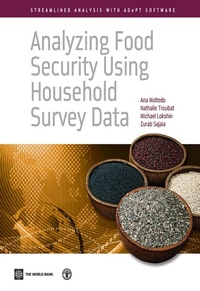
Analyzing Food Security Using Household Survey Data
Streamlined Analysis with ADePT Software
Published on 30. April 2014
Book
Paperback/Softback
264 pages
978-1-4648-0133-4 (ISBN)
Description
Since the end of the Second World War, the international community has been focusing on reducing the number and the proportion of people who suffer from hunger. Over time it became clear that no single indicator would provide a comprehensive picture of the food security situation. Rather, a suite of indicators is necessary to describe food insecurity in all its dimensions. The demand for evidence-based policies, which brings together providers such as statistical offices and users of food security indicators including policy makers and researchers, has also been increasing.
The stand-alone software, ADePT-Food Security Module (available for free downloading), was developed to produce food security indicators from food consumption data collected in household surveys. These indicators, derived at the national and subnational levels, include the consumption of calories and macronutrients, the availability of micronutrients and amino acids, the distribution of calories and the proportion of people undernourished. The book focuses on the theory, methodology, and analysis of these indicators. It has five chapters beginning with a brief overview on concepts of food security. The theory and methodology are further described in the following chapter. To help users with the interpretation of the results some examples are given in chapter 3. Chapter 4 of the book provides guidelines for the preparation of the input datasets. Finally, chapter 5 explains how to use the software.
Both the software and this book are products of decades of experience in analysing food security. This project was made possible through collaboration between FAO and the World Bank, with financial support from the European Union.
The stand-alone software, ADePT-Food Security Module (available for free downloading), was developed to produce food security indicators from food consumption data collected in household surveys. These indicators, derived at the national and subnational levels, include the consumption of calories and macronutrients, the availability of micronutrients and amino acids, the distribution of calories and the proportion of people undernourished. The book focuses on the theory, methodology, and analysis of these indicators. It has five chapters beginning with a brief overview on concepts of food security. The theory and methodology are further described in the following chapter. To help users with the interpretation of the results some examples are given in chapter 3. Chapter 4 of the book provides guidelines for the preparation of the input datasets. Finally, chapter 5 explains how to use the software.
Both the software and this book are products of decades of experience in analysing food security. This project was made possible through collaboration between FAO and the World Bank, with financial support from the European Union.
More details
Language
English
Place of publication
Washington
United States
Target group
Professional and scholarly
Dimensions
Height: 231 mm
Width: 190 mm
Thickness: 15 mm
Weight
570 gr
ISBN-13
978-1-4648-0133-4 (9781464801334)
Copyright in bibliographic data and cover images is held by Nielsen Book Services Limited or by the publishers or by their respective licensors: all rights reserved.
Schweitzer Classification