

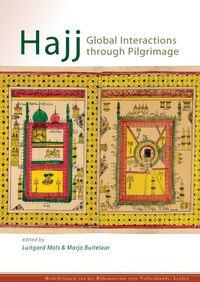
Hajj
Global Interactions through Pilgrimage
1st Edition
Published on 19. February 2015
Book
Paperback/Softback
275 pages
978-90-8890-285-7 (ISBN)
Description
Every year, in the last month of the Islamic calendar, millions of Muslims from around the world come together in Mecca to perform the Hajj, the pilgrimage that all capable Muslims should perform at least once in their lives. In 2013, the National Museum of Ethnology in Leiden organised the exhibition Longing for Mecca. The Pilgrim's Journey. The chapters in this volume are the outcome of the two-day symposium on the Hajj, which was held at the museum in connection to the exhibition.
The central theme that runs through the book is how Hajj practices, representations of Mecca and the exchange of Hajj-related objects have changed over time. The chapters in the first part of the book discuss religious, social, and political meanings of the Hajj. Here the relationship is addressed between the significance of pilgrimage to Mecca for the religious lives of individuals and groups and the wider contexts that they are embedded in. Together, these anthropological contributions provide insights into the effects on Hajj practices and meanings for present-day Muslims caused by current dimensions of globalisation processes. The second part of the book takes material expressions of the Hajj as its starting point. It explores what Hajj-related artefacts can tell us about the import of pilgrimage in the daily lives of Muslims in the past and present. The contributions in this part of the volume point out that Mecca has always been a cosmopolitan city and the nodal point of global interactions far exceeding religious activities.
Together, the chapters in this book depict the Hajj ritual as a living tradition. Each with its own focus, the various contributions testify to the fact that, while the rites that make up the Hajj were formulated and recorded in normative texts in early Islam, details in the actual performance and interpretations of these rites are by no means static, but rather have evolved over time in tandem with changing socio-political circumstances.
The central theme that runs through the book is how Hajj practices, representations of Mecca and the exchange of Hajj-related objects have changed over time. The chapters in the first part of the book discuss religious, social, and political meanings of the Hajj. Here the relationship is addressed between the significance of pilgrimage to Mecca for the religious lives of individuals and groups and the wider contexts that they are embedded in. Together, these anthropological contributions provide insights into the effects on Hajj practices and meanings for present-day Muslims caused by current dimensions of globalisation processes. The second part of the book takes material expressions of the Hajj as its starting point. It explores what Hajj-related artefacts can tell us about the import of pilgrimage in the daily lives of Muslims in the past and present. The contributions in this part of the volume point out that Mecca has always been a cosmopolitan city and the nodal point of global interactions far exceeding religious activities.
Together, the chapters in this book depict the Hajj ritual as a living tradition. Each with its own focus, the various contributions testify to the fact that, while the rites that make up the Hajj were formulated and recorded in normative texts in early Islam, details in the actual performance and interpretations of these rites are by no means static, but rather have evolved over time in tandem with changing socio-political circumstances.
More details
Edition
1. Auflage
Language
English
Place of publication
Leiden
Netherlands
Target group
Professional and scholarly
Illustrations
11x01 | 69x02
Dimensions
Height: 257 mm
Width: 182 mm
Thickness: 16 mm
Weight
566 gr
ISBN-13
978-90-8890-285-7 (9789088902857)
Copyright in bibliographic data and cover images is held by Nielsen Book Services Limited or by the publishers or by their respective licensors: all rights reserved.
Schweitzer Classification
Persons
Luitgard Mols is Curator for the Middle East, West, and Central Asia at the National Museum of Ethnology (NME) in Leiden and an affiliated fellow at Leiden University Centre for the Study of Islam and Society (LUCIS). She curated the exhibition Longing for Mecca. The Pilgrim's Journey (2013-2014) at the NME. She lectures on Islamic art at the University of Amsterdam. Her research currently focuses on the material culture of the Hajj and Western Arabia and on private collectors of Islamic material culture in the Netherlands. Dr. Marjo Buitelaar is Associate Professor Anthropology of Islam at the Faculty of Theology and Religious Studies at the University of Groningen, The Netherlands. Her research interests concern Islam & everyday life; the narrative construction of identity, religion & gender; religion & migration. She is the programme leader of the NWO funded research project 'Modern Articulations of Pilgrimage to Mecca'.
Content
The Hajj and the Anthropological Study of Pilgrimage Marjo Buitelaar Sacrifice, Purification and Gender in the Hajj: Personhood, Metonymy, and Ritual Transformation Pnina Werbner Pilgrimage, Performativity, and British Muslims: Scripted and Unscripted Accounts of the Hajj and Umra Sean McLoughlin The Hajj and Politics in Contemporary Turkey and Indonesia Robert R. Bianchi Islamic Reformism and Pilgrimage: The Hajj of Rashid Rida in 1916 Richard van Leeuwen Gifts, Souvenirs and the Hajj Venetia Porter Hajj from China: Social Meanings and Material Culture Oliver Moore The Uppsala Mecca Painting: A New Source for the Cultural Topography and Historiography for Mecca Mehmet Tutuncu Hajj Murals in Dakhla Oasis (Egypt) Remke Kruk and Frans Oort Souvenir, Testimony, and Device for Instruction: Late Nineteenth- and Early Twentieth-Century Printed Hajj Certificates Luitgard Mols Appearances Belie. A Mecca-Centred World Map and a Snouck Hurgronje Photograph from the Leiden University Collections Arnoud Vrolijk Hajj Music from Egypt, Syria and Lebanon: Some Reflections on Songs for the Pilgrimage Neil van der Linden