

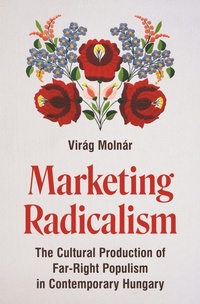
Marketing Radicalism
The Cultural Production of Far-Right Populism in Contemporary Hungary
Will be published approx. on 13. October 2026
Book
Hardback
248 pages
978-0-691-29037-9 (ISBN)
Description
The commodification and marketing of nationalism in a populist-governed country
Most accounts of populist politics revolve around political parties, electoral politics, eroding democratic institutions, media, and political propaganda. In Marketing Radicalism, Virag Molnar examines instead populism as a cultural process-one that reshapes cultural identities and meanings of cultural citizenship. Looking at such domains as fashion, publishing, and tourism, Molnar shows how identity politics, culture wars, culture industries, consumer markets, and popular culture contribute to the rise of far-right populism. The marketing of nationalism creates powerful narratives that reimagine the nation as a populist fantasyland, and these narratives are used by far-right governments in their efforts to topple liberal norms.
Hungary under Viktor Orban has provided an ideological blueprint for far-right populist politicians-and a cautionary tale for liberal democracies. Using Hungary's commodification of nationalism as a case study, Molnar explores the ways that cultural producers relied on consumer markets to promote traditionalism through folk-revivalist fashion; weaponized the public shredding of a children's book to disenfranchise LGBTQ+ communities; used tourism to neighboring Transylvania to envision a "Greater Hungary" that spilled over national borders; and packaged a mythic Orientalism in the form of horseback archery. Molnar's account offers important lessons on the mainstreaming of right-wing popular culture, the importance of markets in circulating and amplifying far-right identity narratives, and the political mobilization of cultural traditions for geopolitical reorientation.
Most accounts of populist politics revolve around political parties, electoral politics, eroding democratic institutions, media, and political propaganda. In Marketing Radicalism, Virag Molnar examines instead populism as a cultural process-one that reshapes cultural identities and meanings of cultural citizenship. Looking at such domains as fashion, publishing, and tourism, Molnar shows how identity politics, culture wars, culture industries, consumer markets, and popular culture contribute to the rise of far-right populism. The marketing of nationalism creates powerful narratives that reimagine the nation as a populist fantasyland, and these narratives are used by far-right governments in their efforts to topple liberal norms.
Hungary under Viktor Orban has provided an ideological blueprint for far-right populist politicians-and a cautionary tale for liberal democracies. Using Hungary's commodification of nationalism as a case study, Molnar explores the ways that cultural producers relied on consumer markets to promote traditionalism through folk-revivalist fashion; weaponized the public shredding of a children's book to disenfranchise LGBTQ+ communities; used tourism to neighboring Transylvania to envision a "Greater Hungary" that spilled over national borders; and packaged a mythic Orientalism in the form of horseback archery. Molnar's account offers important lessons on the mainstreaming of right-wing popular culture, the importance of markets in circulating and amplifying far-right identity narratives, and the political mobilization of cultural traditions for geopolitical reorientation.
More details
Series
Language
English
Place of publication
New Jersey
United States
Target group
College/higher education
Professional and scholarly
Product notice
Trade binding
Illustrations
16 b/w illus. 1 table.
Dimensions
Height: 235 mm
Width: 156 mm
ISBN-13
978-0-691-29037-9 (9780691290379)
Copyright in bibliographic data and cover images is held by Nielsen Book Services Limited or by the publishers or by their respective licensors: all rights reserved.
Schweitzer Classification
Person
Virag Molnar is associate professor of sociology at the New School for Social Research. She is the author of the award-winning book Building the State: Architecture, Politics, and State Formation in Postwar Central Europe.