

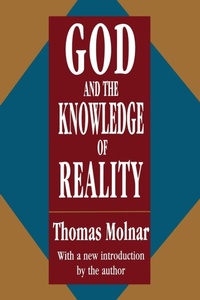
God and the Knowledge of Reality
2nd Edition
Published on 31. December 1993
Book
Paperback/Softback
268 pages
978-1-56000-665-7 (ISBN)
Description
Written simply yet comprehensively, Molnar's anlaysis of the history of philosophy and false mysticism leads him to conclude that a return to a moderate realism will save the philosophical enterprise from a series of epistemological and societal absolutes that are embodied in contemporary rationalism and mysticism alike. Issues that have been systematically excluded from discourse will have to be reintroduced into the discussion of person and providence.
Molnar divided the philosophical systems into two groups according to their vision of God, and consequently of reality.
One group removes God from the human scope, therefore rendering the world unreal, unknowable, and meaningless. The second group holds that God is immanent in the human soul, thereby emphasizing the human attainment of divine status, and reducing the extra-mental world to a condition of utter imperfection. Either way, the result is a pseudo-mysticism, a denial of the creaturely status of human beings.
What is most needed, Molnar claims, is a theory of knowledge whose ideal is not fusion but distinction-between God and Man, subject and object, the self and the society. By thus raising the question of philosophy over against magic Molnar seeks to awaken the reader from neo-dogmatic assumptions and restore speculative thought to its traditional place. Upon publication, Dale Vree in The Review of Politic^, said that "this book will go a long way in establishing Professor Molnar as one of the distinguished conservative philosophers of our time."
Molnar divided the philosophical systems into two groups according to their vision of God, and consequently of reality.
One group removes God from the human scope, therefore rendering the world unreal, unknowable, and meaningless. The second group holds that God is immanent in the human soul, thereby emphasizing the human attainment of divine status, and reducing the extra-mental world to a condition of utter imperfection. Either way, the result is a pseudo-mysticism, a denial of the creaturely status of human beings.
What is most needed, Molnar claims, is a theory of knowledge whose ideal is not fusion but distinction-between God and Man, subject and object, the self and the society. By thus raising the question of philosophy over against magic Molnar seeks to awaken the reader from neo-dogmatic assumptions and restore speculative thought to its traditional place. Upon publication, Dale Vree in The Review of Politic^, said that "this book will go a long way in establishing Professor Molnar as one of the distinguished conservative philosophers of our time."
More details
Edition
2nd edition
Language
English
Place of publication
New York
United States
Publishing group
Taylor & Francis Inc
Target group
College/higher education
Dimensions
Height: 229 mm
Width: 152 mm
Weight
408 gr
ISBN-13
978-1-56000-665-7 (9781560006657)
Copyright in bibliographic data and cover images is held by Nielsen Book Services Limited or by the publishers or by their respective licensors: all rights reserved.
Schweitzer Classification
Other editions
Additional editions
Thomas Molnar
God and the Knowledge of Reality
E-Book
09/2021
2nd Edition
Routledge
€64.49
Available for download
Thomas Molnar
God and the Knowledge of Reality
E-Book
09/2021
2nd Edition
Routledge
€64.49
Available for download
Person
Thomas Molnar is professor emeritus of philosophy at CUNY and at present is a visiting professor at Bupapest University.
Content
Part One THE INACCESSIBLE GOD, THE IMMANENT GOD, THE TRANSCENDENT AND PERSONAL GOD, Part Two THE MAGIC WAY TO PERFECT KNOWLEDGE THE PHILOSOPHER 'S MAGIC QUEST THE PHILOSOPHER'S ABSOLUTE BEING AND ABSOLUTE KNOWLEDGE Part Three THE IDEAL SOCIETY AS THE FRAMEWORK FOR ABSOLUTE KNOWLEDGE Part Four THE POSSIBILITY AND LIMITS OF KNOWLEDGE