

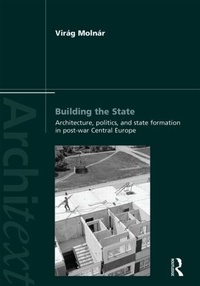
Building the State: Architecture, Politics, and State Formation in Postwar Central Europe
1st Edition
Published on 25. March 2013
Book
Hardback
210 pages
978-0-415-62293-6 (ISBN)
Description
The built environment of former socialist countries is often deemed uniform and drab, an apt reflection of a repressive regime. Building the State peeks behind the grey facade to reveal a colourful struggle over competing meanings of the nation, Europe, modernity and the past in a divided continent.
Examining how social change is closely intertwined with transformations of the built environment, this volume focuses on the relationship between architecture and state politics in postwar Central Europe using examples from Hungary and Germany. Built around four case studies, the book traces how architecture was politically mobilized in the service of social change, first in socialist modernization programs and then in the postsocialist transition.
Building the State does not only offer a comprehensive survey of the diverse political uses of architecture in postwar Central Europe but is the first book to explore how transformations of the built environment can offer a lens into broader processes of state formation and social change.
Examining how social change is closely intertwined with transformations of the built environment, this volume focuses on the relationship between architecture and state politics in postwar Central Europe using examples from Hungary and Germany. Built around four case studies, the book traces how architecture was politically mobilized in the service of social change, first in socialist modernization programs and then in the postsocialist transition.
Building the State does not only offer a comprehensive survey of the diverse political uses of architecture in postwar Central Europe but is the first book to explore how transformations of the built environment can offer a lens into broader processes of state formation and social change.
Reviews / Votes
"Building the State importantly demonstrates how architecture and urbanism construct political objectives by other means. In charting the changing roles and evolving self-identity of the architectural profession in two key parts of Central Europe between 1945 and 2000, Virag Molnar adroitly reveals the complex dialogue among modernism, socialism and nationalism."Lawrence J. Vale, Massachusetts Institute of Technology, USA
"This book offers a fresh perspective on the interaction between architecture and politics in East Germany and Hungary during state socialism and its aftermath. The author's approach, combining case studies and historical ethnography, is a delight for any reader, including architectural historians."
Pal Ritook, Hungarian Architecture Museum "Building the State importantly demonstrates how architecture and urbanism construct political objectives by other means. In charting the changing roles and evolving self-identity of the architectural profession in two key parts of Central Europe between 1945 and 2000, Virag Molnar adroitly reveals the complex dialogue among modernism, socialism and nationalism."
Lawrence J. Vale, Massachusetts Institute of Technology, USA
"This book offers a fresh perspective on the interaction between architecture and politics in East Germany and Hungary during state socialism and its aftermath. The author's approach, combining case studies and historical ethnography, is a delight for any reader, including architectural historians."
Pal Ritook, Hungarian Architecture Museum
"In her book, Virag Molnar provides us with a sophisticated inquiry into architectural discourse in East Germany and Hungary during and after the period of state socialism. Molnar's study takes on an important gap in literature on architecture under state socialism."
Brigitte Le Normand, University of British Columbia, Canada. Planning Perspectives, April 2014
"Molnar shows that whether material construction operates as a "cultural representation", a "cultural medium", or a set of strategies for change is not something that can be answered a priori. By focusing on the same general professional arena over a long period of time and across space, she shows how the "same" arena is transformed as it changes its relation to local and global power structures and histories-- how the material etching of the world emerges simultaneously as an almost "total social fact" and as a powerful way to shape future action. What emerges, then, is a nimble study of culture that truly takes its objects seriously-avoiding easy prefabricated answers, while showing how material culture is brought into action."
Iddo Tavory, European Journal of Sociology, University of California, USA
"Virag Molnar's Building the State: Architecture, Politics, and State Formation in Post-War Central Europe explores the changing meanings of the built environment and its roles in the formulation of the socialist state in two former socialist countries, the German Democratic Republic and Hungary."
Vladimir Kulic, Contemporary European History
More details
Series
Language
English
Place of publication
London
United Kingdom
Publishing group
Taylor & Francis Ltd
Target group
College/higher education
Professional and scholarly
Postgraduate and Professional
Illustrations
34 s/w Photographien bzw. Rasterbilder, 6 s/w Zeichnungen, 2 s/w Tabellen
2 Tables, black and white; 6 Line drawings, black and white; 34 Halftones, black and white
Dimensions
Height: 246 mm
Width: 174 mm
Weight
570 gr
ISBN-13
978-0-415-62293-6 (9780415622936)
Copyright in bibliographic data and cover images is held by Nielsen Book Services Limited or by the publishers or by their respective licensors: all rights reserved.
Schweitzer Classification
Other editions
Additional editions
Virag Molnar
Building the State: Architecture, Politics, and State Formation in Postwar Central Europe
E-Book
10/2013
1st Edition
Routledge
€60.49
Available for download
Virag Molnar
Building the State: Architecture, Politics, and State Formation in Postwar Central Europe
E-Book
10/2013
1st Edition
Routledge
€60.49
Available for download
Person
Virag Molnar is Assistant Professor of Sociology at the New School for Social Research in New York. She holds a Ph.D. in Sociology from Princeton University and her work focuses on the politics of the built environment and urban culture.
Content
1. Introduction 2. Building Socialism on National Traditions: Socialist Realism and Postwar Urban Reconstruction 3. Prefabricating Modernity: Mass Housing and its Discontents 4. Questioning Modernity: Western or Vernacular? 5. The Traditional "European City" in The Global Age: Rebuilding Post-wall Berlin 6. Conclusion