

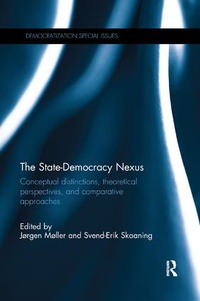
The State-Democracy Nexus
Conceptual Distinctions, Theoretical Perspectives, and Comparative Approaches
1st Edition
Published on 12. January 2018
Book
Paperback/Softback
156 pages
978-1-138-50252-9 (ISBN)
Description
The great dilemma of democracy revolves around the state. Historically, the state has played a crucial role as enforcer of liberal democratic constitutions, but it has also been used by autocratic rulers to entrench their rule. The state is thus a two-edged sword: It can both be the guarantee of democratic rights and a tool that can be used to suppress such rights. One corollary of this is that the influence of state structures on democratic development depends on who holds government power. But the opposite observation can also be made, as governments play an important role in shaping the state apparatus. The state and the regime are thus intertwined.
Against this backdrop, this book presents a series of attempts - authored by influential experts such as Francis Fukuyama and Gerardo Munck - to disentangle the relationship between the state and political regimes. The contributions differ in terms of their particular theoretical and empirical focus. But they share the assumption that three criteria need to be observed to achieve a better understanding of the state-democracy nexus. First, it is valuable to distinguish conceptually between different aspects of the state. Second, the potential relationships between democracy and these attributes of state should be carefully theorized. Third, the consequent propositions must be interrogated using comparative approaches. This book was originally published as a special issue of Democratization.
Against this backdrop, this book presents a series of attempts - authored by influential experts such as Francis Fukuyama and Gerardo Munck - to disentangle the relationship between the state and political regimes. The contributions differ in terms of their particular theoretical and empirical focus. But they share the assumption that three criteria need to be observed to achieve a better understanding of the state-democracy nexus. First, it is valuable to distinguish conceptually between different aspects of the state. Second, the potential relationships between democracy and these attributes of state should be carefully theorized. Third, the consequent propositions must be interrogated using comparative approaches. This book was originally published as a special issue of Democratization.
More details
Series
Language
English
Place of publication
London
United Kingdom
Publishing group
Taylor & Francis Ltd
Target group
College/higher education
Dimensions
Height: 234 mm
Width: 156 mm
Weight
290 gr
ISBN-13
978-1-138-50252-9 (9781138502529)
Copyright in bibliographic data and cover images is held by Nielsen Book Services Limited or by the publishers or by their respective licensors: all rights reserved.
Schweitzer Classification
Other editions
Additional editions
Jorgen Moller | Svend-Erik Skaaning
The State-Democracy Nexus
Conceptual Distinctions, Theoretical Perspectives, and Comparative Approaches
E-Book
04/2016
1st Edition
Routledge
€67.49
Available for download
Jorgen Moller | Svend-Erik Skaaning
The State-Democracy Nexus
Conceptual Distinctions, Theoretical Perspectives, and Comparative Approaches
E-Book
04/2016
1st Edition
Routledge
€67.49
Available for download
Jorgen Moller | Svend-Erik Skaaning
The State-Democracy Nexus
Conceptual Distinctions, Theoretical Perspectives, and Comparative Approaches
Book
03/2016
1st Edition
Routledge
€207.98
Shipment within 10-20 days
Persons
Jorgen Moller is professor of political science at Aarhus University. His research interests include the conceptualization, measurement, and explanation of modern states and political regimes.
Svend-Erik Skaaning is professor of political science at Aarhus University and co-principal investigator of the Varieties of Democracy project. His research interests include the conceptualization, measurement, and explanation of modern states and political regimes.
Their recent books include Democracy and Democratization in Comparative Perspective: Conceptions, Conjunctures, Causes, and Consequences (2013)
Svend-Erik Skaaning is professor of political science at Aarhus University and co-principal investigator of the Varieties of Democracy project. His research interests include the conceptualization, measurement, and explanation of modern states and political regimes.
Their recent books include Democracy and Democratization in Comparative Perspective: Conceptions, Conjunctures, Causes, and Consequences (2013)
Content
1. The state-democracy nexus: conceptual distinctions, theoretical perspectives, and comparative approaches 2. State or democracy first? Alternative perspectives on the state-democracy nexus 3. Exploring the relationship between infrastructural and coercive state capacity 4. State capacity and the paradox of authoritarian elections 5. Meritocratic administration and democratic stability 6. State capacity and political regime stability 7. States and democracy