

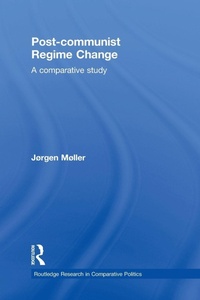
Post-communist Regime Change
A Comparative Study
1st Edition
Published on 15. April 2013
Book
Paperback/Softback
192 pages
978-0-415-85010-0 (ISBN)
Description
This book seeks to explain the divergent political pathways of twenty six post-communist states, following the breakdown and eventual collapse of communism in 1989-1991.
Considering the trajectories of individual states between 1990 - 2007, this book challenges two central bodies of theory relating to democratization and regime change. Through a sustained analysis of global and post-communist developments within this time period, the author shows that claims of an increasing asymmetry between the 'electoral' and 'liberal' elements of modern democracy have been greatly exaggerated. The author goes on to contend that in accounting for the geographical dispersion of post-communist regime forms, deeper structural factors should be considered as crucial. The book is divided into the following parts:
Part I demonstrates how different conceptualisations of democracy can lead to very different conclusions about the empirical dynamics of democratization.
Part II contrasts different explanations of post-communist political change and provides an integrated framework for explaining the political pathways encountered within the former Eastern Bloc.
This book will be of interest to students and scholars of post-communist studies, democratization studies, comparative politics and regime change.
Considering the trajectories of individual states between 1990 - 2007, this book challenges two central bodies of theory relating to democratization and regime change. Through a sustained analysis of global and post-communist developments within this time period, the author shows that claims of an increasing asymmetry between the 'electoral' and 'liberal' elements of modern democracy have been greatly exaggerated. The author goes on to contend that in accounting for the geographical dispersion of post-communist regime forms, deeper structural factors should be considered as crucial. The book is divided into the following parts:
Part I demonstrates how different conceptualisations of democracy can lead to very different conclusions about the empirical dynamics of democratization.
Part II contrasts different explanations of post-communist political change and provides an integrated framework for explaining the political pathways encountered within the former Eastern Bloc.
This book will be of interest to students and scholars of post-communist studies, democratization studies, comparative politics and regime change.
More details
Series
Language
English
Place of publication
London
United Kingdom
Publishing group
Taylor & Francis Ltd
Target group
College/higher education
Illustrations
19 s/w Abbildungen, 19 s/w Zeichnungen, 17 s/w Tabellen
17 Tables, black and white; 19 Line drawings, black and white; 19 Illustrations, black and white
Dimensions
Height: 234 mm
Width: 156 mm
Thickness: 11 mm
Weight
304 gr
ISBN-13
978-0-415-85010-0 (9780415850100)
Copyright in bibliographic data and cover images is held by Nielsen Book Services Limited or by the publishers or by their respective licensors: all rights reserved.
Schweitzer Classification
Other editions
Additional editions
E-Book
06/2009
Routledge
€31.49
Available for download
E-Book
06/2009
1st Edition
Routledge
€31.49
Available for download
Book
06/2009
1st Edition
Routledge
€67.10
Shipment within 15-20 days
Person
Jorgen Moller is Assistant Professor at the Institute of Political Science, University of Aarhus, Denmark.
Content
Introduction: The Puzzle of the Post-communist Tripartition 1. The Gap Between Electoral and Liberal Democracy Revisited. Some Conceptual and Empirical Clarifications 2. The Post-communist Tripartition Described 3. An Actor-centred Analysis of Post-communist Political Pathways 4. A Structural Analysis of Post-Communist Pathways 5. Contrasting Structures, Actors - And Diffusion. Conclusion.