

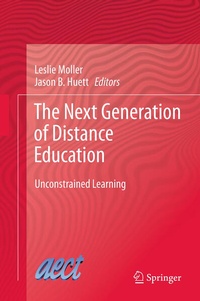
The Next Generation of Distance Education
Unconstrained Learning
Published on 7. February 2012
Book
Hardback
XXVI, 266 pages
978-1-4614-1784-2 (ISBN)
Description
The world of education is being radically altered with the change being driven by technology, openness, and unprecedented access to knowledge. Older correspondence-style methods of instructional delivery are passé and "classroom adapted to the web" approaches to learning are often ineffective and do little to harness the transformational potential of technology. E-Learning scenarios, mobile technologies, communication and information access, and personal learning environments are becoming mainstream and, as a result, control of the learning process is shifting away from institutions and into the hands of learners. This volumes promotes a forward-thinking agenda for research and scholarship that highlights new ideas, deep insights, and novel approaches to "unconstrained" learning.
More details
Edition
2012
Language
English
Place of publication
New York
United States
Target group
Professional and scholarly
Research
Illustrations
XXVI, 266 p.
Dimensions
Height: 241 mm
Width: 160 mm
Thickness: 19 mm
Weight
605 gr
ISBN-13
978-1-4614-1784-2 (9781461417842)
DOI
10.1007/978-1-4614-1785-9
Schweitzer Classification
Other editions
Additional editions

Book
04/2014
Springer
€139.09
Shipment within 15-20 days

E-Book
02/2012
1st Edition
Springer
€128.39
Available for download
Content
-1. Guiding principles of the next generation of learning at a distance.-2. The future of distance learning technology: It's not about the technology, and it's not about the distance.-3.An analysis of success and failures: Planning the foundation for the next generation of distance education.-4. Rethinking design and learning processes.-5. Needs assessment: Identifying teachers' expectations and perceptions of an online P-6 engineering professional development program.-6. Collaborative problem-solving in virtual environments: Effect of social interaction, social presence and sociability on critical thinking.-7. Using the community of inquiry framework to inform effective instructional design.-8. The design critique as a model for distributed learning.-9. Data, information, knowledge, wisdom: A revised model for agents-based knowledge management systems.-10. Higher education and post-industrial society: New ideas about teaching, learning, and technology.-11. CyGaMEs: A full-service instructional design model harnessing game-based technologies for learning and assessment.-12. Learning-communication interfaces model: Implications to virtual learning.-13. The influence of backchannel communication on cognitive load.-14. The next generation of research in distance and online learning: Unconstrained by comparisons to classroom instruction.-15. The effect of delivery method of instructional materials to meet learning goals and objectives in online and open learning environments.-16. Engaging learners in collaborative authentic learning activities.-17. Learning communities.