

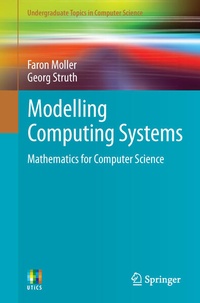
Modelling Computing Systems
Description
Features: demonstrates how game theory provides a paradigm for an intuitive understanding of the nature of computation; contains more than 400 exercises throughout the text, with detailed solutions to half of these presented at the end of the book, together with numerous theorems, definitions and examples; describes a modelling approach based on state transition systems.
Reviews / Votes
"This book by UK academics Moller (Swansea Univ.) and Struth (Univ. of Sheffield) is designed to serve as a textbook for first-year university students in computer science. The volume contains 15 chapters, divided in two parts. ... libraries may wish to acquire it for the benefit of advanced undergraduates. Summing Up: Recommended. Only comprehensive academic mathematics and computer science collections." (B. Borchers, Choice, Vol. 51 (7), March, 2014)"This book contains essential mathematics and modelling techniques for computing systems for which a presentation style suitable for first year undergraduate students has been chosen. ... The book contains more than 200 exercises throughout the text and provides complete solutions at the back of the book on more than 80 pages." (Gudula Ruenger, zbMATH, Vol. 1278, 2014)
"This book by UK academics Moller (Swansea Univ.) and Struth (Univ. of Sheffield) is designed to serve as a textbook for first-year university students in computer science. The volume contains 15 chapters, divided in two parts. ... libraries may wish to acquire it for the benefit of advanced undergraduates. Summing Up: Recommended. Only comprehensive academic mathematics and computer science collections." (B. Borchers, Choice, Vol. 51 (7), March, 2014)
More details
Other editions
Additional editions
Persons
Prof. Faron Moller is a Professor of Computer Science at Swansea University, UK.
Dr. Georg Struth is a Reader in Computer Science at the University of Sheffield, UK.
Content
Introduction.- Part I: Mathematics for Computer Science.- Propositional Logic.- Sets.- Boolean Algebras and Circuits.- Predicate Logic.- Proof Strategies.- Functions.- Relations.- Inductive and Recursive Definitions.- Proofs by Induction.- Games and Strategies.- Part II: Modelling Computing Systems.- Modelling Processes.- Distinguishing Between Processes.- Logical Properties of Processes.- Concurrent Processes.- Temporal Properties.