

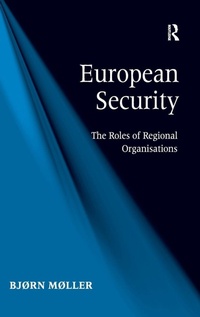
European Security
The Roles of Regional Organisations
1st Edition
Published on 15. November 2012
Book
Hardback
516 pages
978-1-4094-4408-4 (ISBN)
Description
Europe has undergone quite profound changes since the end of the Cold War. Having been a highly militarised, conflict-ridden and war-ridden region, the core of Europe today constitutes a security community where armed conflicts among the constituent states has become inconceivable. This comprehensive book offers a theoretically founded and thoroughly documented analysis of European security, with a special emphasis on the role played by the United Nations and the various regional and sub-regional organisations, especially the North Atlantic Treaty Organisation, the Organisation for Security and Cooperation in Europe, the Council of Europe and the European Union. When it comes to explaining peace in Europe opinions differ widely. Some argue that it was only because the West refused to give in to Soviet threats that the latter eventually gave up; or that the 'long peace' in Europe was due to the combination of a bipolar alliance structure, pitting the North Atlantic Treaty Organisation (NATO) against the Warsaw Pact, with the presence of nuclear weapons on both sides. Others point instead to the extraordinarily dense network of international institutions and organisations in Europe, offering a wide panoply of fora in which to handle disputes peacefully; or to the web of interdependence in economic and other affairs, tying together all states in Europe in relations which militate strongly against war. Still others believe that the external peace between the states in Europe is simply a reflection of a convergence of cultures, democracies with marked economies that are open towards the world market. These questions are the focal point of this book, which concentrates on security, albeit not in the sense of being a treatise on military matters, but security obtainable by much more indirect and non-military means. It will be required reading for all students and scholars of European security and the organisations which underpin it.
Reviews / Votes
'Offers an insightful and detailed analysis of the role of European regional organisations in promoting and maintaining security within and beyond Europe, including an in-depth overview of the constitutive concepts of security, organisations and regions. An excellent exploration of the underlying reasons for European success in regional security building and a "must read" for scholars and students of European security studies.' Maxi Schoeman, University of Pretoria, South Africa 'What has been lacking is a volume that takes a comprehensive and critical view on how the various regional organizations that make up the European security architecture contributed to turning this war-torn region into a tightly coupled security community in less than 50 years. It is this gap that MA?ller sets out to fill, a task in which he succeeds admirably...' International AffairsMore details
Language
English
Place of publication
London
United Kingdom
Publishing group
Taylor & Francis Ltd
Target group
College/higher education
Dimensions
Height: 240 mm
Width: 161 mm
Thickness: 32 mm
Weight
939 gr
ISBN-13
978-1-4094-4408-4 (9781409444084)
Copyright in bibliographic data and cover images is held by Nielsen Book Services Limited or by the publishers or by their respective licensors: all rights reserved.
Schweitzer Classification
Other editions
Additional editions
Book
11/2016
1st Edition
Routledge
€85.90
Shipment within 10-20 days
E-Book
04/2016
Routledge
€77.99
Available for download
E-Book
04/2016
Routledge
€77.99
Available for download
Person
Bjorn Moller, Aalborg University-CPH, Denmark
Content
1: The Concept of Security; 2: Multilateralism, Institutions, Regimes and Organisations; 3: Regions and Regionalism; 4: The United Nations, Global and Regional Security; 5: Europe and its Distinguishing Features; 6: The North Atlantic Treaty Organization; 7: The Council of Europe and the OSCE; 8: The European Union; Conclusion: Comparative Score-Cards