

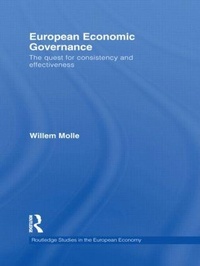
European Economic Governance
The quest for consistency and effectiveness
1st Edition
Published on 4. March 2011
Book
Hardback
408 pages
978-0-415-56544-8 (ISBN)
Description
In the course of its development the EU has had to deal with an expanding policy agenda, covering ever more subjects and an increased diversity of instruments. It has also had to deal with an increased number of member states and an extended range of partners (regional authorities, non governmental organisations). These developments have greatly increased the risk of inconsistencies between the various policies pursued and between the various levels of competence for the same policy. Inconsistent policies are less effective than they ought to be. So, they imply a welfare loss.
The EU has tried to cope with the challenge of consistency by adapting its governance. Traditionally it uses mainly the regulatory method. The effectiveness of this method has recently come into question. So alternative methods are now favoured. One is the financial method; which implies more expenditure via the EU budget. The other is coordination. The application of both methods has certain advantages and disadvantages. The problem for policy makers is then to determine the choice between the modes first and the optimal level of budgetary and coordination efforts next. Notwithstanding its obvious policy relevance the problem has got little attention from academia.
This book sets out to contribute to a solution by following two approaches. The first is a systematisation of the theoretical and conceptual underpinnings of the financial and coordination methods. The second is an empirical investigation into a range of European policy processes, implying to different degrees budgetary outlays and coordination.
The EU has tried to cope with the challenge of consistency by adapting its governance. Traditionally it uses mainly the regulatory method. The effectiveness of this method has recently come into question. So alternative methods are now favoured. One is the financial method; which implies more expenditure via the EU budget. The other is coordination. The application of both methods has certain advantages and disadvantages. The problem for policy makers is then to determine the choice between the modes first and the optimal level of budgetary and coordination efforts next. Notwithstanding its obvious policy relevance the problem has got little attention from academia.
This book sets out to contribute to a solution by following two approaches. The first is a systematisation of the theoretical and conceptual underpinnings of the financial and coordination methods. The second is an empirical investigation into a range of European policy processes, implying to different degrees budgetary outlays and coordination.
More details
Series
Language
English
Place of publication
London
United Kingdom
Publishing group
Taylor & Francis Ltd
Target group
College/higher education
Product notice
sewn/stitched
Cloth over boards
Illustrations
10 s/w Abbildungen, 10 s/w Zeichnungen, 27 s/w Tabellen
27 Tables, black and white; 10 Line drawings, black and white; 10 Illustrations, black and white
Dimensions
Height: 239 mm
Width: 157 mm
Thickness: 28 mm
Weight
726 gr
ISBN-13
978-0-415-56544-8 (9780415565448)
Copyright in bibliographic data and cover images is held by Nielsen Book Services Limited or by the publishers or by their respective licensors: all rights reserved.
Schweitzer Classification
Other editions
Additional editions
Book
11/2013
1st Edition
Routledge
€88.19
Shipment within 15-20 days
Willem Koops | Harke A. Bosma
European Economic Governance
The quest for consistency and effectiveness
E-Book
03/2011
1st Edition
Routledge
€72.49
Available for download
Willem Koops | Harke A. Bosma
European Economic Governance
The quest for consistency and effectiveness
E-Book
03/2011
1st Edition
Routledge
€72.49
Available for download
Person
Willem Molle is Professor in 'Economics of International Integration' at Erasmus University, Rotterdam.
Content
1. Introduction 2. Definitions 3. Consistency 4. Effectiveness 5. Regulation 6. Budget 7. Coordination 8. Systemic Aspects 9. Practice in Major Policy Areas 10. Competitiveness and Innovation 11. Stabilisation 12. Cohesion 13. Sustainaibility 14. Employment and Social Protection 15. External 16. Conclusions