

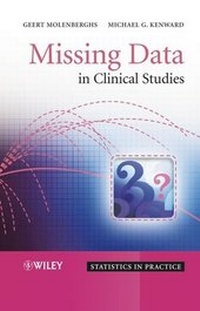
Missing Data in Clinical Studies
Published on 9. March 2007
Book
Hardback
526 pages
978-0-470-84981-1 (ISBN)
Description
The detrimental effects of incomplete data sets on the results of clinical trials are both well known and all too commonly recurrent. It is essential that the correct statistical methodology be applied in order to effectively analyse the results of trials affected by missing data.
Missing Data in Clinical Trials provides a comprehensive account of the problems arising when data from clinical and related studies are incomplete, and presents the reader with approaches to effectively address them. The text provides a critique of conventional and simple methods before moving on to discuss more advanced approaches. The authors focus on practical and modeling concepts, providing an extensive set of case studies to illustrate the problems described.
* Provides a practical guide to the analysis of clinical trials and related studies with missing data.
* Examines the problems caused by missing data, enabling a complete understanding of how to overcome them.
* Presents conventional, simple methods to tackle these problems, before addressing more advanced approaches, including sensitivity analysis, and the MAR missingness mechanism.
* Illustrated throughout with real-life case studies and worked examples from clinical trials.
* Details the use and implementation of the necessary statistical software, primarily SAS.
Missing Data in Clinical Trials has been developed through a series of courses and lectures. Its practical approach will appeal to applied statisticians and biomedical researchers, in particular those in the biopharmaceutical industry, medical and public health organisations. Graduate students of biostatistics will also find much of benefit.
Reviews / Votes
?Overall, this is an excellent text on missing data that is engaging for practitioners while being rigorous enoughfor use in the graduate biostatistics courses.?(Biometrics , September 2009)" "Missing Data in Clinical Studies does an excellent job of presenting essential ideas on modern concepts and techniques relevant to missing data in clinical studies." (Journal of the American Statistician, December 2008) "?this book is reasonably well organized and covers all the relevant theory and much of the practical applications of the field." (Journal of the American Chemical Association, August 6, 2008)"Missing Data in Clinical Studies does an excellent job of presenting essential ideas on modern concepts and techniques relevant to missing data in clinical studies." (Journal of the American Statistician, December 2008)
"Clear, generally accessible and well written, and the content is rich. This text is a highly recommendable addition to the shelves of practicing statisticians." (Journal of Applied Statistics, August 2008)
"The authors give key examples in the form of several clinical trials and their analyses using the appropriate remedial techniques." (Journal of Tropical Pediatrics, August 2007)
More details
Series
Edition
1. Auflage
Language
English
Place of publication
New York
United States
Target group
Professional and scholarly
Product notice
sewn/stitched
Paper over boards
Dimensions
Height: 235 mm
Width: 157 mm
Thickness: 33 mm
Weight
909 gr
ISBN-13
978-0-470-84981-1 (9780470849811)
Schweitzer Classification
Other editions
Additional editions
Geerts Molenberghs | Michael Kenward
Missing Data in Clinical Studies
E-Book
04/2007
Wiley
€80.99
Available for download
Persons
Geert Molenberghs and Michael Kenward are the authors of Missing Data in Clinical Studies, published by Wiley.
Content
Preface.
Acknowledgements.
I Preliminaries.
1 Introduction.
2 Key Examples.
3 Terminology and Framework.
II Classical Techniques and the Need for Modelling.
4 A Perspective on Simple Methods.
5 Analysis of the Orthodontic Growth Data.
6 Analysis of the Depression Trials.
III Missing at Random and Ignorability.
7 The Direct Likelihood Method.
8 The Expectation-Maximization Algorithm.
9 Multiple Imputation.
10 Weighted Estimating Equations.
11 Combining GEE and MI.
12 Likelihood-Based Frequentist Inference.
13 Analysis of the Age-Related Macular Degeneration Trial.
14 Incomplete Data and SAS.
IV Missing Not at Random.
15 Selection Models.
16 Pattern-Mixture Models.
17 Shared-Parameter Models.
18 Protective Estimation.
V Sensitivity Analysis.
19 MNAR, MAR, and the Nature of Sensitivity.
20 Sensitivity Happens.
21 Regions of Ignorance and Uncertainty.
22 Local and Global Influence Methods.
23 The Nature of Local Influence.
24 A Latent-Class Mixture Model for Incomplete Longitudinal Gaussian Data.
VI Case Studies.
25 The Age-Related Macular Degeneration Trial.
26 The Vorozole Study.
References.
Index.