

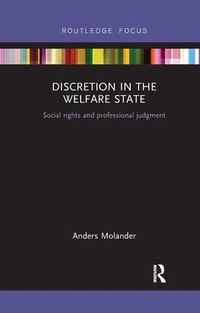
Discretion in the Welfare State
Social Rights and Professional Judgment
1st Edition
Published on 25. July 2018
Book
Paperback/Softback
100 pages
978-1-138-32643-9 (ISBN)
Description
Welfare state professionals decide or establish premises as to whom will receive what, in what manner, when and how much, and when enough is enough. They control who passes through the gates of the welfare state.
This book provides an in-depth understanding of the phenomenon of discretion. It shows why the delegation of discretionary powers to professionals in the front-line of the welfare state is both unavoidable and problematic. Extensive use of discretion can threaten the principles of the rule of law and relinquish democratic control over the implementation of laws and policies. The book introduces an understanding of discretion that adds an epistemic dimension (discretion as a mode of reasoning) to the common structural understanding of discretion (an area of judgment and decision). Accordingly, it distinguishes between structural and epistemic measures of accountability. The aim of the former is to constrain discretionary spaces or the behavior within them while the aim of the latter is to improve the quality of discretionary reasoning.
This text will be of key interest to scholars and students in the fields of applied philosophy, public policy and public administration, welfare state research, and the sociology of professions.
This book provides an in-depth understanding of the phenomenon of discretion. It shows why the delegation of discretionary powers to professionals in the front-line of the welfare state is both unavoidable and problematic. Extensive use of discretion can threaten the principles of the rule of law and relinquish democratic control over the implementation of laws and policies. The book introduces an understanding of discretion that adds an epistemic dimension (discretion as a mode of reasoning) to the common structural understanding of discretion (an area of judgment and decision). Accordingly, it distinguishes between structural and epistemic measures of accountability. The aim of the former is to constrain discretionary spaces or the behavior within them while the aim of the latter is to improve the quality of discretionary reasoning.
This text will be of key interest to scholars and students in the fields of applied philosophy, public policy and public administration, welfare state research, and the sociology of professions.
Reviews / Votes
'What emerges from this 'little book', is a concise but convincing account of the analyticaldistinction between structural and epistemic discretion which is far more accessible than the work
of Alexy (2000) it is inspired by. Molander demonstrates the practical application of his arguments
when addressing concerns over accountability, providing an insight into how the distinction offers
more than simply a theoretical tool for examining tensions in the granting of discretion (i.e. with
the 'rule of law' or 'democratic control'), but can also bear fruit when applied to the real-world
management of discretion decision-making in a welfare bureaucracy.'
Jed Meers York Law School, University of York, UK
More details
Series
Language
English
Place of publication
London
United Kingdom
Publishing group
Taylor & Francis Ltd
Target group
College/higher education
Illustrations
5 s/w Abbildungen, 5 s/w Zeichnungen
5 Line drawings, black and white; 5 Illustrations, black and white
Dimensions
Height: 216 mm
Width: 138 mm
Weight
190 gr
ISBN-13
978-1-138-32643-9 (9781138326439)
Copyright in bibliographic data and cover images is held by Nielsen Book Services Limited or by the publishers or by their respective licensors: all rights reserved.
Schweitzer Classification
Other editions
Additional editions
Book
09/2016
1st Edition
Routledge
€83.70
Shipment within 10-20 days
E-Book
09/2016
Routledge
€31.49
Available for download
E-Book
09/2016
Routledge
€31.49
Available for download
Person
Anders Molander is Associate Professor at Centre for the Study of Professions, Oslo and Akershus University College, Norway.
Content
Introduction
1. Discretion and Its Critics
2. The Anatomy of Discretion
3. Professional Discretion in the Welfare State: Two Normative Tensions
4. Mechanisms of Accountability
5. Summing Up
1. Discretion and Its Critics
2. The Anatomy of Discretion
3. Professional Discretion in the Welfare State: Two Normative Tensions
4. Mechanisms of Accountability
5. Summing Up