

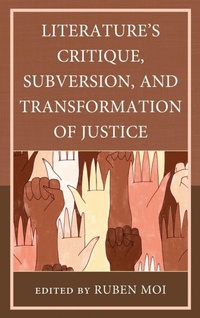
Literature's Critique, Subversion, and Transformation of Justice
Published on 19. March 2024
Book
Hardback
222 pages
978-1-6669-5258-2 (ISBN)
Description
Literature is an institution per se, as is justice, and these two institutions enact each other in complex ways. Justice appears in many forms from divine right and religious ordainment to metaphysical imperative and natural law, to national jurisdiction, social order, human rights, and civil disobedience. What is just and right has varied in time and place, in war and peace. A sense of justice appears inextricable from human concerns of ethics and morals. Literature includes a vast range of writing from holy texts to banned books. Parts of literature, particularly in the past, have laid down the law. In more recent history, literature has gradually assumed radical roles of critique, subversion, and transformation of the existing law and order, in contents, themes, language, and form. Literature's Critique, Subversion, and Transformation of Justice offers a selection of research that examines how various types of literature and arts give shape and significance to ideas of justice in various fields.
More details
Language
English
Place of publication
United States
Publishing group
Bloomsbury Publishing Plc
Target group
Professional and scholarly
Dimensions
Height: 235 mm
Width: 157 mm
Thickness: 18 mm
Weight
521 gr
ISBN-13
978-1-6669-5258-2 (9781666952582)
Copyright in bibliographic data and cover images is held by Nielsen Book Services Limited or by the publishers or by their respective licensors: all rights reserved.
Schweitzer Classification
Other editions
Additional editions
E-Book
03/2024
1st Edition
Lexington Books
€90.99
Available for download
E-Book
03/2024
1st Edition
Lexington Books
€90.99
Available for download
Persons
Ruben Moi is professor of English and Irish literature at The Arctic University of Norway, where he also leads the Just Literature research group.
Content
Introduction, Ruben Moi
Chapter One: A Vendor of the Body and the Spirit: Justice and Social Control in Shakespeare's The Merchant of Venice, William Dwyer III
Chapter Two: Drama and the Search for Justice: The Case of Philip Massinger's Comedy, A New Way to Pay Old Debts (c. 1625/6), Anthony W. Johnson
Chapter Three: Aesthetic Justice and Figuration of the Possible, Lene M. Johannessen
Chapter Four: Art and Justice in the Age of Neoliberalism, Asbjorn Gronstad
Chapter Five: Implicated Readers: Just Storytelling and Violence Against Migrant Women, Cassandra Falke
Chapter Six: The Legacy of Seamus Heaney's North, Ruben Moi
Chapter Seven: Justice and Moral Development in Siobhan Dowd's Bog Child, Erik Mustad
Chapter Eight: Poetic Justice and Translation: Seamus Heaney's Two Greek Plays and the Troubles, Charles Ivan Armstrong
Chapter Nine: Art Write Cope and Sami Birgengoansttat, Biret-Jon-Risten-Kirste-Hanna Lill Tove / Lill Tove Fredriksen
Chapter Ten: The Lesson of Khaufpur and Morichjhapi: Temporal Finitude and the Urgency of Environmental Justice in Indra Sinha's Animal's People and Amitav Ghosh's The Hungry Tide, Edvard Lia
Chapter Eleven: 'It's just not fear' - Fictional Narratives' Role in the Development of Pupils' Perception of Justice and Morality, Christopher Loe Olsen
About the Contributors
Chapter One: A Vendor of the Body and the Spirit: Justice and Social Control in Shakespeare's The Merchant of Venice, William Dwyer III
Chapter Two: Drama and the Search for Justice: The Case of Philip Massinger's Comedy, A New Way to Pay Old Debts (c. 1625/6), Anthony W. Johnson
Chapter Three: Aesthetic Justice and Figuration of the Possible, Lene M. Johannessen
Chapter Four: Art and Justice in the Age of Neoliberalism, Asbjorn Gronstad
Chapter Five: Implicated Readers: Just Storytelling and Violence Against Migrant Women, Cassandra Falke
Chapter Six: The Legacy of Seamus Heaney's North, Ruben Moi
Chapter Seven: Justice and Moral Development in Siobhan Dowd's Bog Child, Erik Mustad
Chapter Eight: Poetic Justice and Translation: Seamus Heaney's Two Greek Plays and the Troubles, Charles Ivan Armstrong
Chapter Nine: Art Write Cope and Sami Birgengoansttat, Biret-Jon-Risten-Kirste-Hanna Lill Tove / Lill Tove Fredriksen
Chapter Ten: The Lesson of Khaufpur and Morichjhapi: Temporal Finitude and the Urgency of Environmental Justice in Indra Sinha's Animal's People and Amitav Ghosh's The Hungry Tide, Edvard Lia
Chapter Eleven: 'It's just not fear' - Fictional Narratives' Role in the Development of Pupils' Perception of Justice and Morality, Christopher Loe Olsen
About the Contributors