

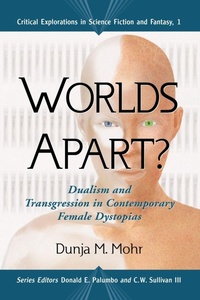
Worlds Apart?
Dualism and Transgression in Contemporary Female Dystopias
Published on 15. June 2005
Book
Paperback/Softback
320 pages
978-0-7864-2142-8 (ISBN)
Description
Literary critics and scholars have written extensively on the demise of the "utopian spirit" in the modern novel. What has often been overlooked is the emergence of a new hybrid subgenre, particularly in science fiction and fantasy, which incorporates utopian strategies within the dystopian narrative, particularly in the feminist dystopias of the 1980s and 1990s. The author names this new subgenre "transgressive utopian dystopias."
Suzette Haden Elgin's Native Tongue trilogy, Suzy McKee Charna's Holdfast series, and Margaret Atwood's The Handmaid's Tale are thoroughly analyzed within the context of this this new subgenre of "transgressive utopian dystopias." Analysis focuses particularly on how these works cover the interrelated categories of gender, race and class, along with their relationship to classic literary dualism and the dystopian narrative. Without completely dissolving the dualistic order, the feminist dystopias studied here contest the notions of unambiguity and authenticity that are generally part of the canon.
Suzette Haden Elgin's Native Tongue trilogy, Suzy McKee Charna's Holdfast series, and Margaret Atwood's The Handmaid's Tale are thoroughly analyzed within the context of this this new subgenre of "transgressive utopian dystopias." Analysis focuses particularly on how these works cover the interrelated categories of gender, race and class, along with their relationship to classic literary dualism and the dystopian narrative. Without completely dissolving the dualistic order, the feminist dystopias studied here contest the notions of unambiguity and authenticity that are generally part of the canon.
Reviews / Votes
"valuable...significant"-Science Fiction Studies; "well-researched"-Anglistik: International Journal of English Studies; "fascinating and incredibly well-researched...valuable...a solid piece of scholarship"-Journal of the Fantastic in the Arts; "interesting and informative"-Critical Mass.More details
Series
Language
English
Place of publication
Jefferson, NC
United States
Target group
College/higher education
Professional and scholarly
Interest Age: From 18 years
Product notice
Paperback (trade)
Illustrations
appendix, notes, bibliography, index
Dimensions
Height: 229 mm
Width: 152 mm
Thickness: 19 mm
Weight
531 gr
ISBN-13
978-0-7864-2142-8 (9780786421428)
Copyright in bibliographic data and cover images is held by Nielsen Book Services Limited or by the publishers or by their respective licensors: all rights reserved.
Schweitzer Classification
Persons
Dunja M. Mohr is the co-editor of the Erfurt Electronic Studies in English and is a faculty member, research assistant, and lecturer at the University of Erfurt in Germany. She has widely published on utopian and dystopian novels and is a recipient of the Margaret Atwood Society Award. She lives in Munich.
Content
Table of Contents
Acknowledgments
Introduction
Part I. Literary History and Theoretical Background
1. The Classical Vision: Utopia, Dystopia, and Science Fiction
2. Demanding the Possible? The Artificiality of Boundaries
Part II. Textual Analyses
3. Rewriting the Colonization of Physical and Mental Space: Suzette Haden Elgin's Native Tongue Trilogy
4. Beyond Separate Worlds and War: Suzy McKee Charnas's Holdfast Series
5. The Poetic Discourse of the Split Self: Margaret Atwood's The Handmaid's Tale
Conclusion
Appendix: "First you are human": An Interview with Suzy McKee Charnas
Bibliography
Index
Acknowledgments
Introduction
Part I. Literary History and Theoretical Background
1. The Classical Vision: Utopia, Dystopia, and Science Fiction
2. Demanding the Possible? The Artificiality of Boundaries
Part II. Textual Analyses
3. Rewriting the Colonization of Physical and Mental Space: Suzette Haden Elgin's Native Tongue Trilogy
4. Beyond Separate Worlds and War: Suzy McKee Charnas's Holdfast Series
5. The Poetic Discourse of the Split Self: Margaret Atwood's The Handmaid's Tale
Conclusion
Appendix: "First you are human": An Interview with Suzy McKee Charnas
Bibliography
Index