

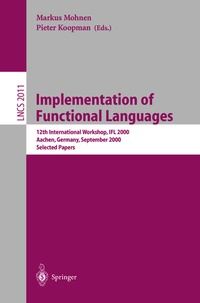
Implementation of Functional Languages
12th International Workshop, IFL 2000 Aachen, Germany, September 4-7, 2000. Selected Papers
Published on 18. April 2001
Book
Paperback/Softback
VIII, 272 pages
978-3-540-41919-8 (ISBN)
Description
The International Workshops on Implementation of Functional Languages (IFL) are a tradition that has lasted for over a decade. The aim of these workshops is to bring together researchers to discuss new results and new directions of research related primarily but not exclusively to the implementation of fu- tional or function-based languages. A not necessarily exhaustive list of topics includes: language concepts, type checking, compilation techniques, (abstract) interpretation, automatic program generation, (abstract) machine architectures, arrayprocessing,concurrent/parallelprogrammingandprogramexecution,heap management, runtime pro?ling and performance measurements, debugging and tracing, tools and programming techniques. IFL 2000 was held at Schloss Rahe, an 18th century castle in Aachen, G- many, during the ?rst week of September 2000. It attracted 49 researchers from the international functional language community, presenting 33 contributions during the four days of the workshop. The contributions covered all topics m- tioned above.
In addition, a special session organised by Thomas Arts from the Ericsson Computer Science Laboratory in Stockholm, Sweden, attracted several prac- tioners from industry who reported on their experiences using the functional language Erlang. The Erlang session was sponsored by Ericsson Computer S- ence Laboratory. This year, the workshop was sponsored by local industry (Ericsson Eurolab DeutschlandGmbHanddebisSystemhausAachen),whichindicatesthegrowing importanceoffunctionallanguageconceptsincommercialspheres.Wethankour sponsors for their generous contributions.
In addition, a special session organised by Thomas Arts from the Ericsson Computer Science Laboratory in Stockholm, Sweden, attracted several prac- tioners from industry who reported on their experiences using the functional language Erlang. The Erlang session was sponsored by Ericsson Computer S- ence Laboratory. This year, the workshop was sponsored by local industry (Ericsson Eurolab DeutschlandGmbHanddebisSystemhausAachen),whichindicatesthegrowing importanceoffunctionallanguageconceptsincommercialspheres.Wethankour sponsors for their generous contributions.
More details
Series
Edition
2001 ed.
Language
English
Place of publication
Berlin
Germany
Publishing group
Springer Berlin
Target group
Professional and scholarly
Research
Illustrations
VIII, 272 p.
Dimensions
Height: 235 mm
Width: 155 mm
Thickness: 16 mm
Weight
429 gr
ISBN-13
978-3-540-41919-8 (9783540419198)
DOI
10.1007/3-540-45361-X
Schweitzer Classification
Other editions
Additional editions
Markus Mohnen | Pieter Koopman
Implementation of Functional Languages
12th International Workshop, IFL 2000 Aachen, Germany, September 4-7, 2000. Selected Papers
E-Book
06/2003
Springer
€53.49
Available for download
Content
Non-determinism Analysis in a Parallel-Functional Language.- Exploiting Implicit Parallelism in Functional Programs with SLAM.- Verifying Generic Erlang Client-Server Implementations.- The Design and Implementation of Glasgow Distributed Haskell.- Implementation Skeletons in Eden: Low-Effort Parallel Programming.- ObjectCurry:An Object-Oriented Extension of the Declarative Multi-Paradigm Language Curry.- Distributed Programming in Haskell with Ports.- The Dynamic Properties of Hume: A Functionally-Based Concurrent Language with Bounded Time and Space Behaviour.- A Usage Analysis with Bounded Usage Polymorphism and Subtyping.- Polygonizing Implicit Surfaces in a Purely Functional Way.- Freja, Hat and Hood - A Comparative Evaluation of Three Systems for Tracing and Debugging Lazy Functional Programs.- Porting the Clean Object I/O Library to Haskell.- Organizing Speculative Computations in Functional Systems.- Improving Cache Effectiveness through Array Data Layout Manipulation in SAC.- The Collective Semantics in Functional SPMD Programming.