

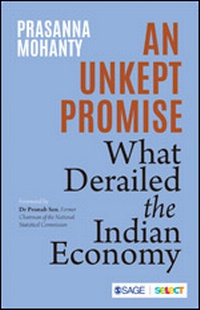
An Unkept Promise
What Derailed the Indian Economy
1st Edition
Published on 21. December 2021
Book
Paperback/Softback
328 pages
978-93-5479-186-4 (ISBN)
Description
The COVID-19 pandemic hit the Indian economy that was already reeling under the shocks of demonetization and GST. The economy wasn't robust to withstand a fresh shock. Has the 'Tyrst with Destiny at Midnight' soured?
An Unkept Promise: What Derailed the Indian Economy looks at some of the pre-pandemic economic decisions and the string of reforms implemented during the pandemic crisis such as new farm laws, new labour codes, decisions to privatize profitable public sector units and de-nationalize banks, and the proposed move to allow corporations to run banks. With hard evidence and data, the book tries to diagnose what has gone wrong and why? It also examines the role of key democratic institutions of checks and balances in policymaking such as Parliament, Niti Aayog, Supreme Court, media and citizenry. As cronyism grows and stock market booms, millions have lost their jobs and incomes, the book warns against neo-liberal economic thinking and suggests corrective measures to get the economy back on track.
An Unkept Promise: What Derailed the Indian Economy looks at some of the pre-pandemic economic decisions and the string of reforms implemented during the pandemic crisis such as new farm laws, new labour codes, decisions to privatize profitable public sector units and de-nationalize banks, and the proposed move to allow corporations to run banks. With hard evidence and data, the book tries to diagnose what has gone wrong and why? It also examines the role of key democratic institutions of checks and balances in policymaking such as Parliament, Niti Aayog, Supreme Court, media and citizenry. As cronyism grows and stock market booms, millions have lost their jobs and incomes, the book warns against neo-liberal economic thinking and suggests corrective measures to get the economy back on track.
Reviews / Votes
The book provides an excellent and comprehensive review of the economic landscape of India since 2014. It describes the symptoms of the economic malaise in detail, with evidence instead of rhetoric, and then provides an incisive analysis of the factors that contributed to it. This includes general systemic factors such as over-centralization of policymaking, arbitrary changes in the statistical system, specific policies, such as demonetization, GST reform and protectionism, as well as dealing with the pandemic. From symptoms to diagnostics to prescription, the book takes a clinical look at the state of the economy and the way forward. -- Maitreesh Ghatak * Professor of Economics, London School of Economics * India is at an inflexion point. From 1991 to 2015, India was seen as an emerging economy and a rising power. The economic slowdown since 2016, made worse by the COVID-19 pandemic, recent political and social trends and an increasingly adverse external environment, has brought into question this narrative. Prasanna Mohanty's detailed analysis of recent economic developments and policies reinforces these concerns about India's economic prospects. This book deserves a wide readership. -- Sanjaya Baru * Political Commentator, Policy Analyst and Writer * Prasanna Mohanty's book provides a timely and detailed x-ray into the path taken by the Indian economy in the last decade. It lays out what's gone wrong and what needs to be done by the way of course correction. In this turbulent period, the policy prescriptions underlined in this book offer a well-researched alternative view to getting the Indian economy back on a high growth trajectory. -- Rajdeep Sardesai * Political Analyst, Journalist and Author * Prasanna Mohanty tracks the Indian economic and political policy changes between 2014 and mid-2021, as well as the effects of those on the socio-economic structure of the country in this excellently researched book. He backs his arguments and assertions with data at each and every step. This is an excellent book for any reader interested in the Indian economy. -- Prosenjit Datta * former Editor, Business Today and Businessworld * This is a well-argued book with lots of supporting data. It dispassionately analyses the current crisis and traces its roots in economic and political developments in the last three decades. It points to the shortcomings of the official data and presents an alternative picture. It takes into account the exogenous factors and highlights institutional failures and points to their long-term impact. All in all, an eminently readable tome. -- Arun Kumar * Malcolm Adiseshiah Chair Professor, Institute of Social Sciences and Retd Professor of Economics, JNU * Prasanna Mohanty's book is grounded in a series of 70 exceptionally researched articles he wrote for Business Today.In on how to fire up the Indian economy after the prolonged downturn got accentuated by the unexpected intensity of Covid I & II. His eye for detail and the unique ability to deliver sound economic arguments via data are capabilities that make this book very special. In the annals of economic history, I hope that this book will be remembered for its plentiful solutions to the problems plaguing the economy. -- Rajeev Dubey * Editor in Chief, Fortune India; former Editor of Business Today * With over a decade of experience covering the Indian economy, Prasanna brings out different processes and facets of reforms in India, especially in the last decade, in this book and argues strongly, without rhetoric, why some of those reforms have not worked well...what led to severe slowdown in recent times. While Prasanna's conclusions appear to be implausible in some places, there is no doubt that they are clearly based on data and empirics. In a way, Prasanna's book tries to provide an alternative explanation to the ongoing reforms push, which, some say, is imposed without much evidence, while others argue that it is through conviction. -- Professor N. R. Bhanumurthy * first Vice Chancellor of Bengaluru Dr B. R. Ambedkar School of Economics University (BASE University), a state university of Karnataka * This is a data-backed economic analysis of the Modi government's performance. Data reveal the truth and conceal little. Prasanna Mohanty has carefully collated data from trustworthy sources and laid the record bare. It's rich with data, and everything you want to know about what happened in India is here. It should be on the bookshelf of every policy analyst. The Modi record is bared, and its claims are dared. -- Mohan Guruswamy * Economist and Policy Analyst *More details
Language
English
Place of publication
New Delhi
India
Target group
College/higher education
Professional and scholarly
Dimensions
Height: 216 mm
Width: 140 mm
Weight
413 gr
ISBN-13
978-93-5479-186-4 (9789354791864)
Copyright in bibliographic data and cover images is held by Nielsen Book Services Limited or by the publishers or by their respective licensors: all rights reserved.
Schweitzer Classification
Person
Prasanna Mohanty is a journalist and researcher with three decades of professional experience. Most recently, he was working as Editor, Policy, with India Today Group until June 2021. He writes on public policy, politics and governance. His area of work includes economics, social, socio-economic development, law and justice and environmental governance. His articles have been carried in the group's various platforms, India Today, Business Today, DailyO and Aaajtak.
Prior to this he worked with Delhi-based think tank Thought Arbitrage Research Institute (2014-2018) as Principal Consultant where his work involved macroeconomics, corporate governance and sustainability.
Earlier he was Deputy Editor with Governance Now (2009-2013), a specialized fortnightly magazine on public policies and governance, in which wrote on public policies covering a wide range of area, including national security, tribal rights, rural development and environmental governance. He has worked with several national dailies and digital platform before that: The Statesman (1991-2000), Deccan Herald (2000-2001), TheNewsPaperToday of India Today Group (2002-03), Delhi Mid-Day (2003-05), IBN7 (2005-09) and News9 (2009). He was awarded for excellence in human development reporting in 1999.
He is a contributing author of "Handbook for Independent Directors" (LexisNexis, 2015, 2016), research contributor to "CSR in India: Steering Business Towards Social Change" (LexisNexis, 2017) and co-authored a chapter in OUP's "Corporate Governance in India: Change and Continuity" (2016).
His articles have been published in several international publications like India Climate Dialogue, Village Square and Asia Times. His opinion pieces have been published in national media platforms like The Hindu Businessline, First Post, Financial Express, Mint, The Wire and others.
Prasanna did his B.Sc. (Hons) in Chemistry and has master's degree in Journalism.
He is an avid photographer and wildlife enthusiast. Lately, he has taken into birding and bird photography. He likes to travel, meet people and learn their lifestyle.
Prior to this he worked with Delhi-based think tank Thought Arbitrage Research Institute (2014-2018) as Principal Consultant where his work involved macroeconomics, corporate governance and sustainability.
Earlier he was Deputy Editor with Governance Now (2009-2013), a specialized fortnightly magazine on public policies and governance, in which wrote on public policies covering a wide range of area, including national security, tribal rights, rural development and environmental governance. He has worked with several national dailies and digital platform before that: The Statesman (1991-2000), Deccan Herald (2000-2001), TheNewsPaperToday of India Today Group (2002-03), Delhi Mid-Day (2003-05), IBN7 (2005-09) and News9 (2009). He was awarded for excellence in human development reporting in 1999.
He is a contributing author of "Handbook for Independent Directors" (LexisNexis, 2015, 2016), research contributor to "CSR in India: Steering Business Towards Social Change" (LexisNexis, 2017) and co-authored a chapter in OUP's "Corporate Governance in India: Change and Continuity" (2016).
His articles have been published in several international publications like India Climate Dialogue, Village Square and Asia Times. His opinion pieces have been published in national media platforms like The Hindu Businessline, First Post, Financial Express, Mint, The Wire and others.
Prasanna did his B.Sc. (Hons) in Chemistry and has master's degree in Journalism.
He is an avid photographer and wildlife enthusiast. Lately, he has taken into birding and bird photography. He likes to travel, meet people and learn their lifestyle.
Content
Foreword by Pronab Sen
Acknowledgements
Introduction
Institutional Vacuum
Masking the Reality
Demonetization: First Direct Shock to Economy and People
GST and Other Taxes: Second Shock and Setbacks
The Pandemic Catastrophe
AatmaNirbhar Bharat: Turning the Clock Black
New Farm Laws: Opening Farming to Corporate Sector
New Labour Codes: Weakening Workers, Empowering Employers
Banking 'Reforms': Risks to Finance
Privatization: Public Assets, Private Profits
Neoliberal Economics Masquerade
Reimagining Indian Economy
State of Economy and Future Growth
Acknowledgements
Introduction
Institutional Vacuum
Masking the Reality
Demonetization: First Direct Shock to Economy and People
GST and Other Taxes: Second Shock and Setbacks
The Pandemic Catastrophe
AatmaNirbhar Bharat: Turning the Clock Black
New Farm Laws: Opening Farming to Corporate Sector
New Labour Codes: Weakening Workers, Empowering Employers
Banking 'Reforms': Risks to Finance
Privatization: Public Assets, Private Profits
Neoliberal Economics Masquerade
Reimagining Indian Economy
State of Economy and Future Growth