

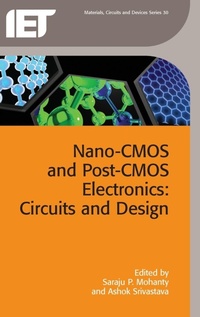
Nano-CMOS and Post-CMOS Electronics: Volume 2
Circuits and design
Published on 28. April 2016
Book
Hardback
448 pages
978-1-84919-999-5 (ISBN)
Description
The demand for ever smaller and portable electronic devices has driven metal oxide semiconductor-based (CMOS) technology to its physical limit with the smallest possible feature sizes. This presents various size-related problems such as high power leakage, low-reliability, and thermal effects, and is a limit on further miniaturization. To enable even smaller electronics, various nanodevices including carbon nanotube transistors, graphene transistors, tunnel transistors and memristors (collectively called post-CMOS devices) are emerging that could replace the traditional and ubiquitous silicon transistor. This book explores these nanoelectronics at the circuit and systems levels including modelling and design approaches and issues.
Topics covered include self-healing analog and radio frequency circuits; on-chip gate delay variability measurement in scaled technology node; nanoscale finFET devices for PVT aware SRAM; data stability and write ability enhancement techniques for finFET SRAM circuits; low-leakage techniques for nanoscale CMOS circuits; thermal effects in carbon nanotube VLSI interconnects; lumped electro-thermal modeling and analysis of carbon nanotube interconnects; high-level synthesis of digital integrated circuits in the nanoscale mobile electronics era; SPICEless RTL design optimization of nanoelectronic digital integrated circuits; green on-chip inductors for three-dimensional integrated circuits; 3D network-on-chips; and DNA computing.
This book is essential reading for researchers, research-focused industry designers/developers, and advanced students working on next-generation electronic devices and circuits.
Topics covered include self-healing analog and radio frequency circuits; on-chip gate delay variability measurement in scaled technology node; nanoscale finFET devices for PVT aware SRAM; data stability and write ability enhancement techniques for finFET SRAM circuits; low-leakage techniques for nanoscale CMOS circuits; thermal effects in carbon nanotube VLSI interconnects; lumped electro-thermal modeling and analysis of carbon nanotube interconnects; high-level synthesis of digital integrated circuits in the nanoscale mobile electronics era; SPICEless RTL design optimization of nanoelectronic digital integrated circuits; green on-chip inductors for three-dimensional integrated circuits; 3D network-on-chips; and DNA computing.
This book is essential reading for researchers, research-focused industry designers/developers, and advanced students working on next-generation electronic devices and circuits.
More details
Series
Language
English
Place of publication
Stevenage
United Kingdom
Target group
College/higher education
Professional and scholarly
Product notice
sewn/stitched
Cloth over boards
Dimensions
Height: 239 mm
Width: 163 mm
Thickness: 28 mm
Weight
771 gr
ISBN-13
978-1-84919-999-5 (9781849199995)
Copyright in bibliographic data and cover images is held by Nielsen Book Services Limited or by the publishers or by their respective licensors: all rights reserved.
Schweitzer Classification
Persons
Saraju Mohanty is Professor at the Department of Computer Science and Engineering, University of North Texas, where he is the director of NanoSystem Design Laboratory (NSDL). His research interests focus on Energy-Efficient High-Performance Secure Electronic Systems. He is the author of more than 200 peer-reviewed journal and conference publications and 3 books. Prof. Mohanty is the current Chair of Technical Committee on Very Large Scale Integration (TCVLSI) of the IEEE Computer Society, is on the editorial board of IET Circuits, Devices and Systems, Integration and Journal of Low Power Electronics, and serves on the organizing and program committee of several international conferences.
Ashok Srivastava is Professor of Engineering at the Division of Electrical & Computer Engineering of Louisiana State University, Baton Rouge, where his research interests lie in low-power VLSI design and testability for nanoscale transistors and integration, and nanoelectronics with focus on novel emerging devices and integrated circuit design based on carbon nanotubes, graphene and other reduced dimension 2D materials. He is the author of more than 160 technical papers including conference proceedings, book chapters, a patent and a book on Carbon Based Electronics. Prof. Srivastava serves on the Editorial Review Board of Modeling and Numerical Simulation of Material Science (MNSMS), Journal of Material Science and Chemical Engineering (JMSCE), The Scientific World Journal (Electronics) and is Editor-in-Chief of the Journal of Sensor Technology.
Ashok Srivastava is Professor of Engineering at the Division of Electrical & Computer Engineering of Louisiana State University, Baton Rouge, where his research interests lie in low-power VLSI design and testability for nanoscale transistors and integration, and nanoelectronics with focus on novel emerging devices and integrated circuit design based on carbon nanotubes, graphene and other reduced dimension 2D materials. He is the author of more than 160 technical papers including conference proceedings, book chapters, a patent and a book on Carbon Based Electronics. Prof. Srivastava serves on the Editorial Review Board of Modeling and Numerical Simulation of Material Science (MNSMS), Journal of Material Science and Chemical Engineering (JMSCE), The Scientific World Journal (Electronics) and is Editor-in-Chief of the Journal of Sensor Technology.
Content
Chapter 1: Self-healing analog/RF circuits
Chapter 2: On-chip gate delay variability measurement in scaled technology node
Chapter 3: Nanoscale FinFET devices for PVT-aware SRAM
Chapter 4: Data stability and write ability enhancement techniques for FinFET SRAM circuits
Chapter 5: Low-leakage techniques for nanoscale CMOS circuits
Chapter 6: Thermal effects in carbon nanotube VLSI interconnects
Chapter 7: Lumped electro-thermal modeling and analysis of carbon nanotube interconnects
Chapter 8: High-level synthesis of digital integrated circuits in the nanoscale mobile electronics era
Chapter 9: SPICEless RTL design optimization of nanoelectronic digital integrated circuits
Chapter 10: Green on-chip inductors for three-dimensional integrated circuits: concepts, algorithms and applications
Chapter 11: 3D NoC: a promising alternative for tomorrow's nanosystem design
Chapter 12: A new paradigm towards performance centric computation beyond CMOS: DNA computing
Chapter 2: On-chip gate delay variability measurement in scaled technology node
Chapter 3: Nanoscale FinFET devices for PVT-aware SRAM
Chapter 4: Data stability and write ability enhancement techniques for FinFET SRAM circuits
Chapter 5: Low-leakage techniques for nanoscale CMOS circuits
Chapter 6: Thermal effects in carbon nanotube VLSI interconnects
Chapter 7: Lumped electro-thermal modeling and analysis of carbon nanotube interconnects
Chapter 8: High-level synthesis of digital integrated circuits in the nanoscale mobile electronics era
Chapter 9: SPICEless RTL design optimization of nanoelectronic digital integrated circuits
Chapter 10: Green on-chip inductors for three-dimensional integrated circuits: concepts, algorithms and applications
Chapter 11: 3D NoC: a promising alternative for tomorrow's nanosystem design
Chapter 12: A new paradigm towards performance centric computation beyond CMOS: DNA computing