

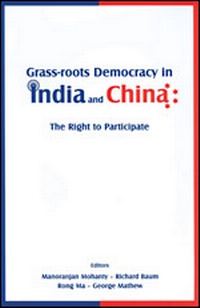
Grass-Roots Democracy in India and China
The Right To Participate
1st Edition
Published on 11. January 2007
Book
Hardback
500 pages
978-0-7619-3515-5 (ISBN)
Description
Both India and China have experienced economic changes and growing social consciousness which have generated new challenges for local institutions. This volume closely studies the resultant grass-roots political experiences in these countries from an interdisciplinary perspective. It examines the process of democratisation and highlights the growing demands for participation and the complex power structures interjecting them.
The contributors to this volume discuss issues relating to institutional structures and the dynamics of local governance in a changing socio-economic environment that panchayati raj in India and village committee system in China represent. In addition to the political economy of rural areas, they also focus on the role of gender, caste, class, ethnicity and religion in local political processes.
The contributors to this volume discuss issues relating to institutional structures and the dynamics of local governance in a changing socio-economic environment that panchayati raj in India and village committee system in China represent. In addition to the political economy of rural areas, they also focus on the role of gender, caste, class, ethnicity and religion in local political processes.
Reviews / Votes
This volume is the product of a collaborative research effort by scholars from India, China and the US analysing the experience of grass-roots political processes in India and China in a comparative perspective in the context of theoretical debates relating to participatory democracy. -- Social Change This book is successful to a great extent in examining and evaluating the process of democratiation and highlighting the growing demands for participations and complex power structures. -- Development Alternatives This volume closely studies the resultant grass-roots political experiences in these countries from an interdisciplinary perspective. -- www.hindustantimes.comMore details
Edition
First Edition
Language
English
Place of publication
Thousand Oaks
United States
Target group
College/higher education
Professional and scholarly
Dimensions
Height: 216 mm
Width: 140 mm
Weight
655 gr
ISBN-13
978-0-7619-3515-5 (9780761935155)
Copyright in bibliographic data and cover images is held by Nielsen Book Services Limited or by the publishers or by their respective licensors: all rights reserved.
Schweitzer Classification
Persons
Manoranjan Mohanty is a renowned political scientist and China scholar whose writings have focused on theoretical and empirical dimensions of social movements, human rights, the development experience and the regional role of India and China. As Vice-President of the Council for Social Development (CSD) and Editor of CSD's social science journal Social Change, published by SAGE, he brings a wealth of experience from both policy and practice perspectives. He is also Chairperson, Development Research Institute, Bhubaneswar, and Honorary Fellow, Institute of Chinese Studies (ICS), Delhi. Until 2004, he was Director, Developing Countries Research Centre, and Professor of Political Science at University of Delhi where he taught until his retirement. Former Chairperson and Director of ICS and former Editor of China Report, he has been on visiting assignments in several universities and research institutes in India and abroad including University of California, Berkeley; Institute of Far Eastern Studies, Moscow, Oxford, Beijing, Copenhagen, Lagos; University of California, Santa Barbara; and the New School, New York. Professor Mohanty has been a part of the founding and evolution of ICS, the Developing Countries Research Centre at University of Delhi and Gabeshana Chakra and Development Research Institute in Odisha. He has also been closely involved with the People's Union for Democratic Rights, Delhi, and the Pakistan-India People's Forum for Democracy since their inception. He was part of the founding process of the Boao Forum for Asia in China and REGGEN, the Third-World sustainable development network in Brazil. His other contributions include 'China's Reforms: The Wuxi Story' in China after 1978: Craters in the Moon (2010), Ideology Matters: China from Mao Zedong to Xi Jinping (2014), 'Political Discourse on Public Sector Reforms in India and China' in Public Sector Reforms in China (2014) and 'India, China and the Emerging Process of Building a Just World' in Building a Just World: Essays in Honour of Muchkund Dubey (2015).
Contact Prof Manoranjan Mohanty at:
University of Delhi and Council for Social Development, Delhi
Email: mm@csdindia.org; mmohantydu@gmail.com George Mathew is Director, Institute of Social Sciences, New Delhi. The founder of the Institute of Social Sciences, he has been on the forefront of research on and promotion of democratic decentralisation in India and has taken a leading role in the international forum on federalism. His major publications include Panchayati Raj: From Legislation to Movement (1994, 2002), Communal Road to a Secular Kerala (1990) and Panchayati Raj in Jammu and Kashmir (edited, 1990). He has also produced an award-winning feature film, Swaraj: The Little Republic (2002).
Richard Baum is Professor of Political Science, University of California at Los Angeles. He was also the director of the UCLA Center for Chinese Studies (1999-2005). A student of Chinese politics and foreign policy, he has written and edited eight books, including Burying Mao: Chinese Politics in the Age of Deng Xiaoping (1996) and Reform and Reaction in Post-Mao China: The Road to Tiananmen (1990).
Rong Ma is Professor and Chair, Department of Sociology and Director, Institute of Sociology and Anthropology, University of Beijing. He is a scholar of ethnic relations, migration, urbanisation, education and rural development. Besides having published a number of articles in various journals, he has authored Introduction to Sociology of Ethnicity (2005) in Chinese, Population and Society in Tibet (1996) and co-edited On Development of China's Frontier Regions (1993).
Contact Prof Manoranjan Mohanty at:
University of Delhi and Council for Social Development, Delhi
Email: mm@csdindia.org; mmohantydu@gmail.com George Mathew is Director, Institute of Social Sciences, New Delhi. The founder of the Institute of Social Sciences, he has been on the forefront of research on and promotion of democratic decentralisation in India and has taken a leading role in the international forum on federalism. His major publications include Panchayati Raj: From Legislation to Movement (1994, 2002), Communal Road to a Secular Kerala (1990) and Panchayati Raj in Jammu and Kashmir (edited, 1990). He has also produced an award-winning feature film, Swaraj: The Little Republic (2002).
Richard Baum is Professor of Political Science, University of California at Los Angeles. He was also the director of the UCLA Center for Chinese Studies (1999-2005). A student of Chinese politics and foreign policy, he has written and edited eight books, including Burying Mao: Chinese Politics in the Age of Deng Xiaoping (1996) and Reform and Reaction in Post-Mao China: The Road to Tiananmen (1990).
Rong Ma is Professor and Chair, Department of Sociology and Director, Institute of Sociology and Anthropology, University of Beijing. He is a scholar of ethnic relations, migration, urbanisation, education and rural development. Besides having published a number of articles in various journals, he has authored Introduction to Sociology of Ethnicity (2005) in Chinese, Population and Society in Tibet (1996) and co-edited On Development of China's Frontier Regions (1993).
Content
Preface
Introduction: Local Governance, Local Democracy and the Right to Participate - Manoranjan Mohanty
PART I: INSTITUTIONAL STRUCTURE AND LOCAL PARTICIPATION
Local Government System in India and China: Learning from Each Other - George Mathew
Dependency versus Autonomy: The Identity Crisis of India's Panchayats - D. Bandyopadhyay, Saila K Ghosh and Buddhadeb Ghosh
Rural Political Participation in the Maoist and Post-Mao Periods - Xiaohong Zhou
Selecting Within the Rules: Institutional Innovation in China's Governance - Tony Saich and Xuedong Yang
'Civil Society' Revisited: The Anatomy of a Rural NGO in Qinghai - Richard Baum and Xin Zhang
Changes in Local Administration and their Impact on Community Life in the Grasslands of Inner Mongolia
Village Panchayats in Maharashtra - Rajendra Vora
Kerala's People's Plan Campaign 1996-2001: A Critical Assessment - T. M. Thomas Isaac
Panchayati Raj System in Karnataka: Trends and Issues - B.S. Bhargava and K. Subha
PART II: LOCAL GOVERNANCE AND THE EMERGING SOCIO-ECONOMIC ISSUES
Imperfect Substitutes: The Local Political Economy of Informal Finance and Microfinance in Rural China and India - Kellee S. Tsai
Stratification and Institutional Exclusion in China and India: Administrative Means versus Social Barriers - Fei-Ling Wang
Women and Local Power in India and China - Bidyut Mohanty
Gender, Work and Power in an Andhra Village - M. Vanamala
Democracy, Good Governance and Economic Development in Rural China - David Zweig and Chung Siu Fung
Grass-roots Democracy: The Working of Panchayati Raj Institutions in Andhra Pradesh - G.Haragopal and G. Sudarshanam
The Environment, the Family and Local Government among the Tajik People - Shengmin Yang
The Evolution and Function of the Kaxie System of the Lahu People in South-west China - Shaoying He
Social Change and the Development of Democracy in Local Governance in Tibet - Tanzen Lhundup
The Party, the Village Committee and the Monastery: Functions and Interactions of Three Institutions at the Grass Roots. - Changjiang Yu
COMPARATIVE REFLECTIONS
Reconceptualising Local Democracy: Reflections on Democracy, Power and Resistance in the Indian and Chinese Countryside - Manoranjan Mohanty and Mark Selden
Index
Introduction: Local Governance, Local Democracy and the Right to Participate - Manoranjan Mohanty
PART I: INSTITUTIONAL STRUCTURE AND LOCAL PARTICIPATION
Local Government System in India and China: Learning from Each Other - George Mathew
Dependency versus Autonomy: The Identity Crisis of India's Panchayats - D. Bandyopadhyay, Saila K Ghosh and Buddhadeb Ghosh
Rural Political Participation in the Maoist and Post-Mao Periods - Xiaohong Zhou
Selecting Within the Rules: Institutional Innovation in China's Governance - Tony Saich and Xuedong Yang
'Civil Society' Revisited: The Anatomy of a Rural NGO in Qinghai - Richard Baum and Xin Zhang
Changes in Local Administration and their Impact on Community Life in the Grasslands of Inner Mongolia
Village Panchayats in Maharashtra - Rajendra Vora
Kerala's People's Plan Campaign 1996-2001: A Critical Assessment - T. M. Thomas Isaac
Panchayati Raj System in Karnataka: Trends and Issues - B.S. Bhargava and K. Subha
PART II: LOCAL GOVERNANCE AND THE EMERGING SOCIO-ECONOMIC ISSUES
Imperfect Substitutes: The Local Political Economy of Informal Finance and Microfinance in Rural China and India - Kellee S. Tsai
Stratification and Institutional Exclusion in China and India: Administrative Means versus Social Barriers - Fei-Ling Wang
Women and Local Power in India and China - Bidyut Mohanty
Gender, Work and Power in an Andhra Village - M. Vanamala
Democracy, Good Governance and Economic Development in Rural China - David Zweig and Chung Siu Fung
Grass-roots Democracy: The Working of Panchayati Raj Institutions in Andhra Pradesh - G.Haragopal and G. Sudarshanam
The Environment, the Family and Local Government among the Tajik People - Shengmin Yang
The Evolution and Function of the Kaxie System of the Lahu People in South-west China - Shaoying He
Social Change and the Development of Democracy in Local Governance in Tibet - Tanzen Lhundup
The Party, the Village Committee and the Monastery: Functions and Interactions of Three Institutions at the Grass Roots. - Changjiang Yu
COMPARATIVE REFLECTIONS
Reconceptualising Local Democracy: Reflections on Democracy, Power and Resistance in the Indian and Chinese Countryside - Manoranjan Mohanty and Mark Selden
Index