

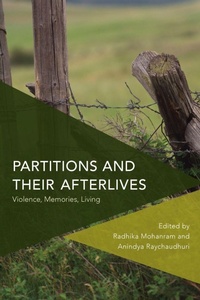
Partitions and Their Afterlives
Violence, Memories, Living
Published on 28. June 2019
Book
Paperback/Softback
272 pages
978-1-78348-839-1 (ISBN)
Description
How can we theorise partitions differently? How are new identities, moralities, polities and life constructed post-partition? How are gender and sexuality recalibrated after partition? How can violence be theorised? What is the relationship between identity in the diaspora and identity after partition? What is the relationship between the movement of capital and national borders that is the mark of partition?
Partitions and their Afterlives engages with political partitions and how their aftermath affects the contemporary life of nations and their citizens. Using a comparative perspective, the essays seek to stretch our understanding of these conflicts and to show how elements of our day-to-day lives have been shaped by them. In juxtaposing the various partitions in a single volume the book contributes to debates on citizenship, collective memory, nation-building, and borders and boundaries. Such a focus also reveals how local communities as well as nations use their knowledge of the past and history. This ground-breaking multi-disciplinary and multi-region volume will analyse the various convergences and departures between the different partitions and draw out lessons for the present. In so doing, this work will also examine methodological challenges and the imperatives for scholars working on individual countries.
Partitions and their Afterlives engages with political partitions and how their aftermath affects the contemporary life of nations and their citizens. Using a comparative perspective, the essays seek to stretch our understanding of these conflicts and to show how elements of our day-to-day lives have been shaped by them. In juxtaposing the various partitions in a single volume the book contributes to debates on citizenship, collective memory, nation-building, and borders and boundaries. Such a focus also reveals how local communities as well as nations use their knowledge of the past and history. This ground-breaking multi-disciplinary and multi-region volume will analyse the various convergences and departures between the different partitions and draw out lessons for the present. In so doing, this work will also examine methodological challenges and the imperatives for scholars working on individual countries.
Reviews / Votes
This book could not be more timely, given the hysteria with which national borders are being increasingly 'protected'. The essays demonstrate that partitions are not erected to keep violent communities away from each other, nor are they simply historically erected border walls, but are the result of ongoing political processes whose consequences spread wide and deep in contemporary communities. These analyses of partitions are both comprehensive and astute and throw a great deal of light upon the bordering practices operating in the world today. -- Bill Ashcroft, University of New South Wales This ambitious and timely volume is the first to bring together humanities and social science scholars to collectively address the historical, theoretical, cultural and social legacies of partition, from the era of decolonisation to the present. Ranging from policy to popular fiction, and from advertising to the archive, the collection insists on the need for a truly comparative partition studies, undeterred by geographical or disciplinary limits. -- Anna Bernard, Head of Department of Comparative Literature, King's College London By inducting numerous parallel case studies of partition in the last century, this volume goes beyond the causation, processes and consequences of decolonisation and border demarcations-often done hastily and self-righteously with complete irreverence for people at large. Areas like gender, selective usage by nationalist narratives and commercial concerns, and an ongoing evolution of sundered and imagined communities feature in this collection offering comparative searchlight on varied examples such as Ireland, Germany, Bosnia, Palestine and certainly the Sub-continent. -- Iftikhar Malik, Professor of History, Bath Spa University Thanks to a 'multidirectional' approach, this multi-region edited collection of essays stretches our understanding of how partitions are constructed and how we are intimately shaped by them. It revisits perspectives that have so far been limited to individual nations and entrenched disciplines. Paradoxically, the framework of memory and trauma studies emphasizes even more how partitions are endlessly replayed in our present. A must-read for anyone interested in the contemporary world. -- Judith Misrahi-Barak, Associate Professor, English Department, Paul Valery University of MontpellierMore details
Series
Language
English
Place of publication
United Kingdom
Publishing group
Bloomsbury Publishing PLC
Target group
Professional and scholarly
US School Grade: From College Freshman to College Graduate Student
Dimensions
Height: 229 mm
Width: 152 mm
Thickness: 16 mm
Weight
449 gr
ISBN-13
978-1-78348-839-1 (9781783488391)
Copyright in bibliographic data and cover images is held by Nielsen Book Services Limited or by the publishers or by their respective licensors: all rights reserved.
Schweitzer Classification
Other editions
Additional editions
E-Book
06/2019
1st Edition
Rowman & Littlefield Publishers
€44.99
Available for download
E-Book
06/2019
1st Edition
Rowman & Littlefield Publishers
€44.99
Available for download
Persons
Radhika Mohanram is a Professor at the Centre for Critical and Cultural Theory, Cardiff University, UK.
Anindya Raychaudhuri is a Lecturer in English at the University of St Andrews.
Anindya Raychaudhuri is a Lecturer in English at the University of St Andrews.
Content
Introduction
Radhika Mohanram and Anindya Raychaudhuri
1. The 1947 Partition Violence: Characteristics and Interpretations
Ian Talbot
2. The Socio-Historical Production of Partition in Palestine
Marcelo Svirsky and Ronnen Ben-Arie
3. Sexuality after Partition: The Great Indian Private Sphere
Radhika Mohanram
4. Lessons not Learned from the Yugoslav Dismemberment and their Implications for the European Union
Stefano Bianchini
5. Legacies of Partition: Remembering the German Democratic Republic
Chris Weedon
6. Legacy of Indian partition
Samuel Sequeira
7. Post-partition anxieties and the matter of authenticity in Ireland
Louise Harrington
8. Drawing Partition and Its Violence: Joe Sacco's Palestine and Vishwajyoti Ghosh's This Side, That Side
Vedita Cowaloosur
9. Advertising (Across) Borders: Fetishizing Humanism and the "Magic" of Capitalism
Anindya Raychaudhuri
10. Following a Theory of Partition
Jennifer Yusin
Radhika Mohanram and Anindya Raychaudhuri
1. The 1947 Partition Violence: Characteristics and Interpretations
Ian Talbot
2. The Socio-Historical Production of Partition in Palestine
Marcelo Svirsky and Ronnen Ben-Arie
3. Sexuality after Partition: The Great Indian Private Sphere
Radhika Mohanram
4. Lessons not Learned from the Yugoslav Dismemberment and their Implications for the European Union
Stefano Bianchini
5. Legacies of Partition: Remembering the German Democratic Republic
Chris Weedon
6. Legacy of Indian partition
Samuel Sequeira
7. Post-partition anxieties and the matter of authenticity in Ireland
Louise Harrington
8. Drawing Partition and Its Violence: Joe Sacco's Palestine and Vishwajyoti Ghosh's This Side, That Side
Vedita Cowaloosur
9. Advertising (Across) Borders: Fetishizing Humanism and the "Magic" of Capitalism
Anindya Raychaudhuri
10. Following a Theory of Partition
Jennifer Yusin