

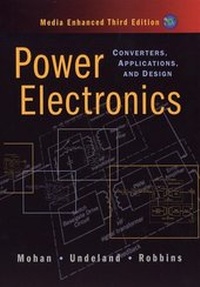
Power Electronics
Converters, Applications, and Design
3rd Edition
Will be published approx. on 8. November 2002
Book
Hardback
XX, 804 pages
978-0-471-22693-2 (ISBN)
Description
Offering step-by-step, in-depth coverage, the new Third Edition of Power Electronics: Converters, Applications, and Design provides a cohesive presentation of power electronics fundamentals for applications and design in the power range of 500 kW or less. The text describes a variety of practical and emerging power electronic converters made feasible by the new generation of power semiconductor devices. The new edition is now enhanced with a new CD-ROM, complete with PSpice-based examples, a new magnetics design program, and PowerPoint slides.
More details
Edition
3. Auflage
Language
English
Place of publication
New York
United States
Target group
College/higher education
Professional and scholarly
Edition type
New edition
Dimensions
Height: 261 mm
Width: 184 mm
Thickness: 32 mm
Weight
1387 gr
ISBN-13
978-0-471-22693-2 (9780471226932)
Schweitzer Classification
Other editions
Previous edition

Ned Mohan | William P. Robbins | Tore M. Undeland
Power Electronics
Converters, Applications and Design, Media Enhanced. International Edition
Book
09/2002
3rd Edition
Wiley
€57.90
Article exhausted; check for reprint
Persons
Ned Mohan is the Oscar A. Schott Professor of Power Electronics at the University of Minnesota, He has numerous patents and publications in this field. He is a Fellow of the IEEE.
Tore M. Undeland is a professor in Power Electronics in the Faculty of Information Technology, Mathematics and Electrical Engineering at the Norwegian University of Science and Technology, NTNU, Trondheim, Norway. He is also a scientific advisor to the SINTEF Energy Research.
William P. Robbins is a professor in the Department of Electrical and Computer Engineering at the University of Minnesota. Prior to joining the University of Minnesota, he was a research engineer at the Boeing Company.
Content
PART 1. INTRODUCTION.
Chapter 1. Power Electronic Systems.
Chapter 2. Overview of Power Semiconductor Switches.
Chapter 3. Review of Basic Electrical and Magnetic Circuit Concepts.
Chapter 4. Computer Simulation of Power Electronic Converters and Systems.
PART 2. GENERIC POWER ELECTRONIC CIRCUITS.
Chapter 5. Line-Frequency Diode Rectifiers: Line-Frequency ac Uncontrolled dc.
Chapter 6. Line-Frequency Phase-Controlled Rectifiers and Inverters: Line-Frequency ac Controlled dc.
Chapter 7. dc-dc Switch-Mode Converters.
Chapter 8. Switch-Mode dc-ac Inverters: dc Sinusoidal ac.
Chapter 9. Resonant Converters: Zero-Voltage and/or Zero-Current Switchings.
PART 3. POWER SUPPLY APPLICATIONS.
Chapter 10. Switching dc Power Supplies.
Chapter 11. Power Conditioners and Uninterruptible Power Supplies.
PART 4. MOTOR DRIVE APPLICATIONS.
Chapter 12. Introduction to Motor Drives.
Chapter 13. dc Motor Drives.
Chapter 14. Induction Motor Drives.
Chapter 15. Synchronous Motor Drives.
PART 5. OTHER APPLICATIONS.
Chapter 16. Residential and Industrial Applications.
Chapter 17. Electric Utility Applications.
Chapter 18. Optimizing the Utility Interface with Power Electronic Systems.
PART 6. SEMICONDUCTOR DEVICES.
Chapter 19. Basic Semiconductor Physics.
Chapter 20. Power Diodes.
Chapter 21. Bipolar Junction Transistors.
Chapter 22. Power MOSFETs.
Chapter 23. Thyristors.
Chapter 24. Gate Turn-Off Thyristors.
Chapter 25. Insulated Gate Bipolar Transistors.
Chapter 26. Emerging Devices and Circuits.
PART 7. PRACTICAL CONVERTER DESIGN CONSIDERATIONS.
Chapter 27. Snubber Circuits.
Chapter 28. Gate and Base Drive Circuits.
Chapter 29. Component Temperature Control and Heat Sinks.
Chapter 30. Design of Magnetic Components.
Index.