

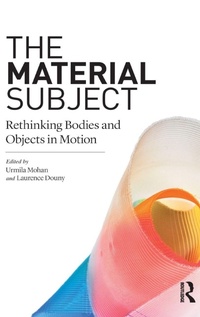
The Material Subject
Rethinking Bodies and Objects in Motion
1st Edition
Published on 2. November 2020
Book
Hardback
224 pages
978-1-350-07736-2 (ISBN)
Description
The Material Subject emphasises how bodily and material cultures combine to make and transform subjects dynamically. The book is based on the French Matiere a Penser (MaP) school of thought, which draws upon the ideas of Mauss, Schilder, Foucault and Bourdieu, among others, to enhance the anthropological study of embodiment, practices, techniques, materiality and power.
Through theoretical sophistication and empirical field research, case studies from Europe, Africa and Asia bring MaP's ideas into dialogue with other strands of material culture studies in the English-speaking world. These studies mediate different scales of engagement through a sensori-motor, affective and cognitive focus on practices of making and doing. Examples range from the precarity of professional divers in French public works to the gendered subjectivity of female carpet weavers in Morocco, from the ways Swiss watchmakers transmit craft knowledge to how Hindu devotees in India make efficacious use of altars, and from the enskilment of Paiwan indigenous people in Taiwan to the prestige of women's wild silk wrappers in Burkina Faso. The chapters are organised according to domains of practice, defined as 'matter of' work and technology, heritage, politics, religion and knowledge.
Scholars and students with an interest in material culture will gain valuable access to global research, rooted in a specific intellectual tradition.
Through theoretical sophistication and empirical field research, case studies from Europe, Africa and Asia bring MaP's ideas into dialogue with other strands of material culture studies in the English-speaking world. These studies mediate different scales of engagement through a sensori-motor, affective and cognitive focus on practices of making and doing. Examples range from the precarity of professional divers in French public works to the gendered subjectivity of female carpet weavers in Morocco, from the ways Swiss watchmakers transmit craft knowledge to how Hindu devotees in India make efficacious use of altars, and from the enskilment of Paiwan indigenous people in Taiwan to the prestige of women's wild silk wrappers in Burkina Faso. The chapters are organised according to domains of practice, defined as 'matter of' work and technology, heritage, politics, religion and knowledge.
Scholars and students with an interest in material culture will gain valuable access to global research, rooted in a specific intellectual tradition.
Reviews / Votes
'This important book brings French and Anglo anthropological traditions of studying the body in practice, material culture and subjectivity into fruitful dialogue with one another. Informed by Mauss, Foucault and seminal ideas of key Matiere a Penser scholars, the editors and contributing authors offer fresh and inspiring perspectives on the ways that bodies and objects 'move together in the material world.'~Trevor Marchand, Emeritus Professor of Social Anthropology, SOAS
'A landmark contribution to the cross-disciplinary study of material culture. The Material Subject delivers a timely and original introduction to the influential French Matiere a Penser School for anglophone readers. Urmila Mohan and Laurence Douny have crafted an essential addition to the bookshelves of every scholar of material culture.'
~Dan Hicks, Professor of Contemporary Archaeology, University of Oxford
'Urmila Mohan and Laurence Douny have assembled a remarkable collection of essays that present to anglophone audiences the important legacy of the work of the Matiere a Penser group, insightfully exploring subjectivation as a material process. This impressive book promises to enrich the study of material culture in a host of fields.'
~David Morgan, Professor of Religious Studies, Duke University
More details
Language
English
Place of publication
London
United Kingdom
Publishing group
Taylor & Francis Ltd
Target group
College/higher education
Illustrations
31 s/w Abbildungen, 30 s/w Photographien bzw. Rasterbilder, 1 s/w Zeichnung
1 Line drawings, black and white; 30 Halftones, black and white; 31 Illustrations, black and white
Dimensions
Height: 240 mm
Width: 161 mm
Thickness: 18 mm
Weight
540 gr
ISBN-13
978-1-350-07736-2 (9781350077362)
Copyright in bibliographic data and cover images is held by Nielsen Book Services Limited or by the publishers or by their respective licensors: all rights reserved.
Schweitzer Classification
Other editions
Additional editions
Book
05/2022
1st Edition
Routledge
€65.60
Shipment within 15-20 days
E-Book
11/2020
1st Edition
Routledge
€73.99
Available for download
E-Book
11/2020
1st Edition
Routledge
€73.99
Available for download
Persons
Urmila Mohan is an anthropologist and curator of material culture and religion who researches textiles, practices and aesthetics in India and Indonesia. She is an Honorary Research Fellow in the Department of Anthropology, University College London, UK.
Laurence Douny specialises in the anthropology and history of materials, techniques and design with a focus on West African wild silks. She is a Research Associate at the cluster 'Matters of Activity. Image Space Materials' at the Humboldt University in Berlin, Germany.
Laurence Douny specialises in the anthropology and history of materials, techniques and design with a focus on West African wild silks. She is a Research Associate at the cluster 'Matters of Activity. Image Space Materials' at the Humboldt University in Berlin, Germany.
Content
Introduction 1.Subjects, their bodies and their objects; Matter of work and technology 2. Making do and wanting: The professional diver's predicament; 3. 'Management' and its refuse; 4. Clothing choices and questioning the incorporation of habitus; Matter of heritage 5. Museum objects in motion: Colonial leftovers and French cultural politics; 6. The material shaping of women's subjectivities: Wild-silk textiles of the Marka-Dafing as a cultural heritage; Matter of politics 7. Politics matters: Matiere a Politique; 8. Chronicles of a moral war: Ascetic subjectivation and formation of the Javanese state; Matter of religion 9. Opening and closing gestures: Weaving rituals that give and sustain life; 10. Devotion on the home altar as 'efficacious intimacy' in a Hindu group; Matter of knowledge 11. Anthropology of knowledge transmission beyond dichotomies: Learning and subjectivation among watchmakers in Switzerland; 12. The enskilled subject: Two paths to becoming a skilled person among the Paiwan indigenous people of Taiwan; 13 Afterword: Matter(s) of material culture