

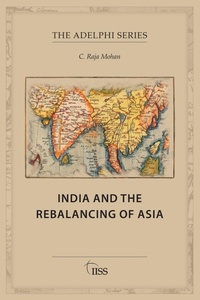
India and the Rebalancing of Asia
1st Edition
Published on 23. September 2025
Book
Paperback/Softback
220 pages
978-1-041-19225-1 (ISBN)
Description
Few regions have transformed as consequentially as Asia in the twenty-first century. In recent decades, China has risen faster than its neighbours and today outranks its major proximate competitors - India and Japan - on economic and defence indices by huge margins. The United States' interest in balancing against China is especially significant for India, because the contradictions between New Delhi and an increasingly assertive Beijing are the sharpest in the region.
In this Adelphi book, C. Raja Mohan delineates the prospects for an Indian role in structuring a new Asian geopolitical order. Grounding his analysis in the (often neglected) evolution of modern Indian foreign and security policies from the colonial era to the twenty-first century, Mohan argues that China's rise has compelled India to discard its traditional ambivalence about Chinese power and counter Beijing by strengthening its own national power and developing partnerships with other states, primarily the US. In addition to considering potential challenges to the emerging US-India strategic relationship, the book evaluates India's likely contributions to a new Asian security, political and economic order in the light of both New Delhi's enduring regional interests and the policy changes envisioned by the second Trump administration.
In this Adelphi book, C. Raja Mohan delineates the prospects for an Indian role in structuring a new Asian geopolitical order. Grounding his analysis in the (often neglected) evolution of modern Indian foreign and security policies from the colonial era to the twenty-first century, Mohan argues that China's rise has compelled India to discard its traditional ambivalence about Chinese power and counter Beijing by strengthening its own national power and developing partnerships with other states, primarily the US. In addition to considering potential challenges to the emerging US-India strategic relationship, the book evaluates India's likely contributions to a new Asian security, political and economic order in the light of both New Delhi's enduring regional interests and the policy changes envisioned by the second Trump administration.
Reviews / Votes
'Raja Mohan's latest work is a carefully crafted analysis of India's role in the emerging geopolitics of Asia. He makes a strong case for India's centrality in this new regional order shaped by China's rapid rise. Mohan explains how India can play its rightful role in Asia, even as it contends with an unpredictable Trump 2.0 administration.'Lisa Curtis, Senior Fellow and Director, Indo-Pacific Security Programme, Center for a New American Security
'How will India help shape the future of Asia and the world? Answers range wildly, from some outsiders' underestimation of India's relevance to an abundance of confidence within parts of the New Delhi establishment. In this significant book, C. Raja Mohan persuasively provides a middle path. He deploys a mastery of geopolitical history to make the case for Indian centrality in the new Indo-Pacific order - as long as New Delhi's decisions remain tempered by realism, in every sense.'
Rory Medcalf, Head of the National Security College, Australia National University and author of Indo-Pacific Empire: China, America and the Contest for the World's Pivotal Region
'Raja Mohan, one of India's foremost thinkers on international relations, offers a clear and timely account of the forces shaping New Delhi's foreign policy and outlook. This book provides a vital guide to the worldview of a rising power and the role of India in an ever-changing Asia.'
Suzannah Jessep, Chief Executive, Asia New Zealand Foundation; former Deputy High Commissioner to India, Sri Lanka, Bangladesh (New Zealand)
'This book provides a compelling account of India's emergence as a strategic balancer in the Indo-Pacific. With historical precision and geopolitical insight, Mohan unpacks India's evolving posture - from ambivalence to assertiveness - as it navigates China's rise and deepens ties with the United States. Essential reading for understanding how India seeks to shape a multipolar Asia while preserving autonomy in a complex strategic environment.'
Ken Jimbo, Professor of International Relations, Keio University; Managing Director of Programs at the International House of Japan (IHJ/I-House); former Special Advisor to the Ministry of Defense and the National Security Secretariat (Japan)
More details
Series
Language
English
Place of publication
London
United Kingdom
Publishing group
Taylor & Francis Ltd
Target group
College/higher education
Professional and scholarly
Postgraduate, Professional Reference, and Undergraduate Advanced
Dimensions
Height: 234 mm
Width: 156 mm
Thickness: 12 mm
Weight
345 gr
ISBN-13
978-1-041-19225-1 (9781041192251)
Copyright in bibliographic data and cover images is held by Nielsen Book Services Limited or by the publishers or by their respective licensors: all rights reserved.
Schweitzer Classification
Other editions
Additional editions
Person
C. Raja Mohan is a Distinguished Professor at the Motwani Jadeja Institute for American Studies, O.P. Jindal Global University, Delhi. He is also a Visiting Research Professor at the Institute of South Asian Studies (ISAS) at the National University of Singapore and was previously the Director of ISAS. Mohan was the founding director of Carnegie India, the sixth international centre of the Carnegie Endowment for International Peace. He also set up the Asia Society Policy Institute branch in New Delhi. He was associated with several Indian think tanks, including the Institute of Defence Studies and Analyses, the Observer Research Foundation and the Centre for Policy Research. Mohan was a Professor of South Asian Studies at Jawaharlal Nehru University in New Delhi and the S. Rajaratnam School of International Studies in Singapore. He served on India's National Security Advisory Board. Mohan was the Henry A. Kissinger Chair in Foreign Policy and International Relations at the John W. Kluge Center at the US Library of Congress in 2009-10. He convened the India chapter of the Pugwash Conferences on Science and World Affairs from 1995 to 2005. Mohan has published widely on India's foreign and security policies, Asian geopolitics and the global governance of advanced technologies. He is the co-author of the IISS Adelphi book, Asia's New Geopolitics: Military Power and Regional Order, published in 2021. He is a columnist for Foreign Policy and the Indian Express.
Content
Contents
Author
Acknowledgements
Map of India and the Indo-Pacific region
Introduction
Chapter One: Great transitions
Introduction
India at the centre
The centre does not hold
Restoring the India centre
Chapter Two: The China challenge
Introduction
Structural divergence
Border dispute
South Asia
Indian Ocean
Multilateral arena
Chapter Three: The US partnership
Introduction
Defence cooperation
Pakistan
The Indo-Pacific
The Quad
Trump 2.0
Chapter Four: Regional dynamics
Introduction
Australia and Japan
Russia
The United Kingdom and Europe
South Asia
Southeast Asia
Asian reset
Chapter Five: India as the balancer
Introduction
Ideological balance
Economic rebalance
Technological rebalance
Military rebalance
Conclusion: In Asia and of Asia
Introduction
Assertive China, disruptive America
The great triangle
Alliances, autonomy and burden-sharing
India's Asian challenges
Appendix
Notes
Index
Author
Acknowledgements
Map of India and the Indo-Pacific region
Introduction
Chapter One: Great transitions
Introduction
India at the centre
The centre does not hold
Restoring the India centre
Chapter Two: The China challenge
Introduction
Structural divergence
Border dispute
South Asia
Indian Ocean
Multilateral arena
Chapter Three: The US partnership
Introduction
Defence cooperation
Pakistan
The Indo-Pacific
The Quad
Trump 2.0
Chapter Four: Regional dynamics
Introduction
Australia and Japan
Russia
The United Kingdom and Europe
South Asia
Southeast Asia
Asian reset
Chapter Five: India as the balancer
Introduction
Ideological balance
Economic rebalance
Technological rebalance
Military rebalance
Conclusion: In Asia and of Asia
Introduction
Assertive China, disruptive America
The great triangle
Alliances, autonomy and burden-sharing
India's Asian challenges
Appendix
Notes
Index