

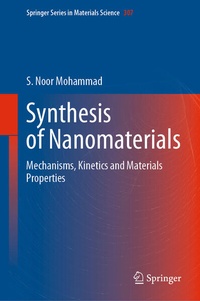
Synthesis of Nanomaterials
Mechanisms, Kinetics and Materials Properties
Published on 28. October 2020
Book
Hardback
XXIII, 446 pages
978-3-030-57584-7 (ISBN)
Description
This book deals with the synthesis of nanomaterials with a strong focus on the underlying reaction kinetics and various synthesis mechanisms. It gives a detailed description of all major synthesis routes of many types of novel nanomaterials including nanowires, carbon nanotubes, semiconductor nanotubes, carbon nanobelts, nanofibers, nanorings, nanodots and quantum dots. In addition, it articulates the fundamental mechanisms of nanomaterials synthesis via vapor-phase, liquid-phase and solid-phase processes, highlighting the various strengths and weaknesses of each mechanism. This monograph provides the reader with a thorough review of the known state-of-the-art, along with a detailed comparison and analysis of all possible nanomaterials synthesis mechanisms. An important element of the book is how to obtain critical knowledge for controlling the morphology of nanomaterials and thereby fine tune their materials properties. The book is an ideal guide for graduate students and researchersnew to the field seeking to establish or enhance their understanding of the physical and chemical fundamentals of nanomaterials synthesis mechanisms.
More details
Series
Edition
2020 ed.
Language
English
Place of publication
Cham
Switzerland
Publishing group
Springer International Publishing
Target group
Professional and scholarly
Illustrations
12 s/w Abbildungen, 105 farbige Abbildungen
XXIII, 446 p. 117 illus., 105 illus. in color.
Dimensions
Height: 241 mm
Width: 160 mm
Thickness: 30 mm
Weight
955 gr
ISBN-13
978-3-030-57584-7 (9783030575847)
DOI
10.1007/978-3-030-57585-4
Schweitzer Classification
Other editions
Additional editions
Book
10/2021
Springer
€149.79
Shipment within 7-9 days
E-Book
10/2020
1st Edition
Springer
€139.09
Available for download
Person
S. Noor Mohammad was born in the village of Paruldihi, West Bengal, India, and graduated from Golgram High School with the highest distinction. He was one of the top 20 graduating students among 1,760,000 students who were examinees at the School Final Examination in the entire West Bengal State Board of Secondary Education, West Bengal, India. He obtained his B.Sc. with Honors in Physics from Midnapore College (University of Calcutta), his M.Sc. in Physics from North Bengal University, Darjeeling, West Bengal, India, his PhD in Physics (Chemical and Solid-State Physics) from the Indian Institute of Technology, Kharagpur, West Bengal, India, and his D.Sc. degree in Physics from the University of Calcutta. Following his D.Sc., he came to the USA in September of 1979, where he carried out extensive postdoctoral research in materials science and engineering at Case Western Reserve University and the University of Illinois at Urbana-Champaign. He had been with the IBM Semiconductor Research and Development Center in New York before moving to Howard University in Washington, DC. He became Professor of Electrical Engineering at Howard University, where he founded externally funded large Nanomaterials Science and Engineering Research Program. He is currently retired and affiliated with a small, self-established non-profit organization, Sciencotech.
Content
Introduction.- Nanomaterials Synthesis Routes.- Catalyst Nanoparticles.- Synthesis and Pre-Synthesis Occurrences.- Vapor-Solid-Liquid (VLS) Growth Mechanism.- Vapor-Solid-Solid (VSS) Growth Mechanism .- Vapor-Solid (VS) Growth Mechanism.- Solution and Supercritical Fluid Based Growth Mechanisms.- Solid-Liquid-Solid (SLS) Growth Mechanism.- Oxide-Assisted Growth (OAG) Mechanism.- Self-Catalytic Growth (SCG) Mechanism.- Vapor-Quasiliquid (Quasisolid)-Solid (VQS) Growth Mechanism.- Catalyst-Mediated VQS Growth Mechanism.- Catalyst-Free VQS Growth Mechanism.- Simple Theoretical Model for VQS Growth Mechanism.- The Universal, Versatile Growth Mechanism.- Conclusions.