

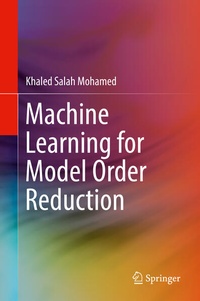
Machine Learning for Model Order Reduction
Published on 9. March 2018
Book
Hardback
XI, 93 pages
978-3-319-75713-1 (ISBN)
Description
This Book discusses machine learning for model order reduction, which can be used in modern VLSI design to predict the behavior of an electronic circuit, via mathematical models that predict behavior. The author describes techniques to reduce significantly the time required for simulations involving large-scale ordinary differential equations, which sometimes take several days or even weeks. This method is called model order reduction (MOR), which reduces the complexity of the original large system and generates a reduced-order model (ROM) to represent the original one. Readers will gain in-depth knowledge of machine learning and model order reduction concepts, the tradeoffs involved with using various algorithms, and how to apply the techniques presented to circuit simulations and numerical analysis.
-
Introduces machine learning algorithms at the architecture level and the algorithm levels of abstraction;
-
Describes new, hybrid solutions for model order reduction;
-
Presents machine learning algorithms in depth, but simply;
-
Uses real, industrial applications to verify algorithms.
More details
Edition
2018 ed.
Language
English
Place of publication
Cham
Switzerland
Publishing group
Springer International Publishing
Target group
Professional and scholarly
Illustrations
XI, 93 p.
Dimensions
Height: 23.5 cm
Width: 15.5 cm
Weight
333 gr
ISBN-13
978-3-319-75713-1 (9783319757131)
DOI
10.1007/978-3-319-75714-8
Schweitzer Classification
Other editions
Additional editions
Khaled Salah Mohamed
Machine Learning for Model Order Reduction
Book
01/2019
Springer
€128.39
Shipment within 7-9 days
Khaled Salah Mohamed
Machine Learning for Model Order Reduction
E-Book
03/2018
1st Edition
Springer
€117.69
Available for download
Person
Khaled Salah Mohamed attended the school of engineering, Department of Electronics and Communications at Ain-Shams University from 1998 to 2003, where he received his B.Sc. degree in Electronics and Communications Engineering with distinction and honors. He received his Masters degree in Electronics from Cairo University, Egypt in 2008. He received his PhD degree in 2012. Dr. Khaled Salah is currently a Technical Lead at the Emulation division at Mentor Graphic, Egypt. Dr. Khaled Salah has published a large number of papers in in the top refereed journals and conferences. His research interests are in 3D integration, IP Modeling, and SoC design.
Content
Chapter1: Introduction.- Chapter2: Bio-Inspired Machine Learning Algorithm: Genetic Algorithm.- Chapter3: Thermo-Inspired Machine Learning Algorithm: Simulated Annealing.- Chapter4: Nature-Inspired Machine Learning Algorithm: Particle Swarm Optimization, Artificial Bee Colony.- Chapter5: Control-Inspired Machine Learning Algorithm: Fuzzy Logic Optimization.- Chapter6: Brain-Inspired Machine Learning Algorithm: Neural Network Optimization.- Chapter7: Comparisons, Hybrid Solutions, Hardware architectures and New Directions.- Chapter8: Conclusions.