

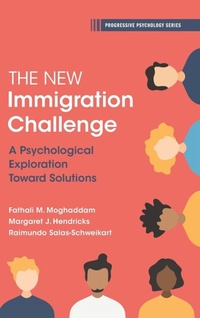
The New Immigration Challenge
A Psychological Exploration Toward Solutions
Will be published approx. on 31. December 2025
Book
Hardback
233 pages
978-1-009-41219-3 (ISBN)
Description
Due to shifting demographic trends and the increased need for workers, immigration continues to grow in many parts of the world. However, the increased diversity that immigration creates within societies is also associated with intergroup friction, perceived threat, and the rise of extremist right-wing nationalist movements, making it a central political issue that impacts societies globally. This book presents a psychological explanation of the immigration challenge in the 21st century and the ongoing backlash against immigrants by examining within nations and beyond national borders. It explains the relationship between immigration and national identity through an analysis of the intersection of globalization, deglobalization, and collective behavior. Addressing a crucial gap in existing literature, it applies a psychological perspective on immigration and offers new solutions to address the complex challenges facing minorities, asylum seekers, undocumented immigrants, and host society members.
Reviews / Votes
'Through a psychological lens, The New Immigration Challenge offers a global consideration of the mass movement of people across border and boundaries. Exploring national backlash, multiple identities, and implications for intergroup relations, this book offers an excellent introductory text for readers interested in diversity and commonality in a globalised world.' Laura K. Taylor, Associate Professor, School of Psychology, University College Dublin, IrelandMore details
Series
Language
English
Place of publication
Cambridge
United Kingdom
Illustrations
Worked examples or Exercises
Dimensions
Height: 235 mm
Width: 157 mm
Thickness: 17 mm
Weight
490 gr
ISBN-13
978-1-009-41219-3 (9781009412193)
Copyright in bibliographic data and cover images is held by Nielsen Book Services Limited or by the publishers or by their respective licensors: all rights reserved.
Schweitzer Classification
Other editions
Additional editions
Fathali M. Moghaddam | Margaret J. Hendricks | Raimundo Salas Schweikart
The New Immigration Challenge
A Psychological Exploration Toward Solutions
Book
approx. 12/2025
Cambridge University Press
€40.20
Not yet published
Fathali M. Moghaddam | Margaret J. Hendricks | Raimundo Salas Schweikart
New Immigration Challenge
A Psychological Exploration Toward Solutions
E-Book
10/2025
Cambridge University Press
€34.49
Available for download
Persons
Fathali M. Moghaddam is Professor of Psychology at Georgetown University. His most recent works include The Psychology of Revolution (Cambridge, 2024) and The Psychology of Assimilation, Multiculturalism, and Omniculturalism (2024). He has been recognized for his research through a number of prestigious academic awards. Margaret J. Hendricks is an Asylum Officer with the US Citizenship and Immigration Services Agency. She is co-editor of Contemporary Immigration: Psychological Perspectives to Address Challenges and Inform Solutions (2022) and was previously awarded a Presidential Management Fellowship. She received her PhD in Psychology from Georgetown University Raimundo Salas-Schweikart is a Ph.D. from Georgetown University researching the intersection of psychology and immigration. He has worked in volunteer formation at Servicio Jesuita Migrantes (https://sjmchile.org/), focusing on intergroup relations and trust.
Content
1. Understanding the immigration challenge: a psychological examination toward solutions; Part I. Understanding the New Immigration Challenge: A Psychological Perspective: 2. Threatened national identity, nationalism, patriotism; 3. The perils of diversity: lowered trust, disunity, and intergroup conflicts; 4. The deglobalization era: the psychology of backlash against immigrants; Part II. The Immigration Challenge and National Identity: 5. Immigration and American identity; 6. Immigration and European identity; 7. Immigration within the global south: case studies of low-income countries; Part III. Traditional and New Solutions to Managing Diversity: 8. The psychological foundations of multiculturalism and assimilation; 9. Building commonality through families, schools, and communities; 10. Looking ahead: the future of immigration, national identity, and deglobalization.