

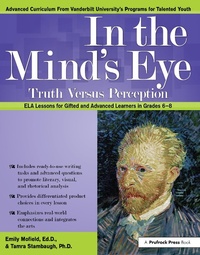
In the Mind's Eye
Truth Versus Perception, ELA Lessons for Gifted and Advanced Learners in Grades 6-8
1st Edition
Published on 15. January 2016
Book
Paperback/Softback
250 pages
978-1-61821-482-9 (ISBN)
Description
Winner of the 2012 NAGC Curriculum Studies Award
In the Mind's Eye: Truth Versus Perception invites students on a philosophical exploration of the themes of truth and perception. Lessons include a major emphasis on rigorous evidence-based discourse through the study of common themes and content-rich, challenging informational and fictional texts. This unit, developed by Vanderbilt University's Programs for Talented Youth and aligned to the Common Core State Standards (CCSS), applies concepts from Plato's "Allegory of the Cave" to guide students to discover how reality is presented and interpreted in fiction, nonfiction, art, and media.
Students engage in activities such as Socratic seminars, literary analyses, skits, and art projects, and creative writing to understand differing perceptions of reality. Lessons include close readings with text-dependent questions, choice-based differentiated products, rubrics, formative assessments, and ELA tasks that require students to analyze texts for rhetorical features, literary elements, and themes through argument, explanatory, and prose-constructed writing.
Ideal for pre-AP and honors courses, the unit features art from M.C. Escher and Vincent Van Gogh, short stories from Guy de Maupassant and Shirley Jackson, longer texts by Daniel Keyes and Ray Bradbury, and informational texts related to sociology, Nazi propaganda, and Christopher Columbus. This unit encourages students to translate learning to real-life contexts and problems by exploring themes of disillusionment, social deception, and the power of perception.
Grades 6-8
In the Mind's Eye: Truth Versus Perception invites students on a philosophical exploration of the themes of truth and perception. Lessons include a major emphasis on rigorous evidence-based discourse through the study of common themes and content-rich, challenging informational and fictional texts. This unit, developed by Vanderbilt University's Programs for Talented Youth and aligned to the Common Core State Standards (CCSS), applies concepts from Plato's "Allegory of the Cave" to guide students to discover how reality is presented and interpreted in fiction, nonfiction, art, and media.
Students engage in activities such as Socratic seminars, literary analyses, skits, and art projects, and creative writing to understand differing perceptions of reality. Lessons include close readings with text-dependent questions, choice-based differentiated products, rubrics, formative assessments, and ELA tasks that require students to analyze texts for rhetorical features, literary elements, and themes through argument, explanatory, and prose-constructed writing.
Ideal for pre-AP and honors courses, the unit features art from M.C. Escher and Vincent Van Gogh, short stories from Guy de Maupassant and Shirley Jackson, longer texts by Daniel Keyes and Ray Bradbury, and informational texts related to sociology, Nazi propaganda, and Christopher Columbus. This unit encourages students to translate learning to real-life contexts and problems by exploring themes of disillusionment, social deception, and the power of perception.
Grades 6-8
Reviews / Votes
"My favorite thing about these books is their organization around abstract themes and their use of classic literature and art to support the theme. Fantastic use of differentiation strategies that go broad as well as deep."Ian Byrd, Byrdseed.com, 4/14/17
More details
Language
English
Place of publication
Oxford
United States
Publishing group
Taylor & Francis Inc
Target group
Professional and scholarly
Professional Practice & Development
Product notice
Paperback (trade)
Unsewn / adhesive bound
Dimensions
Height: 277 mm
Width: 213 mm
Thickness: 15 mm
Weight
590 gr
ISBN-13
978-1-61821-482-9 (9781618214829)
Copyright in bibliographic data and cover images is held by Nielsen Book Services Limited or by the publishers or by their respective licensors: all rights reserved.
Schweitzer Classification
Other editions
Additional editions
Emily Mofield | Tamra Stambaugh
In the Mind's Eye
Truth Versus Perception, ELA Lessons for Gifted and Advanced Learners in Grades 6-8
E-Book
09/2021
1st Edition
Routledge
€49.99
Available for download
Emily Mofield | Tamra Stambaugh
In the Mind's Eye
Truth Versus Perception, ELA Lessons for Gifted and Advanced Learners in Grades 6-8
E-Book
09/2021
1st Edition
Routledge
€49.99
Available for download
Persons
Emily Mofield, Ed.D., is a consulting teacher for gifted education in Sumner County, TN. She is a Nationally Board Certified Teacher in language arts and has taught gifted language arts classes for 10 years.
Tamra Stambaugh, Ph.D., is the Director of Programs for Talented Youth at Vanderbilt University. She is the coauthor (with Dr. Joyce VanTassel-Baska) of Comprehensive Curriculum for Gifted Learners, Overlooked Gems: A National Perspective on Low-Income Promising Students, and the Jacob's Ladder Reading Comprehension Program.
Tamra Stambaugh, Ph.D., is the Director of Programs for Talented Youth at Vanderbilt University. She is the coauthor (with Dr. Joyce VanTassel-Baska) of Comprehensive Curriculum for Gifted Learners, Overlooked Gems: A National Perspective on Low-Income Promising Students, and the Jacob's Ladder Reading Comprehension Program.
Content
Acknowledgements Introduction Pretest Pretest Rubric INTRODUCTION Lesson 1 The Works of M. C. Escher TRUTH: AN EXAMINATION OF WHAT IS PERCEIVED Lesson 2 "Allegory of the Cave by Plato Lesson 3 "The Lottery by Shirley Jackson Lesson 4 Starry Night by Vincent Van Gogh Lesson 5 Christopher Columbus's Encounter TRUTH: AN EXAMINATION OF DISILLUSIONMENT Lesson 6 Flowers for Algernon by Daniel Keyes Lesson 7 "The Necklace by Guy de Maupassant TRUTH: AN EXAMINATION OF HOW SOCIETY IS DECEIVED Lesson 8 Analyzing Propaganda Lesson 9 Fahrenheit 451 by Ray Bradbury Lesson 10 The McDonaldization of Society by George Ritzer Lesson 11 "Tell all the truth but tell it slant by Emily Dickinson CONCLUSION Lesson 12 Final Reflection and Culminating Project Posttest Posttest Rubric References Appendix A: Instructions for Using the Models Appendix B: Blank Models and Guides Appendix C: Rubrics Appendix D: Teacher's Novel Guides About the Authors Common Core State Standards Alignment