

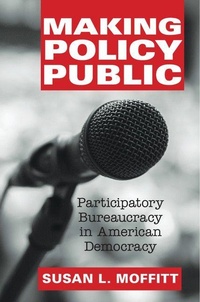
Making Policy Public
Participatory Bureaucracy in American Democracy
Published on 27. September 2014
Book
Paperback/Softback
274 pages
978-1-107-66597-2 (ISBN)
Description
This book challenges the conventional wisdom that government bureaucrats inevitably seek secrecy and demonstrates how and when participatory bureaucracy manages the enduring tension between bureaucratic administration and democratic accountability. Looking closely at federal level public participation in pharmaceutical regulation and educational assessments within the context of the vast system of American federal advisory committees, this book demonstrates that participatory bureaucracy supports bureaucratic administration in ways consistent with democratic accountability when it focuses on complex tasks and engages diverse expertise. In these conditions, public participation can help produce better policy outcomes, such as safer prescription drugs. Instead of bureaucracy's opposite or alternative, public participation can work as its complement.
Reviews / Votes
'Making Policy Public is the best study of advisory committees at any level of government, ever. Susan L. Moffitt offers a novel theoretical perspective about why these committees came to exist, how they are used, and the potential value of their operation for policy making and policy implementation. Moffitt then tests the hypotheses that emerge from this account in very rigorous and nuanced ways.' Daniel Carpenter, Harvard University, Massachusetts 'With this highly original study of federal advisory committees, Susan Moffitt offers anyone interested in democratic government a book that is timely and yet of enduring value. Rich in detail and brimming with insights from careful empirical research, Making Policy Public brings into sharp relief two vital but underappreciated aspects of American bureaucratic policy making: its participatory character and its dependence on information exchange.' Cary Coglianese, University of Pennsylvania 'Moffitt boldly dives into long-standing assumptions about bureaucracy, democracy, accountability, and performance by flipping the question of participation: it's not how participation can control bureaucracy to insure accountability, but rather how does a participatory bureaucracy seek out and utilize public advice through public committees? Through incredibly thoughtful and insightful cases of pharmaceutical information regulation and reporting on the progress of education, Moffitt takes the reader into the world of public committees, the bureaucracies that create them for public advice, and the implications for our policy-making processes.' Anne Khademian, Virginia Tech 'In Making Policy Public, Susan Moffitt makes a vital theoretical contribution to the study of democratic policy making by demonstrating both when and how public participation produces superior policy outcomes through the accrual of additional expertise from a diverse array of stakeholders. Making Policy Public's persuasive logic and evidence underscore the importance of pluralist democracy for improving the conduct of bureaucratic governance and policy making that extends well beyond the representation of diverse interests within the polity.' George A. Krause, University of Pittsburgh 'Professor Moffitt's argument is entirely novel and has changed the way I think about the relationship between elected officials and government agencies. Her multimethod approach is outstanding, and readers gain a real appreciation for the historical work, the data collection, the archival work, and the interviews.' David Lewis, Vanderbilt University 'Making Policy Public is a major contribution to the study of bureaucratic politics. Moffitt demonstrates the important and previously overlooked role of agency advisory committees for both gaining information and communicating to the public. This research will cause scholars to reassess the contribution of advisory committees and take notice of their positive contributions to democracy. This book is must-reading for scholars of public administration and political science.' Kenneth J. Meier, Texas A&M UniversityMore details
Language
English
Place of publication
Cambridge
United Kingdom
Target group
College/higher education
Professional and scholarly
Product notice
Paperback (trade)
Illustrations
20 Tables, unspecified; 8 Line drawings, unspecified
Dimensions
Height: 229 mm
Width: 152 mm
Thickness: 16 mm
Weight
418 gr
ISBN-13
978-1-107-66597-2 (9781107665972)
Copyright in bibliographic data and cover images is held by Nielsen Book Services Limited or by the publishers or by their respective licensors: all rights reserved.
Schweitzer Classification
Other editions
Additional editions
Book
09/2014
Cambridge University Press
€88.00
Shipment within 15-20 days
E-Book
09/2014
1st Edition
Cambridge University Press
€24.99
Available for download
Person
Susan L. Moffitt is the Mary Tefft and John Hazen White, Sr Assistant Professor of Political Science and Public Policy at Brown University. Before joining the faculty at Brown in the fall of 2009, she was a Fellow at the Center for American Political Studies and a Robert Wood Johnson Scholar of Health Policy Research at Harvard University. Her research program focuses on the development and use of knowledge in government agencies, with particular emphasis on the fields of K-12 education policy and pharmaceutical regulation. Moffitt's scholarship connects the study of institutional development with salient and enduring policy problems. Her first book, The Ordeal of Equality (co-authored with David K. Cohen), was published in 2009. Her work has appeared in the American Journal of Political Science, the Journal of Politics, the Journal of Law, Economics and Organization, the American Journal of Education, and numerous edited volumes. She holds a PhD and an MPP from the University of Michigan and a BA from the University of Rochester.
Content
1. Portals of democracy in American bureaucracy; 2. Participatory bureaucracy in practice: implementing complex policy; 3. The private and bureaucratic roots of public participation: the development of American federal public committees; 4. Making educational performance public: reporting on the progress of education; 5. Private knowledge for public problems: regulating pharmaceutical information; 6. Setting the public agenda; 7. Deliberate participation; 8. The impact of public advice on bureaucratic administration; 9. Participatory bureaucracy in American democracy.