

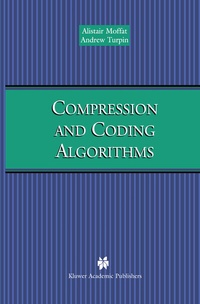
Compression and Coding Algorithms
Published on 31. March 2002
Book
Hardback
XII, 275 pages
978-0-7923-7668-2 (ISBN)
Description
Compression and Coding Algorithms
describes in detail the coding mechanisms that are available for use in data compression systems. The well known Huffman coding technique is one mechanism, but there have been many others developed over the past few decades, and this book describes, explains and assesses them. People undertaking research of software development in the areas of compression and coding algorithms will find this book an indispensable reference. In particular, the careful and detailed description of algorithms and their implementation, plus accompanying pseudo-code that can be readily implemented on computer, make this book a definitive reference in an area currently without one.
More details
Series
Edition
2002 ed.
Language
English
Place of publication
New York
United States
Target group
Professional and scholarly
Research
Illustrations
XII, 275 p.
Dimensions
Height: 241 mm
Width: 160 mm
Thickness: 21 mm
Weight
606 gr
ISBN-13
978-0-7923-7668-2 (9780792376682)
DOI
10.1007/978-1-4615-0935-6
Schweitzer Classification
Other editions
Additional editions
Alistair Moffat | Andrew Turpin
Compression and Coding Algorithms
Book
10/2012
Springer
€53.49
Shipment within 7-9 days
Content
1 Data Compression Systems.- 1.1 Why compression?.- 1.2 Fundamental operations.- 1.3 Terminology.- 1.4 Related material.- 1.5 Analysis of algorithms.- 2 Fundamental Limits.- 2.1 Information content.- 2.2 Kraft inequality.- 2.3 Human compression.- 2.4 Mechanical compression systems.- 3 Static Codes.- 3.1 Unary and binary codes.- 3.2 Elias codes.- 3.3 Golomb and Rice codes.- 3.4 Interpolative coding.- 3.5 Making a choice.- 4 Minimum-Redundancy Coding.- 4.1 Shannon-Fano codes.- 4.2 Huffman coding.- 4.3 Canonical codes.- 4.4 Other decoding methods.- 4.5 Implementing Huffman's algorithm.- 4.6 Natural probability distributions.- 4.7 Artificial probability distributions.- 4.8 Doing the housekeeping chores.- 4.9 Related material.- 5 Arithmetic Coding.- 5.1 Origins of arithmetic coding.- 5.2 Overview of arithmetic coding.- 5.3 Implementation of arithmetic coding.- 5.4 Variations.- 5.5 Binary arithmetic coding.- 5.6 Approximate arithmetic coding.- 5.7 Table-driven arithmetic coding.- 5.8 Related material.- 6 Adaptive Coding.- 6.1 Static and semi-static probability estimation.- 6.2 Adaptive probability estimation.- 6.3 Coping with novel symbols.- 6.4 Adaptive Huffman coding.- 6.5 Adaptive arithmetic coding.- 6.6 Maintaining cumulative statistics.- 6.7 Recency transformations.- 6.8 Splay tree coding.- 6.9 Structured arithmetic coding.- 6.10 Pseudo-adaptive coding.- 6.11 The Q-coder.- 6.12 Making a choice.- 7 Additional Constraints.- 7.1 Length-limited coding.- 7.2 Alphabetic coding.- 7.3 Alternative channel alphabets.- 7.4 Related material.- 8 Compression Systems.- 8.1 Sliding window compression.- 8.2 Prediction by partial matching.- 8.3 Burrows-Wheeler transform.- 8.4 Other compression systems.- 8.5 Lossy modeling.- 9 What Next?.- References.