

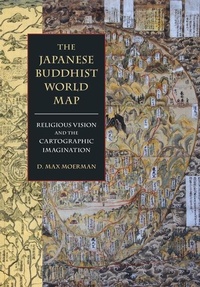
The Japanese Buddhist World Map
Religious Vision and the Cartographic Imagination
Published on 31. December 2021
Book
Hardback
368 pages
978-0-8248-8678-3 (ISBN)
Description
From the fourteenth through the nineteenth centuries Japanese monks created hundreds of maps to construct and locate their place in a Buddhist world. This expansively illustrated volume is the first to explore the largely unknown archive of Japanese Buddhist world maps and analyze their production, reproduction, and reception. In examining these fascinating sources of visual and material culture, author D. Max Moerman argues for an alternative history of Japanese Buddhism-one that compels us to recognize the role of the Buddhist geographic imaginary in a culture that encompassed multiple cartographic and cosmological world views.
The contents and contexts of Japanese Buddhist world maps reveal the ambivalent and shifting position of Japan in the Buddhist world, its encounter and negotiation with foreign ideas and technologies, and the possibilities for a global history of Buddhism and science. Moerman's visual and intellectual history traces the multiple trajectories of Japanese Buddhist world maps, beginning with the earliest extant Japanese map of the world: a painting by a fourteenth-century Japanese monk charting the cosmology and geography of India and Central Asia based on an account written by a seventh-century Chinese pilgrim-monk. He goes on to discuss the cartographic inclusion and marginal position of Japan, the culture of the copy and the power of replication in Japanese Buddhism, and the transcultural processes of engagement and response to new visions of the world produced by Iberian Christians, Chinese Buddhists, and the Japanese maritime trade. Later chapters explore the transformations in the media and messages of Buddhist cartography in the age of print culture and in intellectual debates during the eighteenth and nineteenth centuries over cosmology and epistemology and the polemics of Buddhist science.
The Japanese Buddhist World Map offers a wholly innovative picture of Japanese Buddhism that acknowledges the possibility of multiple and heterogeneous modernities and alternative visions of Japan and the world.
The contents and contexts of Japanese Buddhist world maps reveal the ambivalent and shifting position of Japan in the Buddhist world, its encounter and negotiation with foreign ideas and technologies, and the possibilities for a global history of Buddhism and science. Moerman's visual and intellectual history traces the multiple trajectories of Japanese Buddhist world maps, beginning with the earliest extant Japanese map of the world: a painting by a fourteenth-century Japanese monk charting the cosmology and geography of India and Central Asia based on an account written by a seventh-century Chinese pilgrim-monk. He goes on to discuss the cartographic inclusion and marginal position of Japan, the culture of the copy and the power of replication in Japanese Buddhism, and the transcultural processes of engagement and response to new visions of the world produced by Iberian Christians, Chinese Buddhists, and the Japanese maritime trade. Later chapters explore the transformations in the media and messages of Buddhist cartography in the age of print culture and in intellectual debates during the eighteenth and nineteenth centuries over cosmology and epistemology and the polemics of Buddhist science.
The Japanese Buddhist World Map offers a wholly innovative picture of Japanese Buddhism that acknowledges the possibility of multiple and heterogeneous modernities and alternative visions of Japan and the world.
More details
Language
English
Place of publication
Honolulu, HI
United States
Target group
Professional and scholarly
Product notice
sewn/stitched
Cloth over boards
Illustrations
146 colour, b&w illustrations
Dimensions
Height: 259 mm
Width: 185 mm
Thickness: 30 mm
Weight
1111 gr
ISBN-13
978-0-8248-8678-3 (9780824886783)
Copyright in bibliographic data and cover images is held by Nielsen Book Services Limited or by the publishers or by their respective licensors: all rights reserved.
Schweitzer Classification
Person
D. Max Moerman is professor in the Department of Asian and Middle Eastern Cultures, Barnard College, Columbia University.