

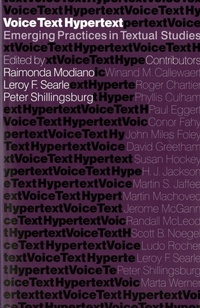
Voice, Text, Hypertext
Emerging Practices in Textual Studies
Published on 1. January 2004
Book
Paperback/Softback
528 pages
978-0-295-98306-6 (ISBN)
Description
Voice, Text, Hypertext illustrates brilliantly why interest in textual studies has grown so dramatically in recent years. For the distinguished authors of these essays, a "text" is more than a document or material object. It is a cultural event, a matrix of decisions, an intricate cultural practice that may focus on religious traditions, modern "underground" literary movements, poetic invention, or the irreducible complexity of cultural politics.
Drawing from classical Roman and Indian to modern European traditions, the volume makes clear that to study a text is to study a culture. It also demonstrates the essential importance of heightened textual awareness for contemporary cultural studies and critical theory-and, indeed, for any discipline that studies human culture.
Drawing from classical Roman and Indian to modern European traditions, the volume makes clear that to study a text is to study a culture. It also demonstrates the essential importance of heightened textual awareness for contemporary cultural studies and critical theory-and, indeed, for any discipline that studies human culture.
More details
Series
Language
English
Place of publication
Seattle
United States
Target group
Professional and scholarly
Product notice
Paperback (trade)
Illustrations
112 illus.
Dimensions
Height: 235 mm
Width: 155 mm
Thickness: 26 mm
Weight
635 gr
ISBN-13
978-0-295-98306-6 (9780295983066)
Copyright in bibliographic data and cover images is held by Nielsen Book Services Limited or by the publishers or by their respective licensors: all rights reserved.
Schweitzer Classification
Persons
Raimonda Modiano and Leroy F. Searle are professors of English and comparative literature at the University of Washington, Seattle. Peter Shillingsburg is professor of English at the University of North Texas.
Content
Preface
Acknowledgments
Part I. Textual Space
1. Emerging Questions: Text and Theory in Contemporary Criticism, Leroy F. Searle
2. The Function of [Textual] Criticism at the Present Time, David Greetham
3. The Text Between the Voice and the Book, Roger Chartier
4. Editing and Auditing Marginalia, H. J. Jackson
Part II. Oral Text
5. Spoke, Written, Incarnate: Ontologies of Textuality in Classical Rabbinic Judaism, Martin S. Jaffee
6. Textualization as Mediation: The Case of Traditional Oral Epic, John Miles Foley
7. Bhakti Literature: An "Oral-Scribal" Archetype, Winand M. Callewaert
Part III. Material Text
8. Text, Script, and Media: New Observations on Scribal Activity in the Ancient Near East, Scott B. Noegel
9. Magical Texts and Popular Literacy: Vulgarizations, Iterations, or Appropriations?, Phyllis Culham
10. The Way of All Text: The Materialist Shakespeare, Paul Eggert
11. Gerard Hopkins and the Shapes of His Sonnets, Randall McLeod
12. The Flights of A821: Dearchiving the Proceedings of a Birdsong, Marta Werner
Part IV. Subersive/Subverted Text
13. Reinterpreting Text: When Revealed Sanskrit Texts Become Modern Law Books, Ludo Rocher
14. Czech Underground Literature, 1969-1989: A Challenge to Textual Studies, Martin Machovec
Part V. Electronic Text
15. The Reality of Electronic Editions, Susan Hockey
16. Imagining What You Don't Know: The Theoretical Goals of the Rossetti Archive, Jerome McGann
Part VI. Textual Maintenance
17. Old and New in Italian Textual Criticism, Conor Fahy
18. Hagiolatry, Cultural Engineering, Moment Building, and Other Functions of Scholarly Editing, Peter Shillingsburg
Contributors
Index
Acknowledgments
Part I. Textual Space
1. Emerging Questions: Text and Theory in Contemporary Criticism, Leroy F. Searle
2. The Function of [Textual] Criticism at the Present Time, David Greetham
3. The Text Between the Voice and the Book, Roger Chartier
4. Editing and Auditing Marginalia, H. J. Jackson
Part II. Oral Text
5. Spoke, Written, Incarnate: Ontologies of Textuality in Classical Rabbinic Judaism, Martin S. Jaffee
6. Textualization as Mediation: The Case of Traditional Oral Epic, John Miles Foley
7. Bhakti Literature: An "Oral-Scribal" Archetype, Winand M. Callewaert
Part III. Material Text
8. Text, Script, and Media: New Observations on Scribal Activity in the Ancient Near East, Scott B. Noegel
9. Magical Texts and Popular Literacy: Vulgarizations, Iterations, or Appropriations?, Phyllis Culham
10. The Way of All Text: The Materialist Shakespeare, Paul Eggert
11. Gerard Hopkins and the Shapes of His Sonnets, Randall McLeod
12. The Flights of A821: Dearchiving the Proceedings of a Birdsong, Marta Werner
Part IV. Subersive/Subverted Text
13. Reinterpreting Text: When Revealed Sanskrit Texts Become Modern Law Books, Ludo Rocher
14. Czech Underground Literature, 1969-1989: A Challenge to Textual Studies, Martin Machovec
Part V. Electronic Text
15. The Reality of Electronic Editions, Susan Hockey
16. Imagining What You Don't Know: The Theoretical Goals of the Rossetti Archive, Jerome McGann
Part VI. Textual Maintenance
17. Old and New in Italian Textual Criticism, Conor Fahy
18. Hagiolatry, Cultural Engineering, Moment Building, and Other Functions of Scholarly Editing, Peter Shillingsburg
Contributors
Index