

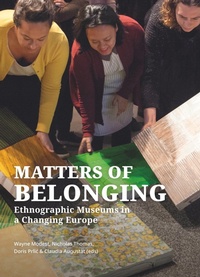
Matters of Belonging
Ethnographic Museums in a Changing Europe
1st Edition
Published on 10. October 2019
Book
Hardback
150 pages
978-90-8890-778-4 (ISBN)
Description
Matters of Belonging foregrounds critical practices within ethnographic museums in relation to their diverse stakeholders, with a special focus on collaboration with artists and differently constituted, self-identified communities. The book emerges from the EU-funded project SWICH (Sharing a World of Inclusion, Creativity and Heritage) that places ethnographic museums at the centre of ongoing debates about Europe's shifting polity and questions around heritage, citizenship and belonging. Addressing diverse political climates and citizenship regimes, legal frameworks and colonial/migratory histories, the articles seek to question the role of ethnographic and world cultures museums within contemporary negotiations of how to define Europe, Europeans, and European heritage, especially mindful of the region's colonial and migratory pasts.
The book is neither celebratory nor congratulatory, and does not depict a triumphal overcoming by ethnographic museums of their troubled pasts. Its aim is to think critically about these museums' responses, to identify both pitfalls and positive developments, and to sketch out possible futures for museums generally, and ethnographic museums specifically, as they try to locate themselves within discussions about Europe and its futures.
Core to the book's argument is that it may exactly be in their entanglement with the colonial past that these museums can become important sites for thinking about colonial entailments in the present. Facing up to this past is the beginning of addressing these larger legacies. The authors suggest that the ethnographic museum has been the site not just for trenchant questioning of colonial durabilities in contemporary Europe, but also for the development of new practices - of collaboration and authority-sharing, of recognition and belonging. The book explores these models, not as complete, but as a starting point to push forward new practices.
The book is neither celebratory nor congratulatory, and does not depict a triumphal overcoming by ethnographic museums of their troubled pasts. Its aim is to think critically about these museums' responses, to identify both pitfalls and positive developments, and to sketch out possible futures for museums generally, and ethnographic museums specifically, as they try to locate themselves within discussions about Europe and its futures.
Core to the book's argument is that it may exactly be in their entanglement with the colonial past that these museums can become important sites for thinking about colonial entailments in the present. Facing up to this past is the beginning of addressing these larger legacies. The authors suggest that the ethnographic museum has been the site not just for trenchant questioning of colonial durabilities in contemporary Europe, but also for the development of new practices - of collaboration and authority-sharing, of recognition and belonging. The book explores these models, not as complete, but as a starting point to push forward new practices.
More details
Edition
1. Auflage
Language
English
Place of publication
Leiden
Netherlands
Target group
Professional and scholarly
Illustrations
25fc/16bw
Dimensions
Height: 236 mm
Width: 170 mm
Thickness: 19 mm
Weight
702 gr
ISBN-13
978-90-8890-778-4 (9789088907784)
Copyright in bibliographic data and cover images is held by Nielsen Book Services Limited or by the publishers or by their respective licensors: all rights reserved.
Schweitzer Classification
Persons
Wayne Modest is the Head of the Research Center for Material Culture, the research institute of the Tropenmuseum, Museum Volkenkunde, Africa Museum and Wereldmuseum in the Netherlands. He is also Professor of Material Culture and Critical Heritage Studies in the Faculty of Humanities at the Vrije Universiteit Amsterdam. Modest was previously head of the curatorial department at the Tropenmuseum, Amsterdam; Keeper of Anthropology at the Horniman Museum in London, and Director of the Museums of History and Ethnography in Kingston, Jamaica. He has published widely on issues of belonging and displacement; histories of (ethnographic) collecting and exhibitionary practices; and difficult/contested heritage with a special focus on slavery, colonialism and post-colonialism. His most recent publications include Victorian Jamaica (Duke University Press, 2018, with Tim Barringer), and "Anxious Politics in Postcolonial Europe" (American Anthropologist, 2017, with Anouk de Koning). Prof. Dr. Nicholas Thomas was an undergraduate at the Australian National University from 1979 to 1982; his BA (Honours) thesis, on Fijian politics, was supervised by Anthony Forge. He visited the Pacific first in 1984 to undertake doctoral research in the Marquesas Islands and has since written extensively on exploration and cross-cultural encounters and on art histories in the Pacific. He has been Director of the Museum of Archaeology and Anthropology in Cambridge since 2006. Doris Prlic is coordinator of the European cooperation project SWICH - Sharing a World of Inclusion, Creativity and Heritage at Weltmuseum Wien (since January 2015). She previously worked as independent curator, realizing projects for different cultural organisations such as Festival der Regionen or afo - architekturforum oberoesterreich (Linz, Austria). Claudia Augustat is curator of the South America collections at Weltmuseum Wien, Vienna, with a regional focus on Amazonia. In her research, she concentrates on topics such as material culture and cultural memory, collaborative projects as well as decolonization of museum practice. She is project leader of SWICH - Sharing a World of Inclusion, Creativity and Heritage (since January 2018).
Content
Acknowledgements
List of images
Introduction
Wayne Modest
Heritage
The Museum Inside-out - Twenty Observations
Nicholas Thomas
Museums and Source Communities: Reflections and implications
Laura Peers
Our House is Made of Thin, Burning Ice. Let?s Dance
Sandra Ferracuti
On Collaboration - the Making of the Afterlives of Slavery exhibition at the Tropenmuseum
Rita Ouedraogo, Robin Lelijveld, Wayne Modest
Creativity
Questions of Belonging
Alana Jelinek
Love and Loss in the Ethnographic Museum
Rajkamal Kahlon
Eyes in the Back of Your Head
Bianca Baldi
I came as a Stranger
Aleksandra Pawloff
The Long Walk: Following the Tick Ticking Sounds into the Unknown - Or the Omitted
Jacqueline Hoang Nguy?n
Inclusion
Shared Authority Matters: Collaboration with Heritage Bearers with Migrant Background
Tina Palaic and Bojana Rogelj Skafar
Uncomfortable Memory and Community Participation at the Barcelona Ethnological and World Cultures Museum
Salvador Garcia Arnillas and Lluis-Josep Ramoneda Aigueade
The Making of a Point of View: A Participatory Exhibition at the Pigorini Museum in Rome
Rosa Anna Di Lella - Loretta Paderni
Out of Boxes: Touching Wor(l)ds, Moving Pictures
Urban Nomad Mixes
List of images
Introduction
Wayne Modest
Heritage
The Museum Inside-out - Twenty Observations
Nicholas Thomas
Museums and Source Communities: Reflections and implications
Laura Peers
Our House is Made of Thin, Burning Ice. Let?s Dance
Sandra Ferracuti
On Collaboration - the Making of the Afterlives of Slavery exhibition at the Tropenmuseum
Rita Ouedraogo, Robin Lelijveld, Wayne Modest
Creativity
Questions of Belonging
Alana Jelinek
Love and Loss in the Ethnographic Museum
Rajkamal Kahlon
Eyes in the Back of Your Head
Bianca Baldi
I came as a Stranger
Aleksandra Pawloff
The Long Walk: Following the Tick Ticking Sounds into the Unknown - Or the Omitted
Jacqueline Hoang Nguy?n
Inclusion
Shared Authority Matters: Collaboration with Heritage Bearers with Migrant Background
Tina Palaic and Bojana Rogelj Skafar
Uncomfortable Memory and Community Participation at the Barcelona Ethnological and World Cultures Museum
Salvador Garcia Arnillas and Lluis-Josep Ramoneda Aigueade
The Making of a Point of View: A Participatory Exhibition at the Pigorini Museum in Rome
Rosa Anna Di Lella - Loretta Paderni
Out of Boxes: Touching Wor(l)ds, Moving Pictures
Urban Nomad Mixes