

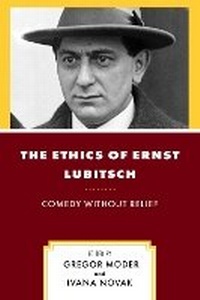
The Ethics of Ernst Lubitsch
Comedy Without Relief
Published on 22. August 2024
Book
Hardback
176 pages
978-1-5381-4616-3 (ISBN)
Description
Against the idea that comedy offers us a relief from the horrors of the real world, the German-Jewish-American filmmaker Ernst Lubitsch defended his masterpiece To Be or Not to Be, a comedy from 1942 about the concurrent Nazi occupation of Poland, with the claim that he had made up his mind "to make a picture with no attempt to relieve anybody from anything at any time." The essays included in The Ethics of Ernst Lubitsch consider Lubitsch's work from his early Berlin years to his Hollywood fame, emphasizing the idea of 'comedy without relief' as the fundamental ethical premise of his special cinematic 'touch.' In this edited collection, contributors take a closer look at how Lubitsch addresses delicate and controversial topics like sexuality, love, and revolution, and set out a picture of an engaged ethics without moralism. The Ethics of Ernst Lubitsch is a vital contribution to film scholarship and a tribute to an essential filmmaker.
Reviews / Votes
The title of this superb volume tells it all: it treats Ernst Lubitsch not just as a great director of comedies but as an author whose movies confront the basic ethical dilemmas of his time. Lubitsch is the greatest philosopher among movie directors, much greater than the celebrated art-movies classics. Is this not reason enough to read The Ethics of Ernst Lubitsch for all who care about the mess we're in? -- Slavoj Zizek, professor of philosophy, University of Ljubljana, Slovenia There are those who see comedy only as a mode of relief from the dangers and anxieties of the real world and who thus dismiss the genre merely as a form of distraction. Such a ridiculous stance drastically avoids the precise ethical core of comedy, which, in the hands of Ernst Lubitsch, provides a real and authentic encounter with the world-one that is needed more than ever today. This is a fact demonstrated with excitement and brilliance by the authors collected in Novak and Moder's book. Building upon the rich and expanding analytical frameworks produced by the Ljubljana School for Theoretical Psychoanalysis, The Ethics of Ernst Lubitsch is a marvelous achievement showing why the name Lubitsch deserves to be etched in stone alongside the names Lacan and Hegel. -- Matthew Flisfeder, associate professor of rhetoric and communications, The University of Winnipeg, CanadaMore details
Language
English
Place of publication
United States
Publishing group
Bloomsbury Publishing Plc
Target group
College/higher education
Illustrations
6 BW Photos
Dimensions
Height: 236 mm
Width: 157 mm
Thickness: 20 mm
Weight
445 gr
ISBN-13
978-1-5381-4616-3 (9781538146163)
Copyright in bibliographic data and cover images is held by Nielsen Book Services Limited or by the publishers or by their respective licensors: all rights reserved.
Schweitzer Classification
Other editions
Additional editions
E-Book
08/2024
1st Edition
Rowman & Littlefield Publishers
€82.49
Available for download
Persons
Gregor Moder, PhD, is a senior research associate in the Department of Philosophy at the University of Ljubljana. He has written and coedited several books on comedy and tragedy.
Ivana Novak is a film programmer at the Slovenian National Television, film critic, and musician. She has coedited five books on classical Hollywood cinema, film comedy, and television.
Ivana Novak is a film programmer at the Slovenian National Television, film critic, and musician. She has coedited five books on classical Hollywood cinema, film comedy, and television.
Content
Introduction: The Ethics of Ernst Lubitsch by Gregor Moder and Ivana Novak
Section One. POLITICS AND REVOLUTION
Chapter 1: An Uprising with a Lubitsch Touch by Alenka Zupancic
Chapter 2: Communist Ninotchka by Aaron Schuster
Section Two. THEATER AND COMICALITY
Chapter 3: The Uncanny and the Comic: Freud avec Lubitsch by Mladen Dolar
Chapter 4: Lubitsch, Shakespeare, and the Theatricality of Power by Gregor Moder
Chapter 5: What Touches Me Under My Ego. Comicality in Lubitsch, and its Psychoanalytic Structure by Robert Pfaller
Section Three. LOVE AND SEX
Chapter 6: Lubitsch's Women, or, Why Women Deserve Love and Money by Jela Krecic
Chapter 7: The Princess Learns to Wink: Lubitsch and the Politics of the Obscene by Yuval Kremnitzer
Chapter 8: The Disenchantment and the Restoration of Love in The Shop Around the Cornerby Ivana Novak
Index
About the Contributors
Section One. POLITICS AND REVOLUTION
Chapter 1: An Uprising with a Lubitsch Touch by Alenka Zupancic
Chapter 2: Communist Ninotchka by Aaron Schuster
Section Two. THEATER AND COMICALITY
Chapter 3: The Uncanny and the Comic: Freud avec Lubitsch by Mladen Dolar
Chapter 4: Lubitsch, Shakespeare, and the Theatricality of Power by Gregor Moder
Chapter 5: What Touches Me Under My Ego. Comicality in Lubitsch, and its Psychoanalytic Structure by Robert Pfaller
Section Three. LOVE AND SEX
Chapter 6: Lubitsch's Women, or, Why Women Deserve Love and Money by Jela Krecic
Chapter 7: The Princess Learns to Wink: Lubitsch and the Politics of the Obscene by Yuval Kremnitzer
Chapter 8: The Disenchantment and the Restoration of Love in The Shop Around the Cornerby Ivana Novak
Index
About the Contributors