

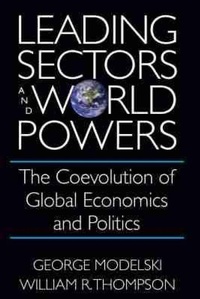
Leading Sectors and World Powers
Coevolution of Global Economics and Politics
Published on 2. March 1996
Book
Hardback
300 pages
978-1-57003-054-3 (ISBN)
Description
The idea that political and economic power moves in coordinated cycles has long intrigued political scientists and political economists, for if a pattern exists in the rise and fall of international political power, a model explaining this pattern gains predictive qualities. In Leading Sectors and World Powers, George Modelski and William R. Thompson venture beyond previous attempts to explain why major powers rise, fall, and fight about their changing status to establish an explicit connection between war, economic innovation, and world leadership. They argue that surges in economic innovation, which in turn are tied to global war, determine leadership in the global system. Modelski and Thompson base their theory on the coordination of long cycles (phases of world order and decay punctuated by intensive bouts of global war) and K-waves (cycles delineating the wax and wane of leading industrial sectors). They contend that K-waves appear in paired sets correlated to long-cycle shifts in political power. Modelski and Thompson conclude by discussing the nature and timing of the next K-wave/long cycle peak, commenting on the relevance of it for U.S. industrial policy and speculating on the possibility of evolving away from this pattern in the near future.
More details
Language
English
Place of publication
South Carolina
United States
Target group
College/higher education
Product notice
sewn/stitched
Cloth over boards
Illustrations
illustrations, maps
Dimensions
Height: 233 mm
Width: 157 mm
Thickness: 24 mm
Weight
608 gr
ISBN-13
978-1-57003-054-3 (9781570030543)
Copyright in bibliographic data and cover images is held by Nielsen Book Services Limited or by the publishers or by their respective licensors: all rights reserved.
Schweitzer Classification
Persons
William R. Thompson is professor of political science and director of the Center for the Study of International Relations at Indiana University.