

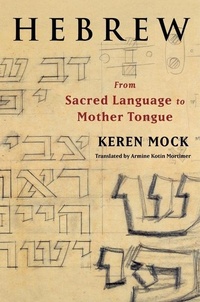
Hebrew
From Sacred Language to Mother Tongue
Published on 23. December 2025
Book
Paperback/Softback
360 pages
978-0-231-21712-5 (ISBN)
Description
For nearly two thousand years, Hebrew belonged to the realm of the sacred. A written liturgical language used primarily by rabbis and scholars, it was not spoken in everyday contexts. A revival process in the late nineteenth century brought Hebrew back into daily use, adapting sacred texts as the foundations for a new vernacular. A "mother tongue" emerged.
Keren Mock provides a strikingly original multidisciplinary account of this transformation of Hebrew from an ancient sacred tongue to a secular spoken language. Bringing together psychoanalytic, semiotic, and comparative-literature perspectives, she provides deep insight into key moments in this history. Drawing on extensive, revealing interviews, Mock offers critical readings of two major Israeli authors, Aharon Appelfeld and Sami Michael, focusing on their struggles to write in Hebrew as immigrants. She delves into the archives of the lexicographer Eliezer Ben-Yehuda, the creator of an all-embracing dictionary of ancient and modern Hebrew, and considers Baruch Spinoza's little-known Hebrew grammar in light of his philosophical works. In reflecting on the making and meaning of a mother tongue, Mock addresses questions of memory and forgetting, mourning and restitution, and the sacred and the secular. Through the exceptional history of Hebrew, this book uncovers the workings of language in the social and psychological realms.
Hebrew features forewords by Pierre-Marc de Biasi, an artist and scholar of literature, and Julia Kristeva, a renowned psychoanalyst, philosopher, and linguist, speaking to the significance of the book.
Keren Mock provides a strikingly original multidisciplinary account of this transformation of Hebrew from an ancient sacred tongue to a secular spoken language. Bringing together psychoanalytic, semiotic, and comparative-literature perspectives, she provides deep insight into key moments in this history. Drawing on extensive, revealing interviews, Mock offers critical readings of two major Israeli authors, Aharon Appelfeld and Sami Michael, focusing on their struggles to write in Hebrew as immigrants. She delves into the archives of the lexicographer Eliezer Ben-Yehuda, the creator of an all-embracing dictionary of ancient and modern Hebrew, and considers Baruch Spinoza's little-known Hebrew grammar in light of his philosophical works. In reflecting on the making and meaning of a mother tongue, Mock addresses questions of memory and forgetting, mourning and restitution, and the sacred and the secular. Through the exceptional history of Hebrew, this book uncovers the workings of language in the social and psychological realms.
Hebrew features forewords by Pierre-Marc de Biasi, an artist and scholar of literature, and Julia Kristeva, a renowned psychoanalyst, philosopher, and linguist, speaking to the significance of the book.
Reviews / Votes
Keren Mock's book offers a new and illuminating perspective on the modern revival of Hebrew. Working in reverse chronological order, she begins with two contemporary Hebrew writers who came from the background of another language, then proceeds to the foundational enterprise in renewing the language of Eliezer Ben-Yehuda at the beginning of the twentieth century, and concludes with Spinoza, who extracted Hebrew from its status as a holy tongue. This is a work of exemplary scholarship. -- Robert B. Alter, translator of <i>The Hebrew Bible</i> In this fascinating and innovative book, Mock examines the revival of the Hebrew language and the roots of its secularization. Bringing together philosophy, psychoanalysis, linguistics, and literary studies, she provides a thought-provoking reflection on how a language becomes a mother tongue. -- Clemence Boulouque, author of <i>On the Edge of the Abyss: The Jewish Unconscious before Freud</i> Mock has done a remarkable job of detailing the revitalization of modern-day Hebrew, culminating in a comprehensive and insightful account of the language's evolution. * Jewish Link * The book introduces new perspectives by highlighting the lesser-known roles of Appelfeld and Michael and their impact on the development of modern Hebrew. * Times of Israel *More details
Series
Language
English
Place of publication
New York
United States
Target group
Professional and scholarly
College/higher education
Product notice
Paperback (trade)
Illustrations
13 b/w illustrations
Dimensions
Height: 156 mm
Width: 235 mm
Thickness: 23 mm
Weight
548 gr
ISBN-13
978-0-231-21712-5 (9780231217125)
Copyright in bibliographic data and cover images is held by Nielsen Book Services Limited or by the publishers or by their respective licensors: all rights reserved.
Schweitzer Classification
Other editions
Additional editions
E-Book
12/2025
1st Edition
Columbia University Press
€29.49
Available for download
Persons
Keren Mock is a research associate at the Institut des textes et manuscrits modernes, a research unit of the Centre national de la recherche scientifique and the Ecole normale superieure de Paris; adjunct faculty at Sciences Po Paris; and a clinical psychologist.
Armine Kotin Mortimer has translated many works of literary fiction and nonfiction from French, including Julia Kristeva's Dostoyevsky in the Face of Death (Columbia, 2023).
Armine Kotin Mortimer has translated many works of literary fiction and nonfiction from French, including Julia Kristeva's Dostoyevsky in the Face of Death (Columbia, 2023).
Content
Foreword: Keren Mock, a New Voice in Critical Thinking, by Pierre-Marc de Biasi
Foreword: The Signifying Nature of Language, by Julia Kristeva
Introduction
Part I. The Age of the Pioneers Appelfeld and Michael: Edification of a New Mother Tongue
1. Hebrew as a Mother Tongue Among Languages
2. Hiatus and Reconstructive Narration in the Work of Aharon Appelfeld
3. Sami Michael's "Literary Fall" Through Translation
Part II. The Ben-Yehuda Worksite: Literary Excavations and Lexicographical Matter
4. The "Resurrection" of Hebrew?
5. Spectra and Corpus of a New Mother Tongue: Eliezer Ben-Yehuda's Vision
6. Words as Language "Bricks"
Part III. Spinoza's New Concept: The Philosophical Foundations of Secular Hebrew
7. To Be Jewish and Multilingual in Amsterdam in the 1660s
8. From Scriptures to Writing
9. Regularity as the Foundation of Immanence
10. The Nature of Words: The Omnipotence of the Noun
11. Hebrew as a Mother Tongue
Acknowledgments
Notes
Index
Foreword: The Signifying Nature of Language, by Julia Kristeva
Introduction
Part I. The Age of the Pioneers Appelfeld and Michael: Edification of a New Mother Tongue
1. Hebrew as a Mother Tongue Among Languages
2. Hiatus and Reconstructive Narration in the Work of Aharon Appelfeld
3. Sami Michael's "Literary Fall" Through Translation
Part II. The Ben-Yehuda Worksite: Literary Excavations and Lexicographical Matter
4. The "Resurrection" of Hebrew?
5. Spectra and Corpus of a New Mother Tongue: Eliezer Ben-Yehuda's Vision
6. Words as Language "Bricks"
Part III. Spinoza's New Concept: The Philosophical Foundations of Secular Hebrew
7. To Be Jewish and Multilingual in Amsterdam in the 1660s
8. From Scriptures to Writing
9. Regularity as the Foundation of Immanence
10. The Nature of Words: The Omnipotence of the Noun
11. Hebrew as a Mother Tongue
Acknowledgments
Notes
Index