

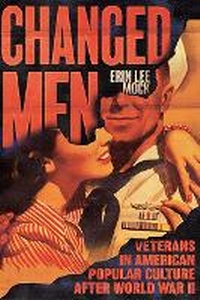
Changed Men
Veterans in American Popular Culture After World War II
Published on 30. June 2024
Book
Hardback
284 pages
978-0-8139-5094-5 (ISBN)
Description
Postwar culture and anxiety over the reintegration of veterans into American society
Millions of GIs returned from overseas in 1945. A generation of men who had left their families and had learned to kill and to quickly dispatch sexual urges were rapidly reintegrated into civilian life, told to put the war behind them with cheer and confidence. Many veterans struggled, openly or privately, with this transition. Others in society wondered what the war had wrought in them. As Erin Lee Mock shows in this insightful book, the "explosive" potential of men became a central concern of postwar American culture.
This wariness of veterans settled into a generalized anxiety over men's "inherent" violence and hypersexuality, which increasingly came to define masculinity. Changed Men engages with studies of film, media, literature, and gender and sexuality to advance a new perspective on the artistic and cultural output of and about the "Greatest Generation," arguing that depictions of men's violent and erotic potential emerged differently in different forms and genres but nonetheless permeated American culture in these years. Viewing this homecoming through the lenses of war and trauma, classical Hollywood, pulp fiction, periodical culture, and early television, Mock shows this history in a provocative new light.
Millions of GIs returned from overseas in 1945. A generation of men who had left their families and had learned to kill and to quickly dispatch sexual urges were rapidly reintegrated into civilian life, told to put the war behind them with cheer and confidence. Many veterans struggled, openly or privately, with this transition. Others in society wondered what the war had wrought in them. As Erin Lee Mock shows in this insightful book, the "explosive" potential of men became a central concern of postwar American culture.
This wariness of veterans settled into a generalized anxiety over men's "inherent" violence and hypersexuality, which increasingly came to define masculinity. Changed Men engages with studies of film, media, literature, and gender and sexuality to advance a new perspective on the artistic and cultural output of and about the "Greatest Generation," arguing that depictions of men's violent and erotic potential emerged differently in different forms and genres but nonetheless permeated American culture in these years. Viewing this homecoming through the lenses of war and trauma, classical Hollywood, pulp fiction, periodical culture, and early television, Mock shows this history in a provocative new light.
More details
Series
Language
English
Place of publication
Charlottesville
United States
Target group
Professional and scholarly
Product notice
Cloth over boards
Dimensions
Height: 229 mm
Width: 152 mm
Thickness: 32 mm
Weight
272 gr
ISBN-13
978-0-8139-5094-5 (9780813950945)
Copyright in bibliographic data and cover images is held by Nielsen Book Services Limited or by the publishers or by their respective licensors: all rights reserved.
Schweitzer Classification
Other editions
Additional editions
E-Book
06/2024
1st Edition
Naval Institute Press
from
€84.99
Available for download
Person
Erin Lee Mock is an independent scholar.
Content
Acknowledgments
Introduction: "His Blood Is Up"
Prologue: Before We Pick Up Where We Left Off
1. "It Was Easy": Postwar Paperback and the Veteran Killer
2. "Do We Become What We Do?": Glenn Ford and Van Heflin in Hollywood
3. Getting Comfortable: Hugh Hefner'sPlayboyin the 1950s
4. The Horror of "Honey, I'm Home!": 1950s Domestic Sitcoms in the Twilight Zone
Conclusion: The "Loving Little Stoic" Speaks
Notes
Bibliography
Index
Introduction: "His Blood Is Up"
Prologue: Before We Pick Up Where We Left Off
1. "It Was Easy": Postwar Paperback and the Veteran Killer
2. "Do We Become What We Do?": Glenn Ford and Van Heflin in Hollywood
3. Getting Comfortable: Hugh Hefner'sPlayboyin the 1950s
4. The Horror of "Honey, I'm Home!": 1950s Domestic Sitcoms in the Twilight Zone
Conclusion: The "Loving Little Stoic" Speaks
Notes
Bibliography
Index