

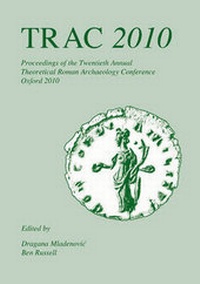
TRAC 2010
Proceedings of the Twentieth Annual Theoretical Roman Archaeology Conference
Published on 15. April 2011
Book
Paperback/Softback
160 pages
978-1-84217-452-4 (ISBN)
Description
This volume contains ten papers reflecting current aspects of the debate in theoretical Roman archaeology. They include papers on what the pottery finds from the Nepi Survey Project can tell us about how the local landscape was used and inhabited, poliadic deities in Roman colonies in Italy, Pompeii, the practice of the recycling of architectural materials and personal adornment concerning textile remains and brooches.
Reviews / Votes
"...the two volumes show that TRAC is in good health, and that it should continue to look forwards not backwards. The diversity of papers will always mean there is something for most readers. The range of international authors represented by the two volumes is a noticeable change from the early volumes and this mixing of academic traditions can only serve to strengthen the discipline." -- Louise Revell BritanniaMore details
Series
Language
English
Place of publication
Oxford
United Kingdom
Target group
Professional and scholarly
Illustrations
b/w illus
ISBN-13
978-1-84217-452-4 (9781842174524)
Copyright in bibliographic data and cover images is held by Nielsen Book Services Limited or by the publishers or by their respective licensors: all rights reserved.
Schweitzer Classification
Other editions
Additional editions
Mladenovic Dragana Mladenovic | Russell Ben Russell
TRAC 2010
Proceedings of the Twentieth Annual Theoretical Roman Archaeology Conference
E-Book
04/2011
Oxbow Books
€25.49
Available for download
Content
1. Interpreting a Ceramiscene Landscape - the Roman Pottery from the Nepi Survey Project (Philip Mills and Ulla Rajala)
2. In excelsissimo loco - An Approach to Poliadic Deities in Roman Colonies (Marion Boos)
3. Globalisation, Consumerism and the Ancient Roman Economy: A Preliminary Look at Bronze and Iron Production and Consumption (Melissa L. Ratliff)
4. Meaningful Insula: Bridging the Gap between Large and Small Scale Studies of Urban Living Conditions (Heini Ynnilae)
5. Doors in Domestic Space at Pompeii and Herculaneum: A Preliminary Study (M. Taylor Lauritsen)
6. Approaching Architectural Recycling in Roman and Late Roman Villas (Beth Munro)
7. Nineteenth-Century Labour Figures for Demolition: A Theoretical Approach to Understand the Economics of Re-use (Simon J. Barker)
8. Cloth and Clothing from Cemeteries in Noricum (Karina Groemer and Eva Hoelbling-Steigberger)
9. Pinning Down Identity: The Negotiation of Personhood and the Materialisation of the Late Iron Age and Early Roman Severn Estuary (Caroline Pudney)
10. British Emigrants in the Roman Empire: Complexities and Symbols of Ethnic Identities (Tatiana Ivleva)
2. In excelsissimo loco - An Approach to Poliadic Deities in Roman Colonies (Marion Boos)
3. Globalisation, Consumerism and the Ancient Roman Economy: A Preliminary Look at Bronze and Iron Production and Consumption (Melissa L. Ratliff)
4. Meaningful Insula: Bridging the Gap between Large and Small Scale Studies of Urban Living Conditions (Heini Ynnilae)
5. Doors in Domestic Space at Pompeii and Herculaneum: A Preliminary Study (M. Taylor Lauritsen)
6. Approaching Architectural Recycling in Roman and Late Roman Villas (Beth Munro)
7. Nineteenth-Century Labour Figures for Demolition: A Theoretical Approach to Understand the Economics of Re-use (Simon J. Barker)
8. Cloth and Clothing from Cemeteries in Noricum (Karina Groemer and Eva Hoelbling-Steigberger)
9. Pinning Down Identity: The Negotiation of Personhood and the Materialisation of the Late Iron Age and Early Roman Severn Estuary (Caroline Pudney)
10. British Emigrants in the Roman Empire: Complexities and Symbols of Ethnic Identities (Tatiana Ivleva)