

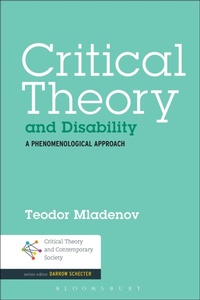
Critical Theory and Disability
A Phenomenological Approach
Published on 30. June 2016
Book
Paperback/Softback
232 pages
978-1-5013-2216-7 (ISBN)
Description
Critical Theory and Disability explores social and ontological issues encountered by present-day disabled people, applying ideas from disability studies and phenomenology. It focuses on disabling contexts in order to highlight and criticize the ontological assumptions of contemporary society, particularly those related to the meaning of human being. In empirical terms, the book explores critically social practices that undermine disabled people's well being, drawing on cases from contemporary Bulgaria. It includes in-depth examination of key mechanisms such as disability assessment, personal assistance (direct payments) and disability-based discrimination. On this basis, wider sociological and ontological claims are made concerning the body, identity, otherness, and exclusion.
Reviews / Votes
In this wonderfully affirmative appeal to the power of social theory and philosophy, Teodor Mladenov has written a book that carefully exposes the existential-ontological dimensions of disablism whilst, simultaneously, opening up a space for positively re-imagining and re-valuing different ways of being human. This is a potent reminder that activism and theory work together at the levels of the society and the self. * Dan Goodley, Professor of Disability Studies and Education, the University of Sheffield, UK * This extremely original and innovative book brings perspectives of existential phenomenology and critical theory to bear on disability studies. Clearly and confidently argued, it is a major contribution to the field. * William Outhwaite, Professor of Sociology, Newcastle University, UK. * Teodor Mladenov uses phenomenological philosophy and a carnal approach to sociology in order to focus scholarly attention on what it means to be human and how negative ontologies derived from dis/ableist sentiments and practices undermine and invalidate disabled peoples claims to membership of the human community. Through closely argued case studies of disabled peoples experience of life in his native Bulgaria - including, for example, in depth discussions of personal assistance, disability assessment and media representations - Mladenov introduces disability studies to its philosophical soul. * Bill Hughes, Professor, Glasgow Caledonian University, Scotland * A must read. By exploring contemporary Bulgaria's conceptual and institutional relations with disability, Teodor Mladenov has written an intriguing phenomenological analysis of embodiment. More intriguing still, Mladenov provides a convincing demonstration of the significance of disability to the lingering question of what it means to be human. * Rod Michalko, Lecturer Emeritus, Department of Social Justice Education, University of Toronto, Canada. *More details
Series
Language
English
Place of publication
New York
United States
Publishing group
Bloomsbury Publishing Plc
Target group
College/higher education
Dimensions
Height: 229 mm
Width: 152 mm
Thickness: 13 mm
Weight
346 gr
ISBN-13
978-1-5013-2216-7 (9781501322167)
Copyright in bibliographic data and cover images is held by Nielsen Book Services Limited or by the publishers or by their respective licensors: all rights reserved.
Schweitzer Classification
Other editions
Additional editions
E-Book
12/2014
1st Edition
Bloomsbury Academic USA
€43.49
Available for download
E-Book
12/2014
1st Edition
Bloomsbury Academic USA
€43.49
Available for download
Person
Teodor Mladenov has a PhD in Sociology of Disability from King's College London. He has published articles in Disability & Society, Critical Social Policy and Alter - European Journal of Disability Research, and has worked for many years as a researcher for disabled people's organisations and international NGOs operating in Bulgaria.
Content
ACKNOWLEDGEMENTS
CHAPTER 1: INTRODUCTION
CHAPTER 2: THE BODY
CHAPTER 3: DISABILITY ASSESSMENT
CHAPTER 4: PERSONAL ASSISTANCE
CHAPTER 5: DISCRIMINATION
CHAPTER 6: MEDIA REPRESENTATIONS OF INACCESSIBILITY
CHAPTER 7: SEXUALITY 257
CHAPTER 8: THE UN CONVENTION ON THE RIGHTS OF PERSONS WITH DISABILITIES
CHAPTER 9: CONCLUSIONS
BIBLIOGRAPHY
INDEX
CHAPTER 1: INTRODUCTION
CHAPTER 2: THE BODY
CHAPTER 3: DISABILITY ASSESSMENT
CHAPTER 4: PERSONAL ASSISTANCE
CHAPTER 5: DISCRIMINATION
CHAPTER 6: MEDIA REPRESENTATIONS OF INACCESSIBILITY
CHAPTER 7: SEXUALITY 257
CHAPTER 8: THE UN CONVENTION ON THE RIGHTS OF PERSONS WITH DISABILITIES
CHAPTER 9: CONCLUSIONS
BIBLIOGRAPHY
INDEX