

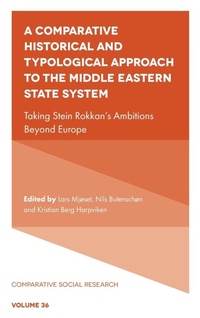
A Comparative Historical and Typological Approach to the Middle Eastern State System
Taking Stein Rokkan's Ambitions Beyond Europe
Published on 19. April 2024
Book
Hardback
288 pages
978-1-83753-123-3 (ISBN)
Description
The study of state formation and nation building is a proud tradition. Currently, however, it is difficult to discern a unified research frontier in this field, due to a persistent gap between the more case-based historical focus seen in area studies, and more generalizing approaches inspired by the natural sciences.
Showcasing the legacy of Norwegian political scientist and sociologist Stein Rokkan, this volume explores the potential of his work to address this gap. Featuring Rokkan's lecture skeleton methodology, given in Paris 1976, but included here as the first ever English language translation, this collection brings into sharp focus how Rokkan developed a set of methodological tools that allowed the construction of regional models and typological maps for guiding paired or clustered comparisons of state formation and nation building in any world region. Acknowledging Rokkan's key argument that relevant models and maps need to be developed through knowledge about a region's history rather than through formal concepts alone, contributors draw on the full potential of Rokkan's innovations by calibrating them with empirical material from a world region not analysed by Rokkan himself: the Middle East.
Thoughtfully reconstructing and upgrading Rokkan's methodology, A Comparative Historical and Typological Approach to the Middle Eastern State System ushers in a new vision in the field of state formation and nation building.
Showcasing the legacy of Norwegian political scientist and sociologist Stein Rokkan, this volume explores the potential of his work to address this gap. Featuring Rokkan's lecture skeleton methodology, given in Paris 1976, but included here as the first ever English language translation, this collection brings into sharp focus how Rokkan developed a set of methodological tools that allowed the construction of regional models and typological maps for guiding paired or clustered comparisons of state formation and nation building in any world region. Acknowledging Rokkan's key argument that relevant models and maps need to be developed through knowledge about a region's history rather than through formal concepts alone, contributors draw on the full potential of Rokkan's innovations by calibrating them with empirical material from a world region not analysed by Rokkan himself: the Middle East.
Thoughtfully reconstructing and upgrading Rokkan's methodology, A Comparative Historical and Typological Approach to the Middle Eastern State System ushers in a new vision in the field of state formation and nation building.
More details
Series
Language
English
Place of publication
Bingley
United Kingdom
Target group
Professional and scholarly
Dimensions
Height: 235 mm
Width: 157 mm
Thickness: 20 mm
Weight
571 gr
ISBN-13
978-1-83753-123-3 (9781837531233)
Copyright in bibliographic data and cover images is held by Nielsen Book Services Limited or by the publishers or by their respective licensors: all rights reserved.
Schweitzer Classification
Other editions
Additional editions
Lars Mjoset | Nils Butenschon | Kristian Berg Harpviken
A Comparative Historical and Typological Approach to the Middle Eastern State System
Taking Stein Rokkan's Ambitions Beyond Europe
E-Book
04/2024
1st Edition
Emerald Publishing Limited
€117.99
Available for download
Persons
Lars Mjoset is Professor Emeritus of Sociology and former Director of the Oslo Summer School for Social Science Studies at the Social Science Faculty, University of Oslo, Norway.
Nils Butenschon is Professor Emeritus of Political Science and former Director of the Norwegian Centre for Human Rights, University of Oslo, Norway.
Kristian Berg Harpviken is Research Professor and former Director of PRIO, the International Peace Research Institute, Norway.
Nils Butenschon is Professor Emeritus of Political Science and former Director of the Norwegian Centre for Human Rights, University of Oslo, Norway.
Kristian Berg Harpviken is Research Professor and former Director of PRIO, the International Peace Research Institute, Norway.
Content
Chapter 1. A Family of Models for European Comparative History: Paris Lecture December 4th, 1976; Stein Rokkan (translated by Lars Mjoset)
Chapter 2. Rokkan and the 'Variable'; Lars Mjoset
Chapter 3. What is a Country? History and the Creation of the 'Maghreb'; Knut S. Vikor
Chapter 4. A Conceptual Map for Comparison of State Formation and Nation Building in the Middle East 1870-1918; Lars Mjoset, Nils Butenschon, Roel Meijer, and Kristian Berg Harpviken
Chapter 5. Female Citizenship and Divorce Law Reform in Arab States: The Gradual Expansion of Woman's Legal Capacity in North Africa; Rania Maktabi
Chapter 6. External Intervention and Domestic Instrumentalization: A Structured, Focused Comparison of Iran and Saudi Arabia's Role in Yemen; Julia Palik
BOOK SYMPOSIUM
Chapter 7. The Authoritarian State in the Muslim World: Comparative Insights from Ibn Khaldun and Stein Rokkan; Ahmet T. Kuru
Chapter 8. What has Islam Got to Do with It?; Knut S. Vikor
Chapter 9. Citizenship and the Issue of Islam, Authoritarianism and Underdevelopment; Roel Meijer
Chapter 10. A Rejoinder; Ahmet T. Kuru
Chapter 2. Rokkan and the 'Variable'; Lars Mjoset
Chapter 3. What is a Country? History and the Creation of the 'Maghreb'; Knut S. Vikor
Chapter 4. A Conceptual Map for Comparison of State Formation and Nation Building in the Middle East 1870-1918; Lars Mjoset, Nils Butenschon, Roel Meijer, and Kristian Berg Harpviken
Chapter 5. Female Citizenship and Divorce Law Reform in Arab States: The Gradual Expansion of Woman's Legal Capacity in North Africa; Rania Maktabi
Chapter 6. External Intervention and Domestic Instrumentalization: A Structured, Focused Comparison of Iran and Saudi Arabia's Role in Yemen; Julia Palik
BOOK SYMPOSIUM
Chapter 7. The Authoritarian State in the Muslim World: Comparative Insights from Ibn Khaldun and Stein Rokkan; Ahmet T. Kuru
Chapter 8. What has Islam Got to Do with It?; Knut S. Vikor
Chapter 9. Citizenship and the Issue of Islam, Authoritarianism and Underdevelopment; Roel Meijer
Chapter 10. A Rejoinder; Ahmet T. Kuru