

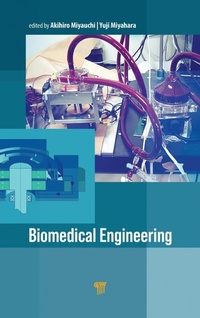
Biomedical Engineering
1st Edition
Published on 30. November 2021
Book
Hardback
380 pages
978-981-4877-63-3 (ISBN)
Description
Several developed countries are facing serious problems in medical environments owing to the aging society, and extension of healthy lifetime has become a big challenge. Biomedical engineering, in addition to life sciences and medicine, can help tackle these problems. Innovative technologies concerning minimally invasive treatment, prognosis and early diagnosis, point-of-care testing, regenerative medicine, and personalized medicine need to be developed to realize a healthy aging society.
This book presents cutting-edge research in biomedical engineering from materials, devices, imaging, and information perspectives. The contributors are senior members of the Research Center for Biomedical Engineering, supported by the Ministry of Education, Culture, Sports, Science and Technology, Japan. All chapters are results of collaborative research in engineering and life sciences and cover nanotechnology, materials, optical sensing technology, imaging technology, image processing technology, and biomechanics, all of which are important areas in biomedical engineering. The book will be a useful resource for researchers, students, and readers who are interested in biomedical engineering.
This book presents cutting-edge research in biomedical engineering from materials, devices, imaging, and information perspectives. The contributors are senior members of the Research Center for Biomedical Engineering, supported by the Ministry of Education, Culture, Sports, Science and Technology, Japan. All chapters are results of collaborative research in engineering and life sciences and cover nanotechnology, materials, optical sensing technology, imaging technology, image processing technology, and biomechanics, all of which are important areas in biomedical engineering. The book will be a useful resource for researchers, students, and readers who are interested in biomedical engineering.
More details
Language
English
Place of publication
Singapore
Target group
College/higher education
Professional and scholarly
Academic, Postgraduate, and Professional Practice & Development
Illustrations
151 s/w Abbildungen, 50 farbige Abbildungen, 39 s/w Photographien bzw. Rasterbilder, 28 Farbfotos bzw. farbige Rasterbilder, 112 s/w Zeichnungen, 22 farbige Zeichnungen, 7 s/w Tabellen
7 Tables, black and white; 22 Line drawings, color; 112 Line drawings, black and white; 28 Halftones, color; 39 Halftones, black and white; 50 Illustrations, color; 151 Illustrations, black and white
Dimensions
Height: 235 mm
Width: 157 mm
Thickness: 26 mm
Weight
725 gr
ISBN-13
978-981-4877-63-3 (9789814877633)
Copyright in bibliographic data and cover images is held by Nielsen Book Services Limited or by the publishers or by their respective licensors: all rights reserved.
Schweitzer Classification
Other editions
Additional editions
Akihiro Miyauchi | Yuji Miyahara
Biomedical Engineering
E-Book
11/2021
1st Edition
Pan Stanford Publishing Pte Ltd
€153.99
Available for download
Akihiro Miyauchi | Yuji Miyahara
Biomedical Engineering
E-Book
11/2021
1st Edition
Pan Stanford Publishing Pte Ltd
€153.99
Available for download
Persons
Akihiro Miyauchi received his PhD from Tokyo Institute of Technology, Japan, in 1995. He worked for Hitachi Ltd. from 1986 to 2017 and was a visiting scientist at Massachusetts Institute of Technology, USA, from 1995 to 1996. He has been working in semiconductor process, nanoimprint, and biomimetics. The related books were published by Jenny Stanford Publishing. Since 2018, he is a professor at the Institute of Biomaterials and Bioengineering, Tokyo Medical and Dental University, Japan.
Yuji Miyahara received his PhD from Tokyo Institute of Technology in 1985. He worked for Hitachi Ltd. from 1985 to 2002 and National Institute for Materials Science, Japan, from 2002 to 2010. Since 2010, he is a professor at the Institute of Biomaterials and Bioengineering, Tokyo Medical and Dental University. He has been working in the field between electronics and biotechnology for more than 35 years. Based on the semiconductor technology, he has developed several types of biosensors and sensing technologies for life science and medical fields.
Yuji Miyahara received his PhD from Tokyo Institute of Technology in 1985. He worked for Hitachi Ltd. from 1985 to 2002 and National Institute for Materials Science, Japan, from 2002 to 2010. Since 2010, he is a professor at the Institute of Biomaterials and Bioengineering, Tokyo Medical and Dental University. He has been working in the field between electronics and biotechnology for more than 35 years. Based on the semiconductor technology, he has developed several types of biosensors and sensing technologies for life science and medical fields.
Content
1. Biosensors Using Metal Oxides as a Sensing Material 2. Biosensors Based on FETs Containing Nanostructures 3. Noble Metallic Pt Coating on Silk Textile by a Supercritical CO2-Promoted Metallization Technique towards Applications of Biocompatible Medical Wearable Devices 4. Biosensors Based on Silicon Photonics 5. Reusable Surface Acoustic Wave Immunosensor for Enhanced Monitoring of Airborne House Dust Mite Allergens 6. Development of Novel Fluorescent Sensors Based on Fluorescent Natural Compounds 7. Living-Cell Analysis by Surface Plasmon Resonance and Its Medical Application 8. Oximetry for Various Tissues Using Near-Infrared Spectroscopy 9. Development of THz Laser Spectrometer and Its Application for Pharmaceutical Inspection 10. Microwave Imaging for Breast Cancer Screening 11. Ultrasonic Transducers and Non-Contact Measurement Technique for Medical and Agricultural Application/Flexible Acoustic Force Sensor 12. Time-Resolved CMOS Image Sensors for Biomedical Applications 13. High-Resolution Optical Microscopy for Bio-Imaging 14. X-Ray Semiconductor Imaging Device Technology and Medical-Imaging Application 15. Deep Learning in Medical Image Processing and Computer-Aided Diagnosis 16. A Hierarchical Type Segmentation Hardware for Colorectal Endoscopic Images with Narrow-Band Imaging Magnification 17. Robotics in Minimally Invasive Surgery 18. Ventricular Assist Devices Utilizing Magnetic Bearing Systems