

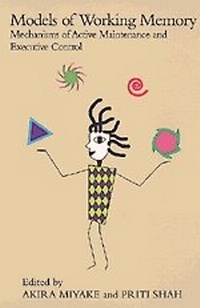
Models of Working Memory
Mechanisms of Active Maintenance and Executive Control
Published on 13. April 1999
Book
Hardback
526 pages
978-0-521-58325-1 (ISBN)
Description
Working memory is currently a 'hot' topic in cognitive psychology and neuroscience. Because of their radically different scopes and emphases, however, comparing different models and theories and understanding how they relate to one another has been a difficult task. This volume offers a much-needed forum for systematically comparing and contrasting existing models of working memory. It does so by asking each contributor to address the same comprehensive set of important theoretical questions on working memory. The answers to these questions provided in the volume elucidate the emerging general consensus on the nature of working memory among different theorists and crystallize incompatible theoretical claims that must be resolved in future research. As such, this volume serves not only as a milestone that documents the state-of-the-art in the field but also as a theoretical guidebook that will likely promote new lines of research and more precise and comprehensive models of working memory.
Reviews / Votes
'The theories are highly diverse in content and terminology ... The book is recommended for anyone who strives to remain current in the neurosciences ... provides an innovative strategy for comparing theory that can be emulated in other areas ... it will stimulate advanced conceptualization of brain functioning.' Journal of the International Neuropsychological SocietyMore details
Language
English
Place of publication
Cambridge
United Kingdom
Target group
Professional and scholarly
Illustrations
22 Tables, unspecified; 66 Line drawings, unspecified
Dimensions
Height: 236 mm
Width: 158 mm
Thickness: 32 mm
Weight
815 gr
ISBN-13
978-0-521-58325-1 (9780521583251)
Copyright in bibliographic data and cover images is held by Nielsen Book Services Limited or by the publishers or by their respective licensors: all rights reserved.
Schweitzer Classification
Other editions
New editions
Akira Miyake | Priti Shah
Models of Working Memory
Mechanisms of Active Maintenance and Executive Control
Book
04/1999
Cambridge University Press
€89.50
Shipment within 15-20 days
Additional editions
Akira Miyake | Priti Shah
Models of Working Memory
Mechanisms of Active Maintenance and Executive Control
Book
04/1999
Cambridge University Press
€89.50
Shipment within 15-20 days
Persons
Content
Preface; Acknowledgements; 1. Models of working memory: an introduction Priti Shah and Akira Miyake; 2. Working memory: the multiple-component model Alan D. Baddeley and Robert H. Logie; 3. An embedded-processes model of working memory Nelson Cowan; 4. Individual differences in working memory capacity and what they tell us about controlled attention, general fluid intelligence and functions of the prefrontal cortex Randall W. Engle, Michael J. Kane and Stephen W. Tuholski; 5. Modelling working memory in a unified architecture: an ACT-R perspective Marsha C. Lovett, Lynne M. Reder and Christian Lebiere; 6. Insights into working memory from the perspective of the EPIC architecture for modelling skilled perceptual-motor and cognitive human performance David E. Kieras, David E. Meyer, Shane Mueller and Travis Seymour; 7. The soar cognitive architecture and human working memory Richard M. Young and Richard L. Lewis; 8. Long-term working memory as an alternative to capacity models of working memory in everyday skilled performance K. Anders Ericsson and Peter F. Delaney; 9. Interacting cognitive subsystems: modelling working memory phenomena within a multiprocessor architecture Philip J. Barnard; 10. Working memory in a multilevel hybrid connectionist control architecture (CAP2) Walter Schneider; 11. A biologically based computational model of working memory Randall C. O' Reilly, Todd S. Braver and Jonathan D. Cohen; 12. Models of working memory: eight questions and some general issues Walter Kintsch, Alice F. Healy, Mary Hegarty, Bruce F. Pennington and Timothy A. Salthouse; 13. Toward unified theories of working memory: emerging general consensus, unresolved theoretical issues and future research directions Akika Miyake and Priti Shah; Indexes.