

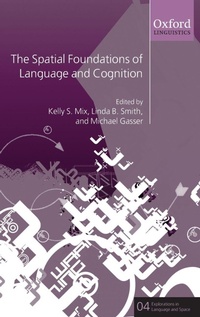
The Spatial Foundations of Language and Cognition
Thinking Through Space
Published on 24. December 2009
Book
Hardback
328 pages
978-0-19-955324-2 (ISBN)
Description
This book presents recent research on the role of space as a mechanism in language use and learning. It proceeds from the notion that cognition in real time, developmental time, and over evolutionary time occurs in space, and that the physical properties of space may provide insights into basic cognitive processes, including memory, attention, action, and perception. It looks at how physical space and landmarks are used in cognitive representations and serve as the basis of human cognition in a range of core mechanisms to index memories and ground meanings that are not themselves explicitly about space. The editors have brought together experimental psychologists, computer scientists, robotocists, linguists, and researchers in child language in order to consider the nature and applications of this research and in particular its implications for understanding the processes involved in language acquisition.
More details
Series
Language
English
Place of publication
Oxford
United Kingdom
Target group
College/higher education
Professional and scholarly
Illustrations
numerous Tables, Line Drawings, Diagrams
Dimensions
Height: 240 mm
Width: 161 mm
Thickness: 23 mm
Weight
669 gr
ISBN-13
978-0-19-955324-2 (9780199553242)
Copyright in bibliographic data and cover images is held by Nielsen Book Services Limited or by the publishers or by their respective licensors: all rights reserved.
Schweitzer Classification
Other editions
Additional editions
Kelly S. Mix | Linda B. Smith | Michael Gasser
The Spatial Foundations of Language and Cognition
Thinking Through Space
E-Book
12/2009
OUP eBook
€58.99
Available for download
Persons
Kelly S. Mix is Associate Professor of Educational Psychology and Director of the Cognitive Development Laboratory at Michigan State University. She is the co-author, with J. Huttenlocher and S. C. Levine, of Quantitative Development in Infancy and Early Childhood (OUP 2002).
Linda B. Smith is Chancellor's Professor of Psychology and Director of the Cognitive Development Laboratory at Indiana University. She has published widely on cognition and language acquisition.
Michael Gasser is Associate Professor of Computer and Cognitive Science at Indiana University. He has published widely on cognition and language acquisition.
S. Mix is Director of the Cognitive Development Laboratory at Michigan State University. She is the co-author, with J. Huttenlocher and S. C. Levine, of Quantitative Development in Infancy and Early Childhood (OUP USA 2002).
Linda B. Smith is Chancellor's Professor of Psychology and Director of the Cognitive Development Laboratory at Indiana University. She has published widely on cognition and language acquisition.
Michael Gasser is Associate Professor of Computer and Cognitive Science at Indiana University. He has published widely on cognition and language acquisition.
S. Mix is Director of the Cognitive Development Laboratory at Michigan State University. She is the co-author, with J. Huttenlocher and S. C. Levine, of Quantitative Development in Infancy and Early Childhood (OUP USA 2002).
Editor
Associate Professor of Educational Psychology and Director of the Cognitive Development Laboratory,Michigan State University
Chancellor's Professor of Psychology and Director of the Cognitive Development LaboratoryIndiana University
Associate Professor of Computer and Cognitive ScienceIndiana University
Content
PART I: THINKING THROUGH SPACE; PART II: FROM EMBODIMENT TO ABSTRACT THOUGHT; PART III: USING SPACE TO GROUND LANGUAGE